88: guy in an alley, fatberg, 6 acres and not enough time, trains planes and automobiles, and bicycles!, dymaxion, have a seat mr. lincoln, parks' bus, nomotown, finding a whitehead, pottery, pizza shootout, shrines, the wright stuff - My Midlife Crisis - CycleBlaze
88: guy in an alley, fatberg, 6 acres and not enough time, trains planes and automobiles, and bicycles!, dymaxion, have a seat mr. lincoln, parks' bus, nomotown, finding a whitehead, pottery, pizza shootout, shrines, the wright stuff
Detroit
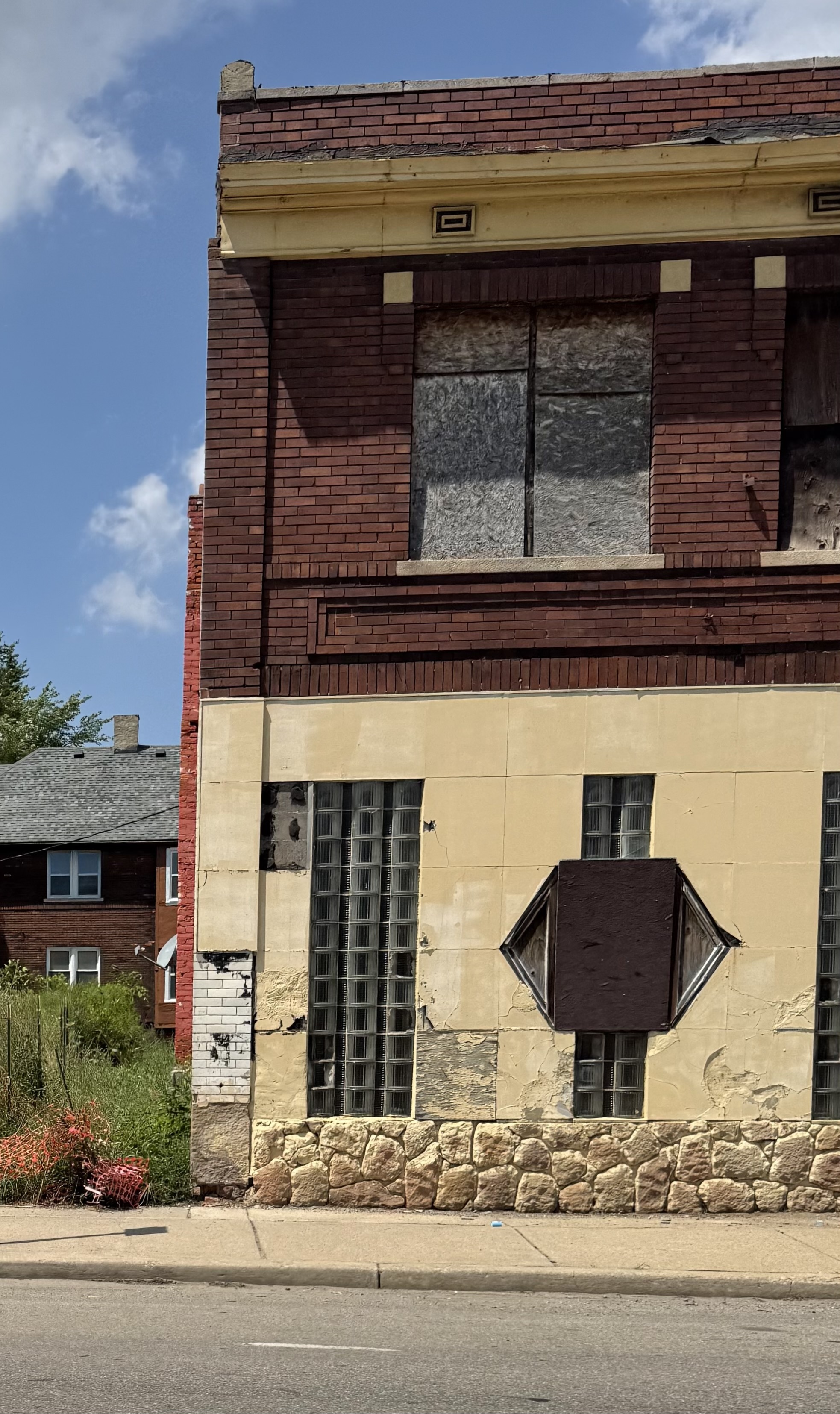
Detroit is the guy in a dark alley that you walk past at midnight, a desperate look in his eyes, maybe even a little crazy.
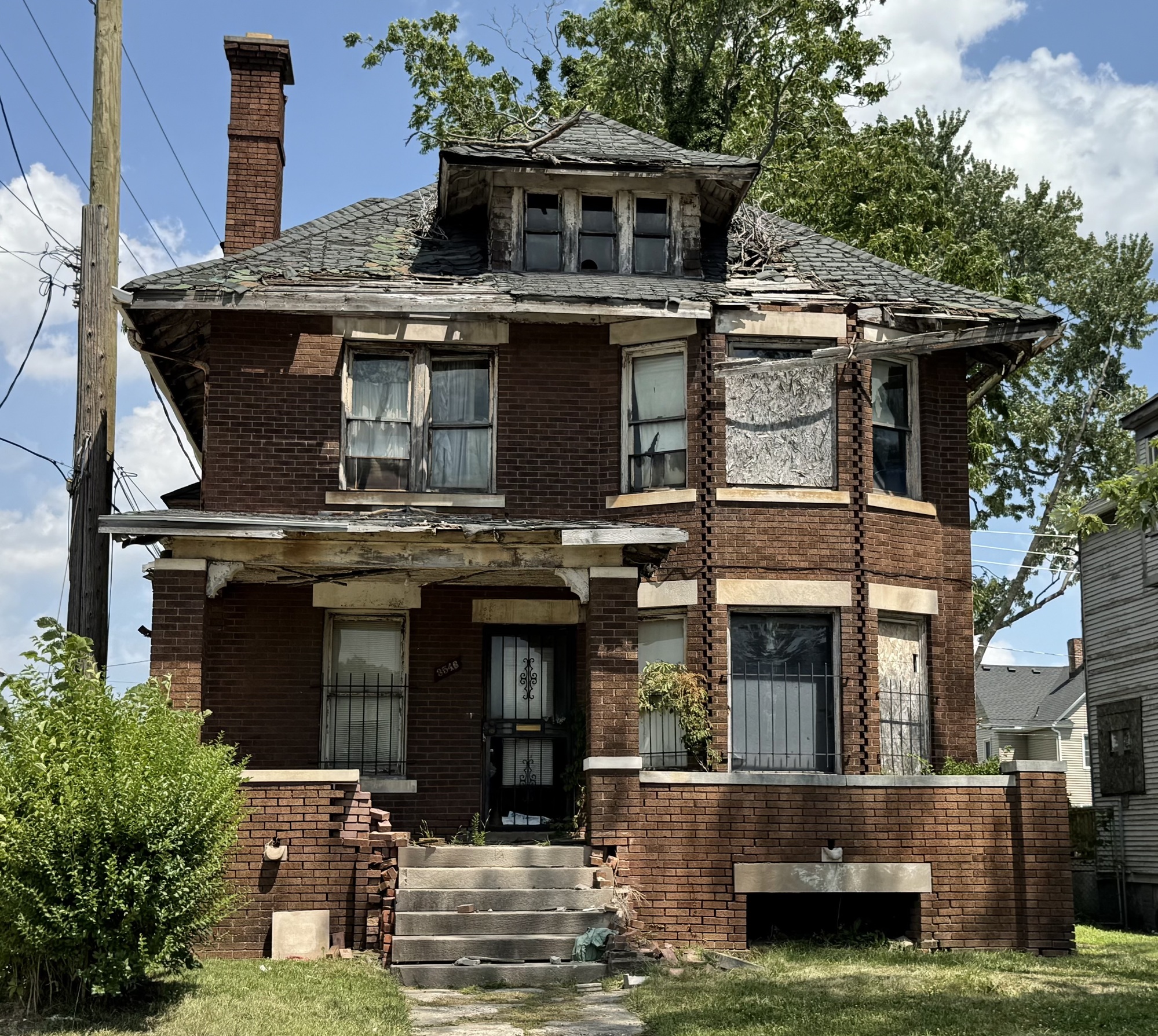
When riding through Youngstown, I could see the scars from the injuries caused when the factories shut down. In Detroit, those wounds are still gaping, a painful oozing maw. Youngstown is to Detroit as a paper cut is to a gunshot wound.
In all fairness, maybe it's just the areas I visited. However, I saw a lot of the city. The roads I drove over were as pockmarked as a teenage boy's face, but with less attention and care. If I hadn't rented a car for the day, I'm not sure I would've been able to bicycle on some of the roads. Even the "nicer" neighborhoods have built-in speed deterrents, and if you manage to accelerate your car to more than the walking pace of a one-legged man using a cane to find his way through a thicket, then you'll probably need new shocks by the end of the day.
The people walking along the street were either shirtless, emaciated stick men, or bloated balloons parodying human forms.
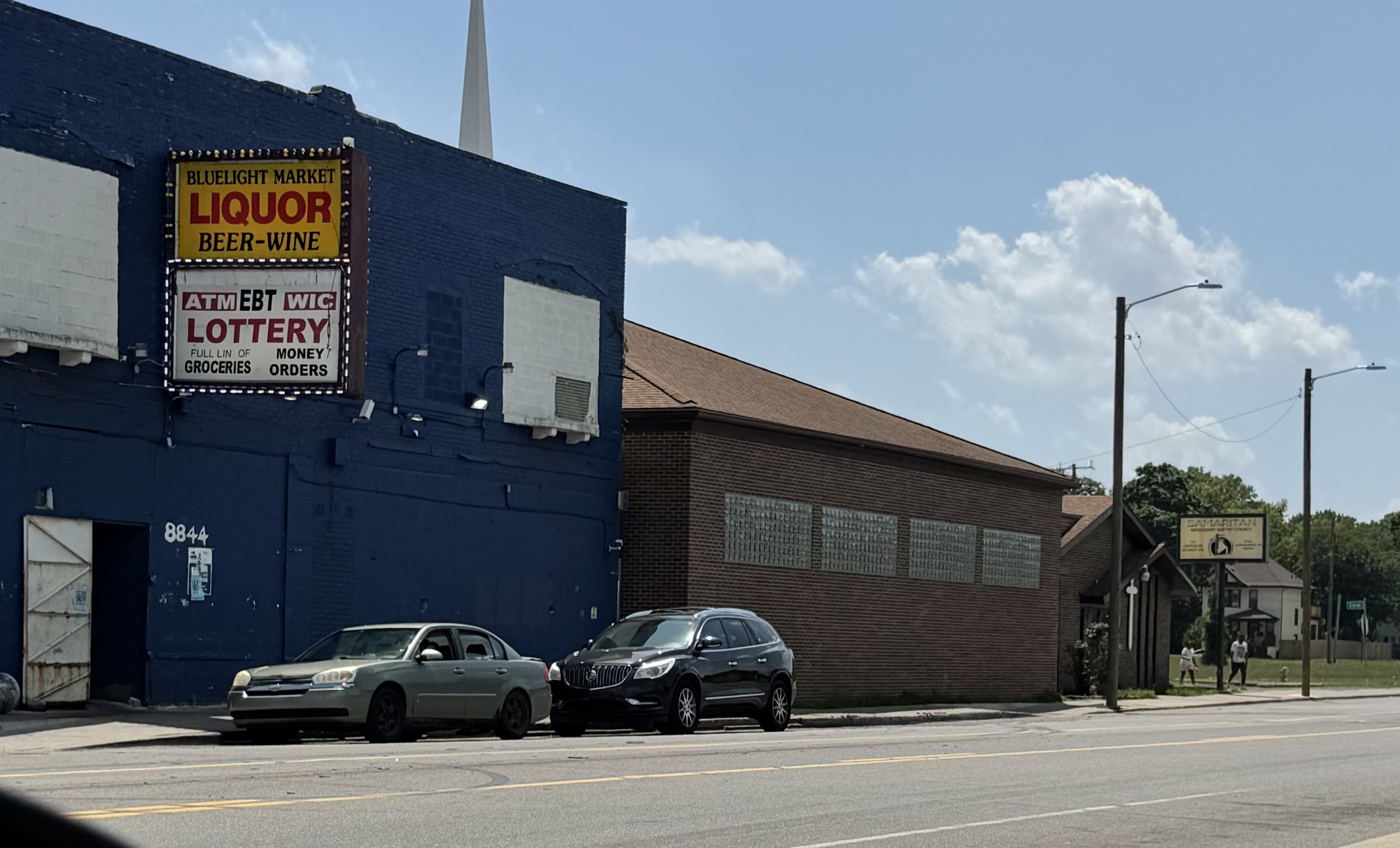
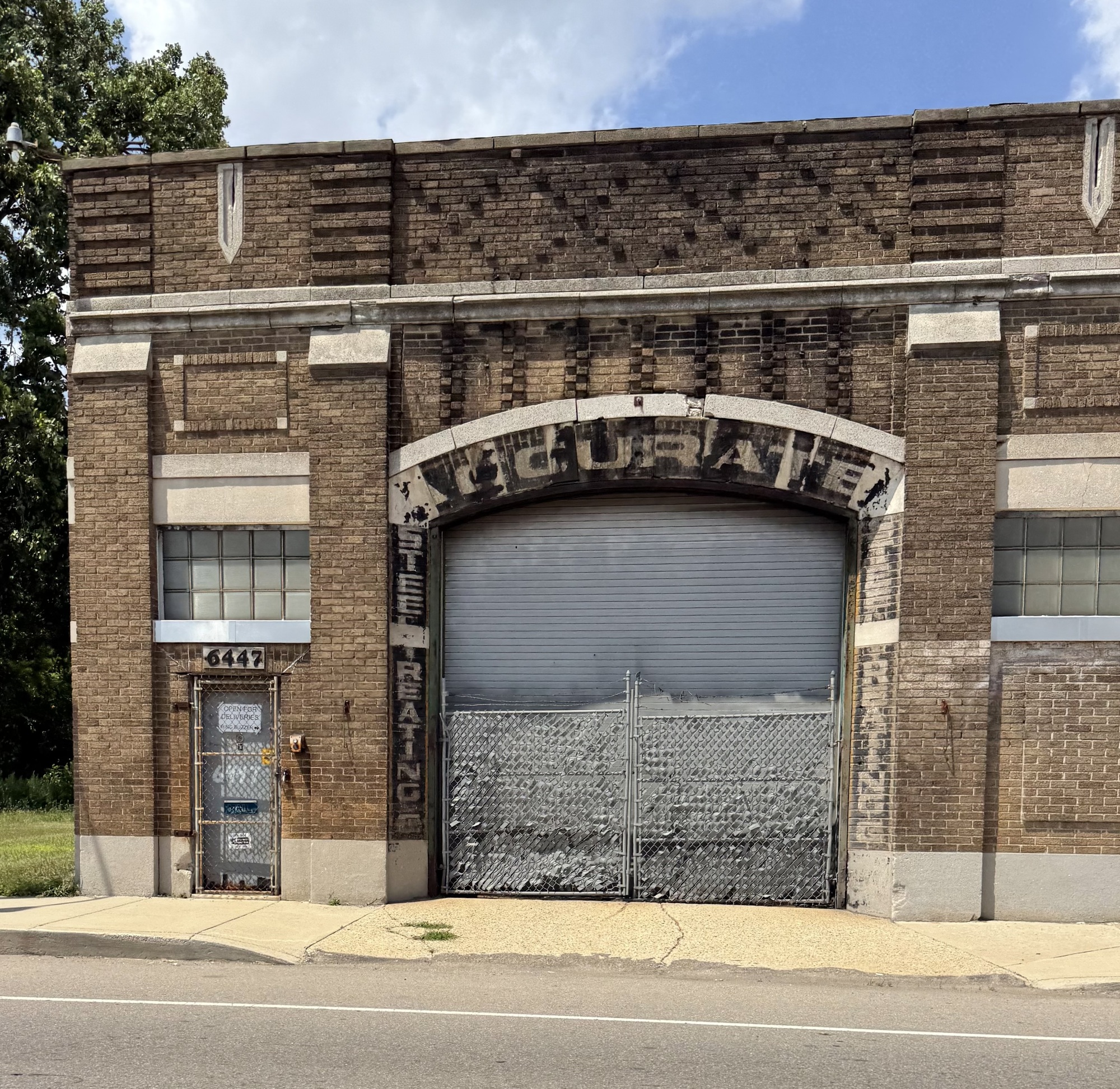
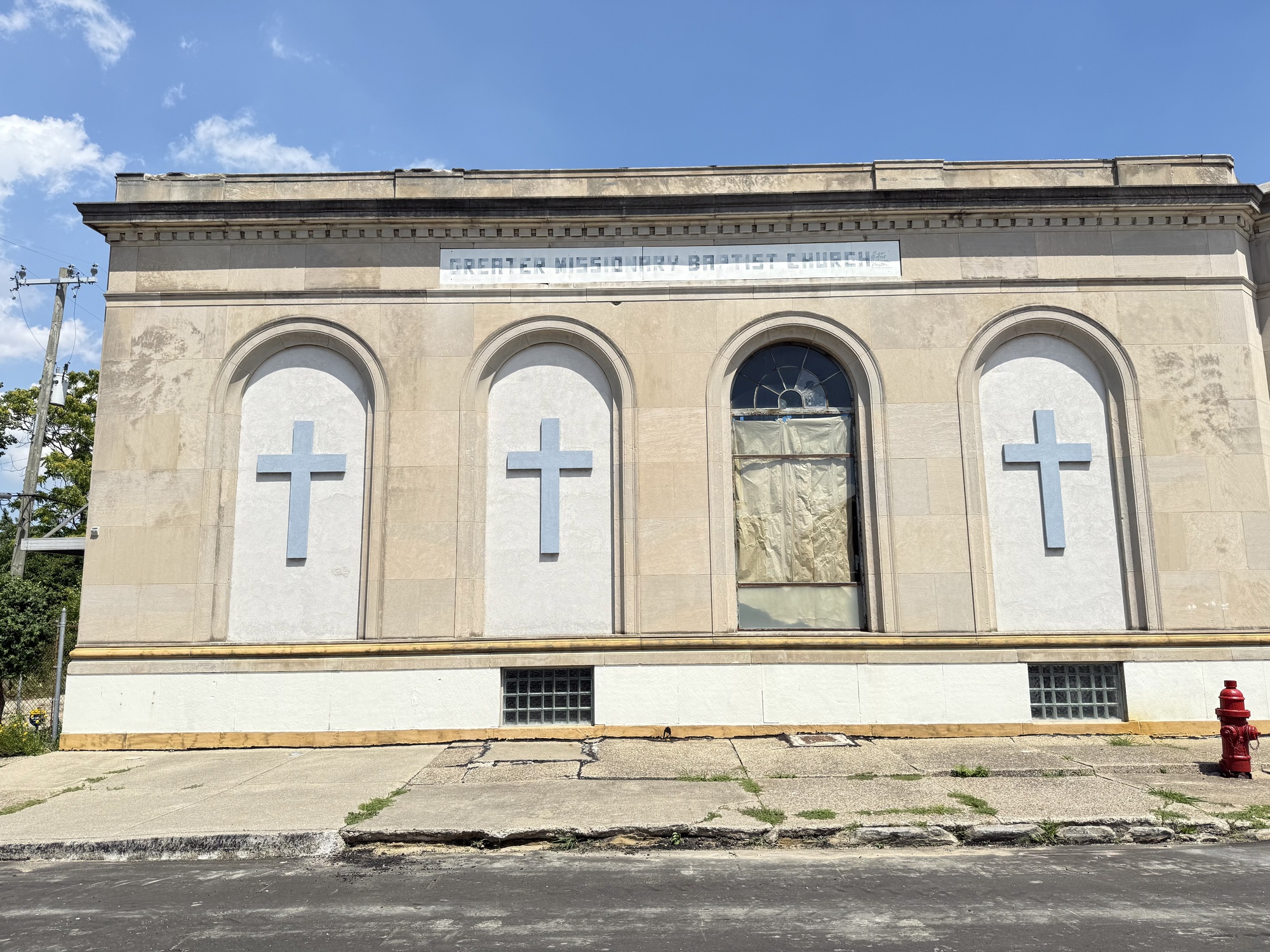
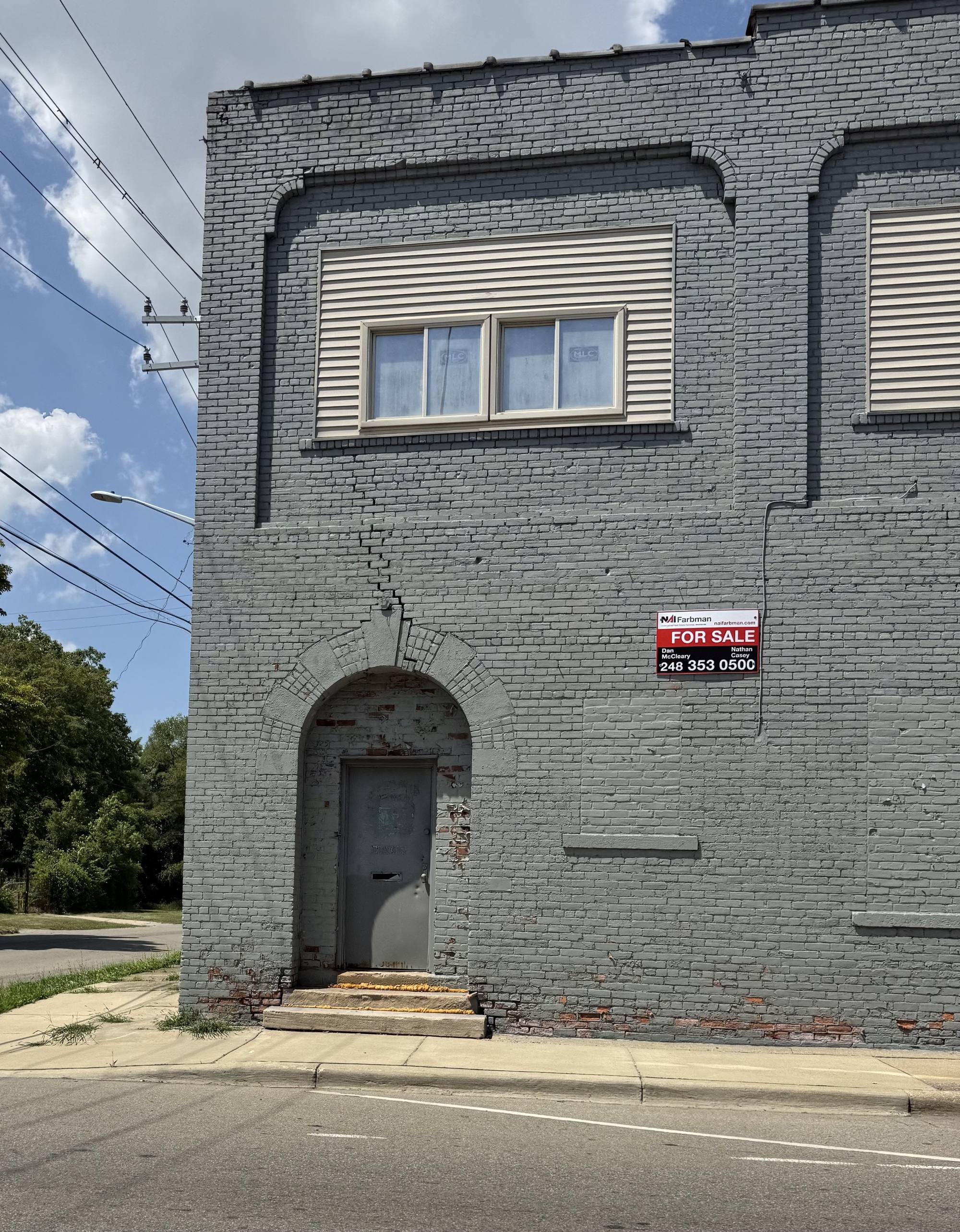
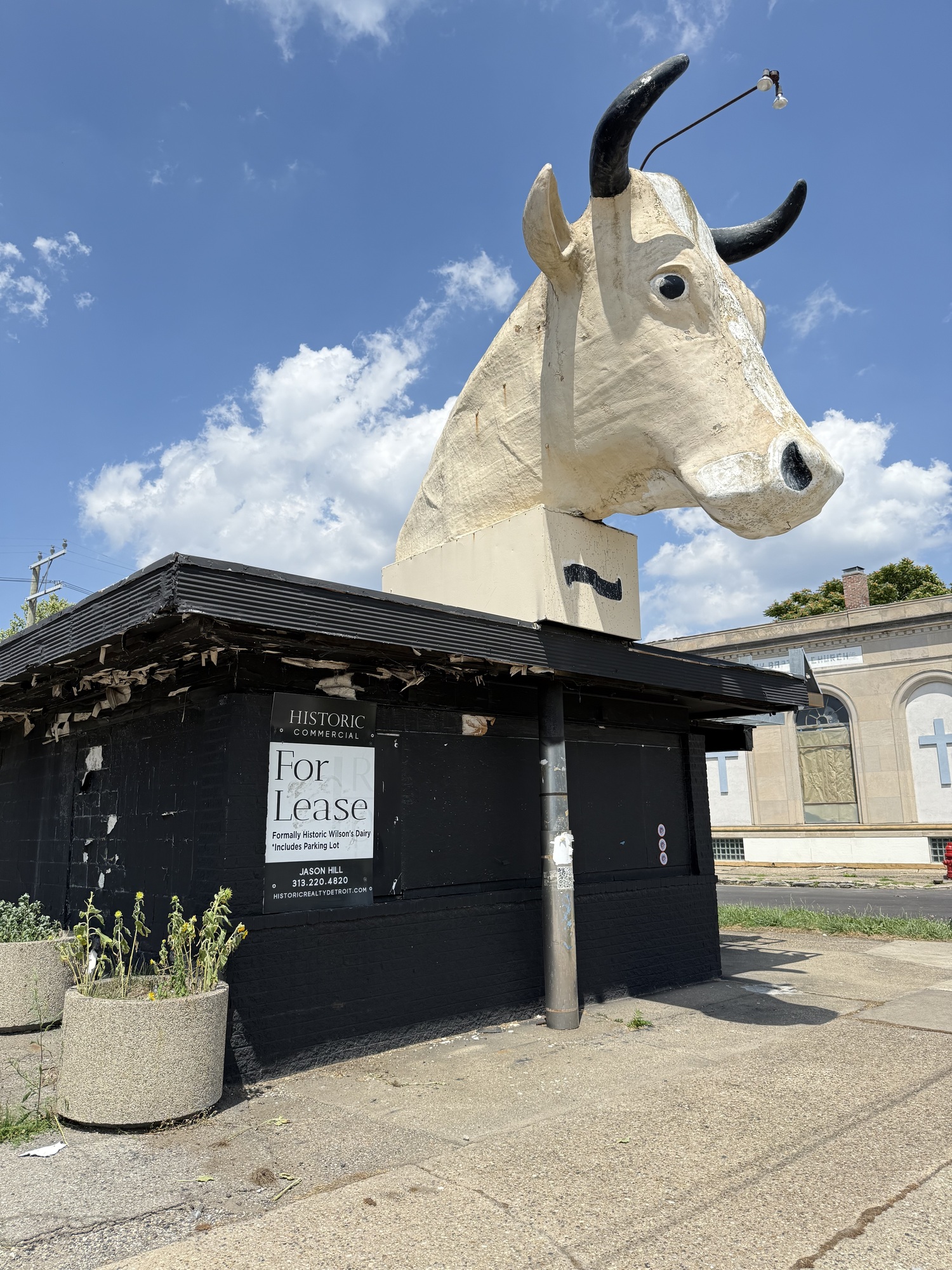
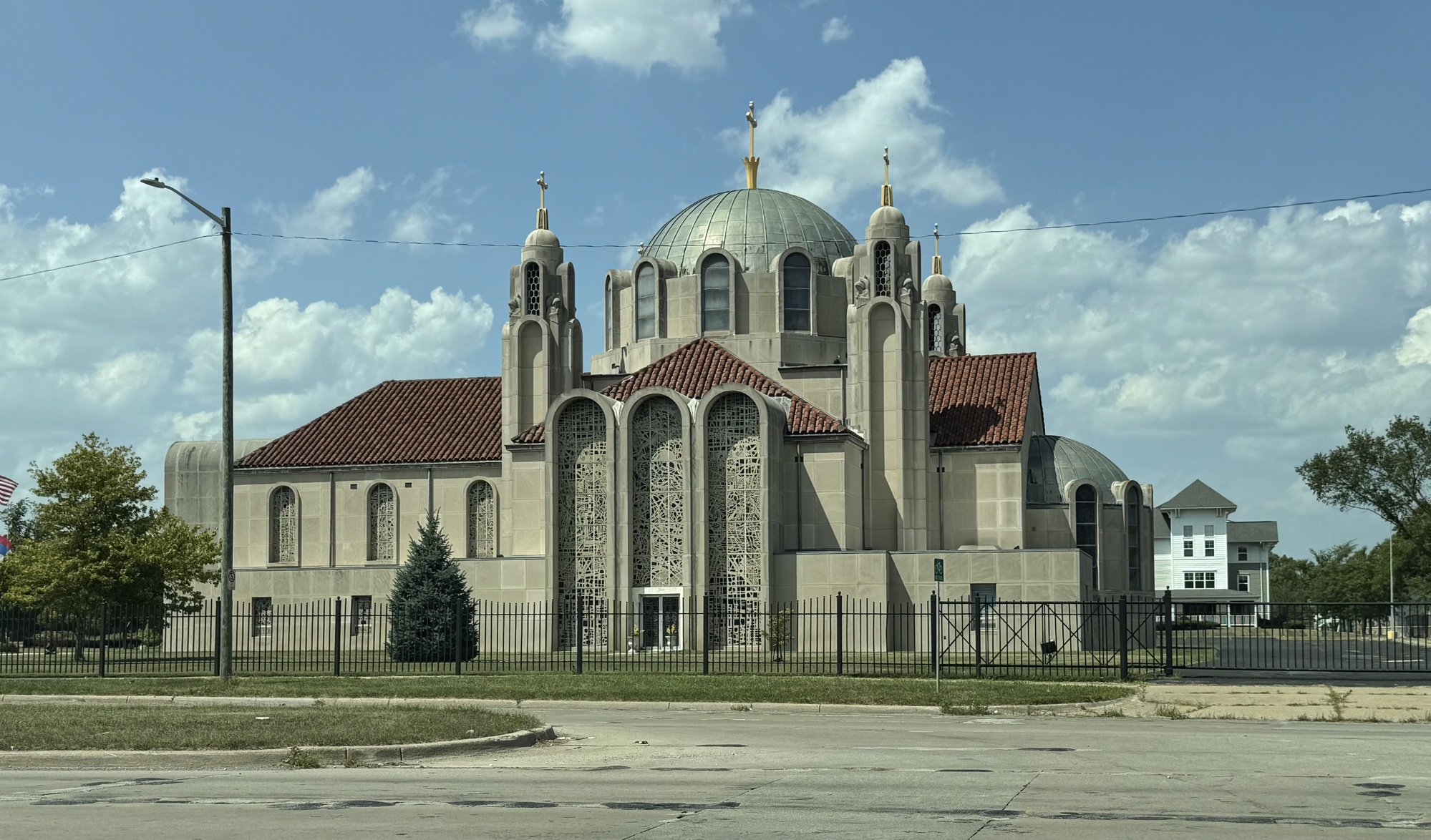
Places with names like "The Samaritan Center" and "Mission Outreach" peppered the streets - I saw at least a dozen. Pawn shops, check cashing services, and auto body repair shops were the only businesses without shuttered windows and doors. Of course, the liquor stores were open, and there was at least one on every block, and sometimes two. Even many of the churches were boarded. Billboards let me know the best personal injury lawyers and who to call if I need to be bailed out of jail.
Even searching "Interesting Places to See in Detroit," I was led to a website with tragic descriptions: * Vanity Ballroom - This dilapidated Mayan-themed ballroom was one of Detroit's most popular venues through the 40s. * Grande Ballroom - An abandoned concert venue legendary for its rock counterculture. * Heidelberg Project - One man's attempt to create an artistic wonder on a run-down block in Detroit. * Michigan Theatre - This opulent downtown movie theater now houses cars as an indoor parking garage. * Abandoned Abundant Life Christian Center - An ornate Detroit church, left empty and ravaged by time. * Grand Army of the Republic Building - Detroit’s downtown castle is one of the oldest structures in the city. It now houses two restaurants. [It has 30,000 square feet of space] * Fisher Body Plant 21 - Glass and concrete building designed by Albert Kahn. Despite it's appealing location and over a million dollars in cleanup, the site is still considered contaminated by the EPA and while available for purchase and renovation has not found a buyer.
A church and a liquor store on the same block like these wasn't uncommon, but about half the time the church was either shuttered or a mission. This upscale liquor store boasts a "full line of groceries."
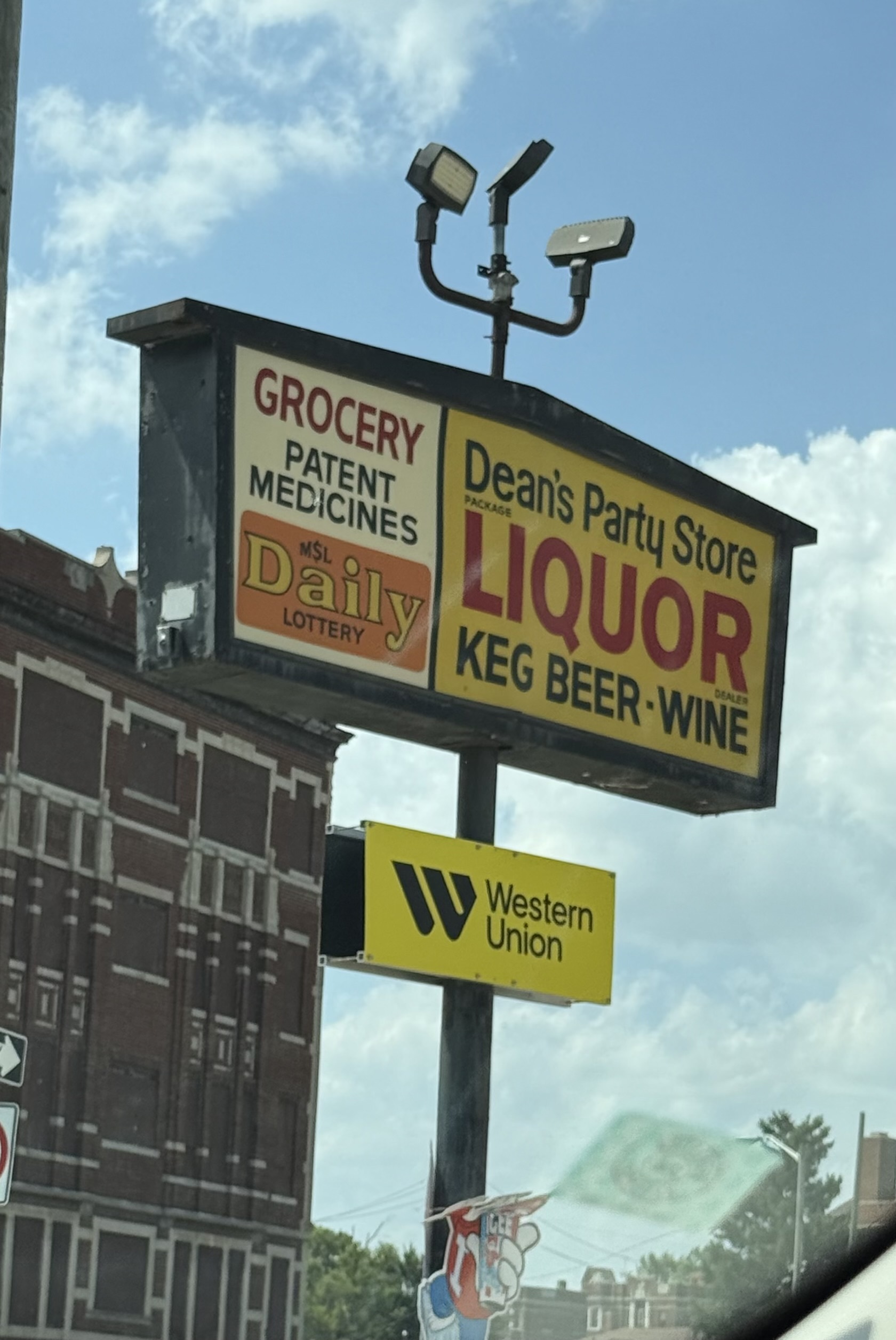
And this liquor store either misspelled the word "patient" (wanting you to know, I suppose, that the medicines are not for veterinary purposes), or is touting the fact that the medicines have been patented, to show it's a productive product like, say, a Gravity Powered Shoe Air Conditioner (https://www.wipo.int/en/web/patents/2019_patent_picks)
Undeterred, I knew that there are interesting places, quirky and full of wonderment, to see here in Detroit, so I kept digging.
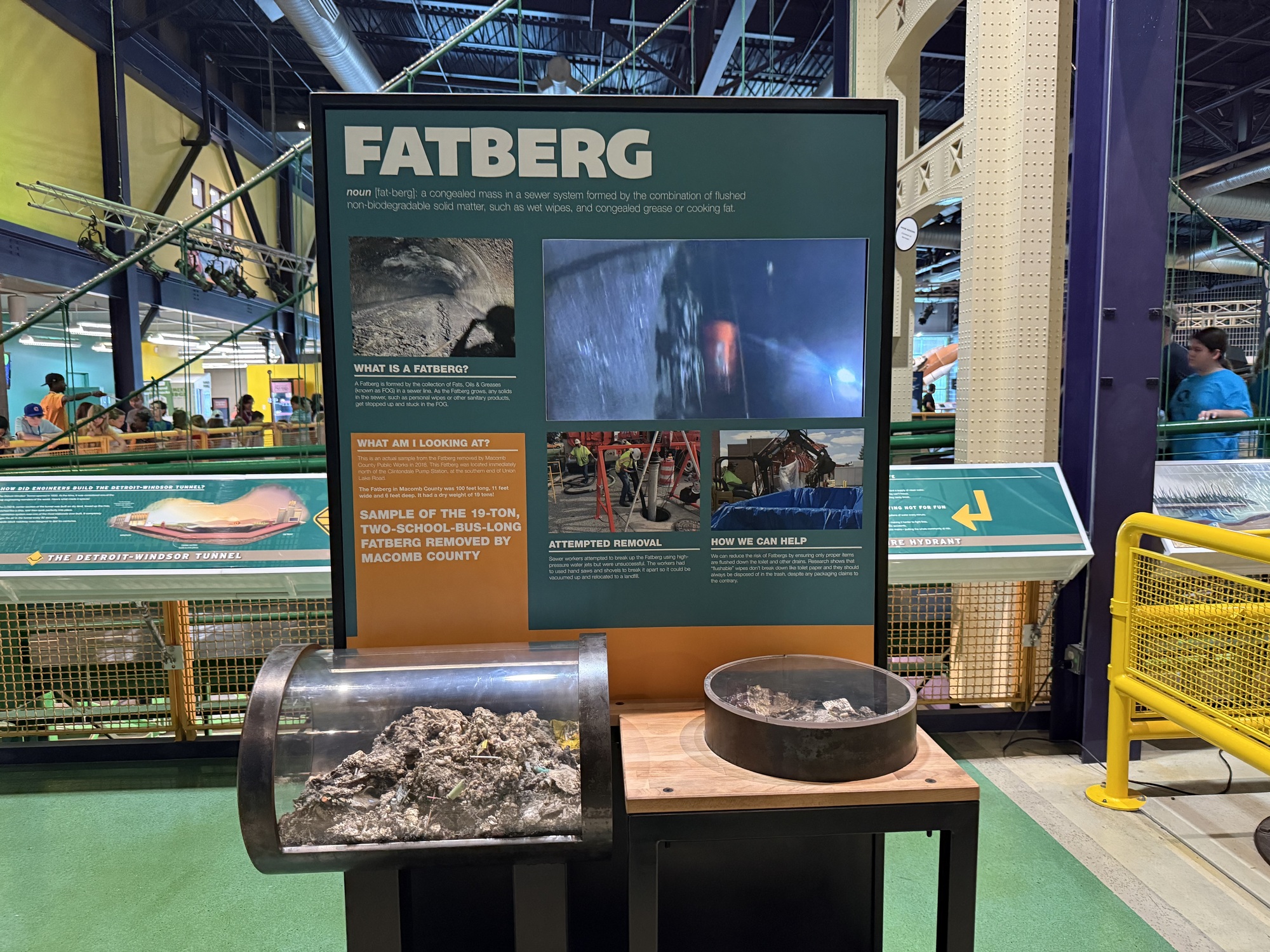
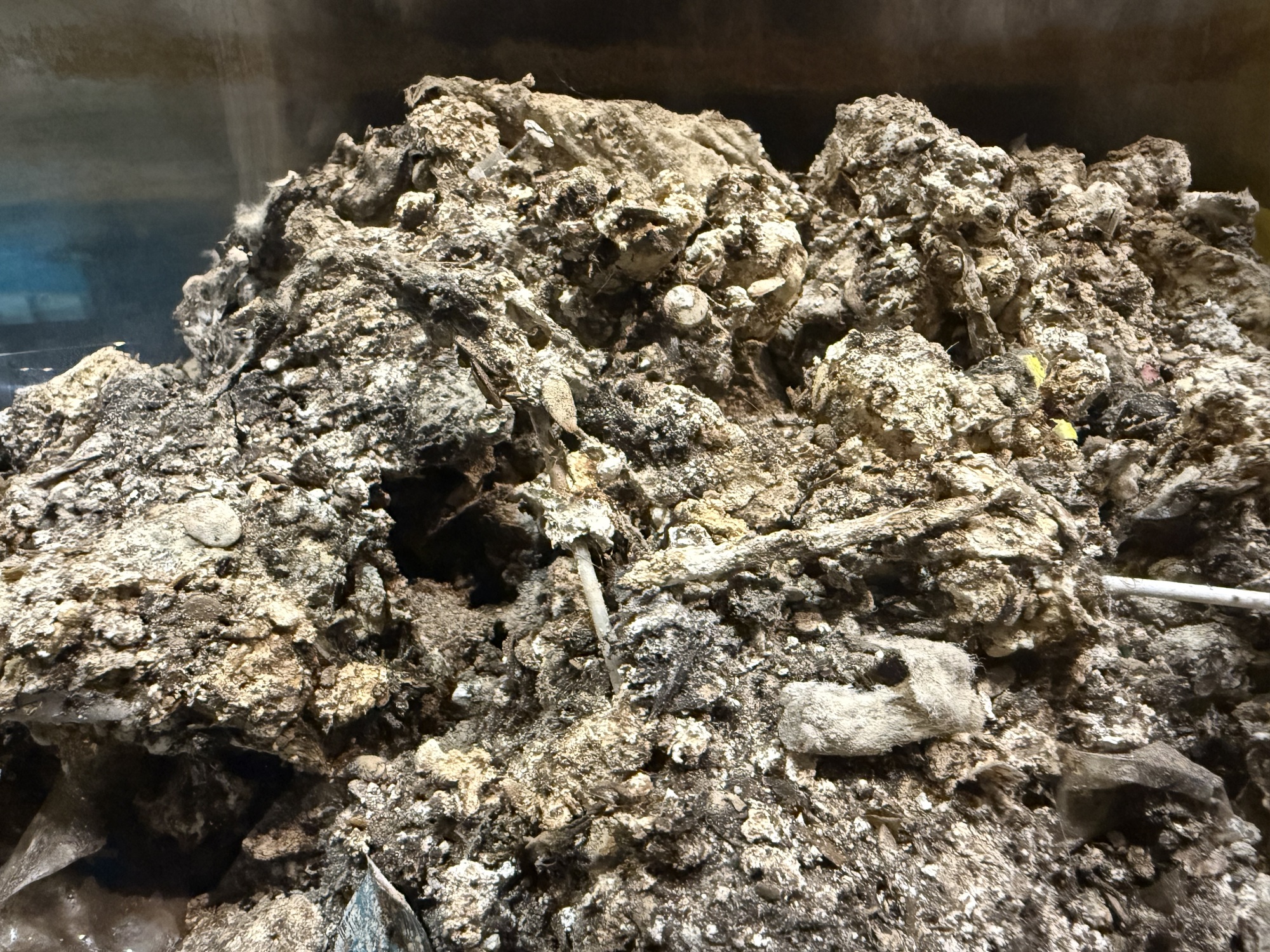
And, of course, that's when I discovered The Fatberg. I immediately headed over to the Michigan Science Center.
A fatberg is an enormous, solid mass that forms in sewers and drains when fats, oils, and grease congeal and get mixed with nonbiodegradable waste like wet wipes, tampons, paper towels, and other trash. "Fatberg" is a portmanteau, combining the words "fat," because of what it contains, and “iceberg,” because most of the mass is hidden below the surface in the sewer line.
Detroit’s fatberg, the largest in America, stretched 100 feet long, measured 11 feet wide, and stood 6 feet tall. It weighted 19 tons and caused countless sewers to back up.
Detroit's fatberg was the world's second largest fatberg, but numerous other locations in the UK and Ireland have outpaced it in the coveted lardy sewer competition (It appears Detroit can't even win a competition in fatbergs.) London's fatberg weighed in at 30 tons and was 820 ft long. It was slowly air-dried and displayed under museum lighting where visitors could see indentations of trash, fingerprints, and drain-fly larvae. The exhibit sparked controversy and, of course, record attendance.
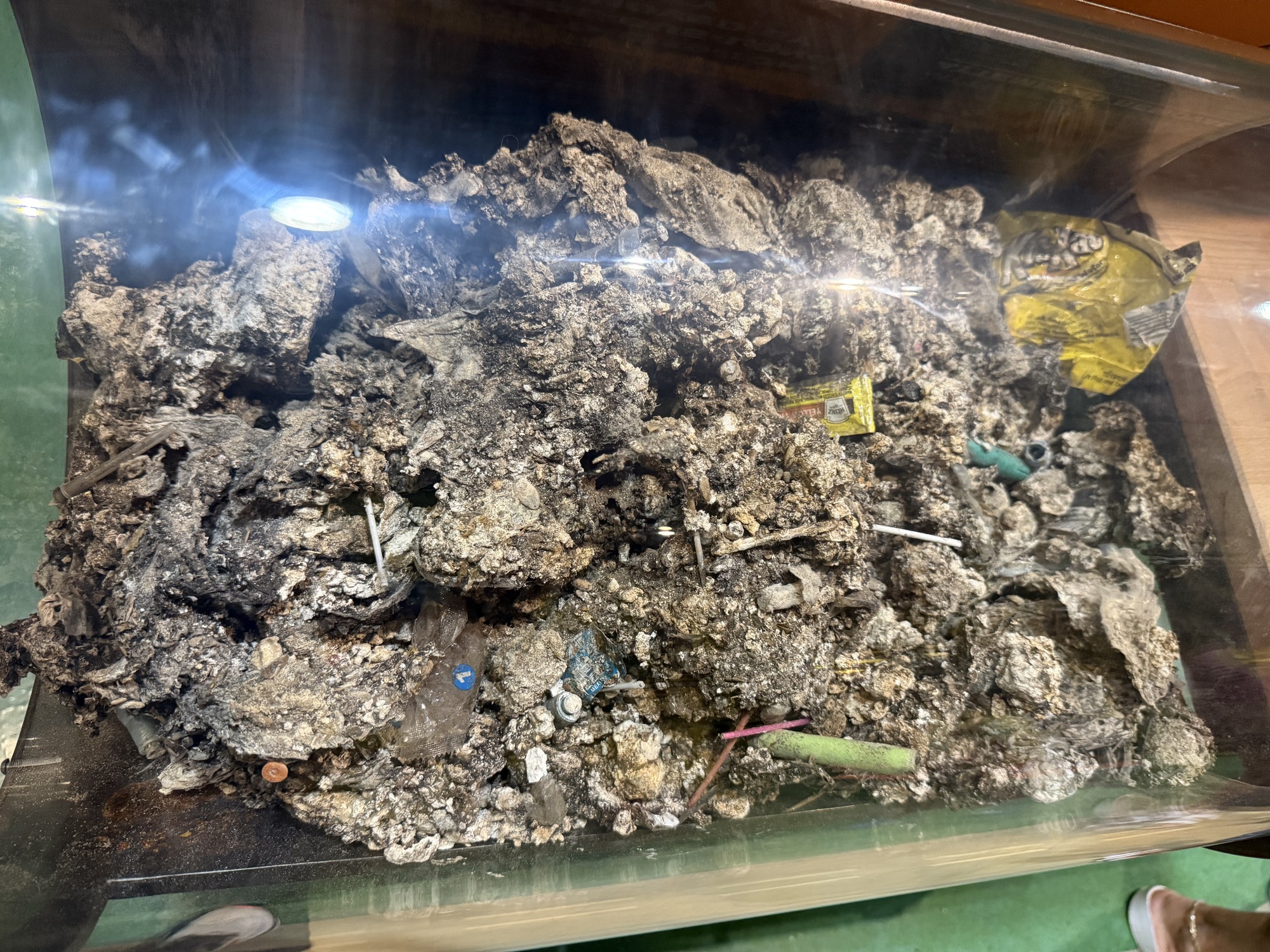
Karen PoretPerhaps a note of “why” this occurred? The white and yellow flatter object at the middle left of the photo reads “honey”…😲 Reply to this comment 5 months ago
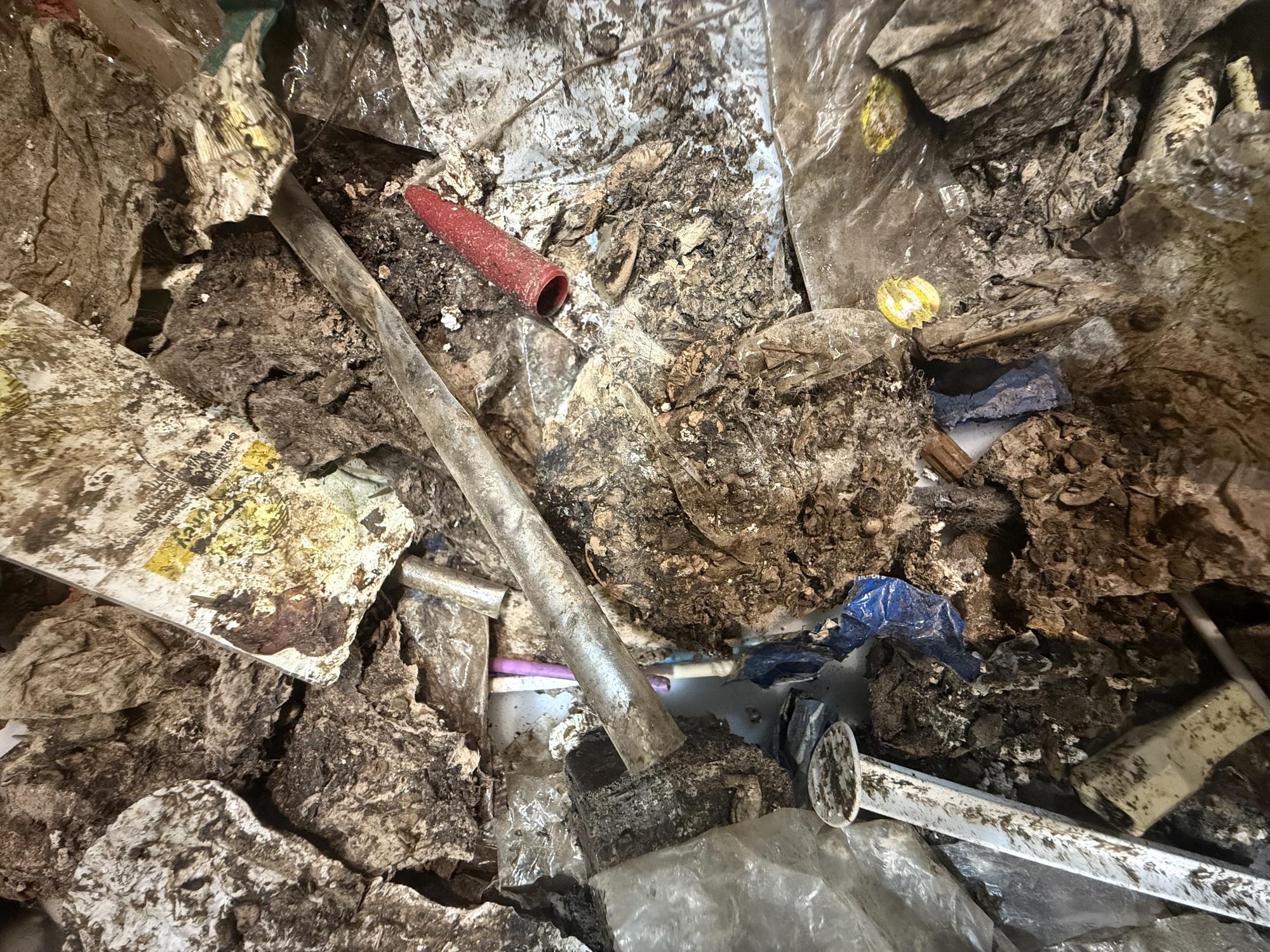
Mark BinghamTo Karen PoretIt occurs because people flush things down the toilet that shouldn't be flushed: diapers, nonbiodegradable paper towels, Heinz yellow mustard packages, tampons, candy wrappers, syringes, and even plastic packages of honey. I guess the "why" is that people are sometimes stupid, and don't realize the consequences of their actions. Reply to this comment 5 months ago
Karen PoretTo Karen PoretMy “why” was supposed to be obvious ( and snarky, not funny) because you and I both know people really are dumb and throw objects in the sink, toilet, trash, etc which should not be discarded in these “holes”. The honey comment was made strictly because it was visible in the pile of stuff, making me think of a bear being lured to food with a honey scent.
Thanks for your time to send all of us these photos, Mark.
On a better subject, the Ford Museum was quite inspiring, even if it has to be in Detroit. Reply to this comment 5 months ago
Jon AylingJust think how much fish 'n chip fat would've gone into the London example. Striking up Land of Hope and Glory and holding back a tear of pride.... Reply to this comment 5 months ago
Mark BinghamTo Jon AylingThat lump in the throat of all Londoners is pride... profound pride.
Removing Detroit's fatberg was extremely difficult. Hydrojetting failed, then suction failed, so crews had to enter the pipe and hack it apart by hand using saws and shovels before hauling it out in buckets or bits.
Karen PoretThis is an example of what should not even begin to happen. Water and wastewater treatment operators worst nightmare . Flushing out the lines on a regular basis and checking even more often would have prevented this. Of course, people put things down a sink and toilet that are not even close to being biodegradable, nor “recyclable”..
At least this fatberg could be a teaching moment for NOT allowing this to occur again, instead of “Hey, Dad, let’s try this at home”. 🙄 Reply to this comment 5 months ago
Man in bar: "Interesting you should ask. Why, just today I climbed down into the sewer with a hacksaw and a shovel to break up a 19-ton fatberg, which, I'm sure you know, is a bunch of coagulated fats, oils, and grease, with paper plates, diapers, tampons... things like that."
Woman: "Wow, that's.... fascinating. Now if you'll excuse me, I just this minute developed bulimia and need to go purge."
From there, I went to the Henry Ford Museum, and found it to be much more interesting than I had anticipated. Knowing my time was limited, I literally ran from exhibit to exhibit, not wanting to miss anything ("literally" meaning "literally," and when not trotting around I was walking very briskly). Even racing from item to item, I barely managed to take in the six acres in the three and a half hours I spent there.
I'm posting a lot of pictures, at least a handful of which I hope you find interesting. After scouring through about two hundred, culling most of them, and even deleting some that I had uploaded onto CycleBlaze, I'm still hoping that the volume isn't overwhelming.
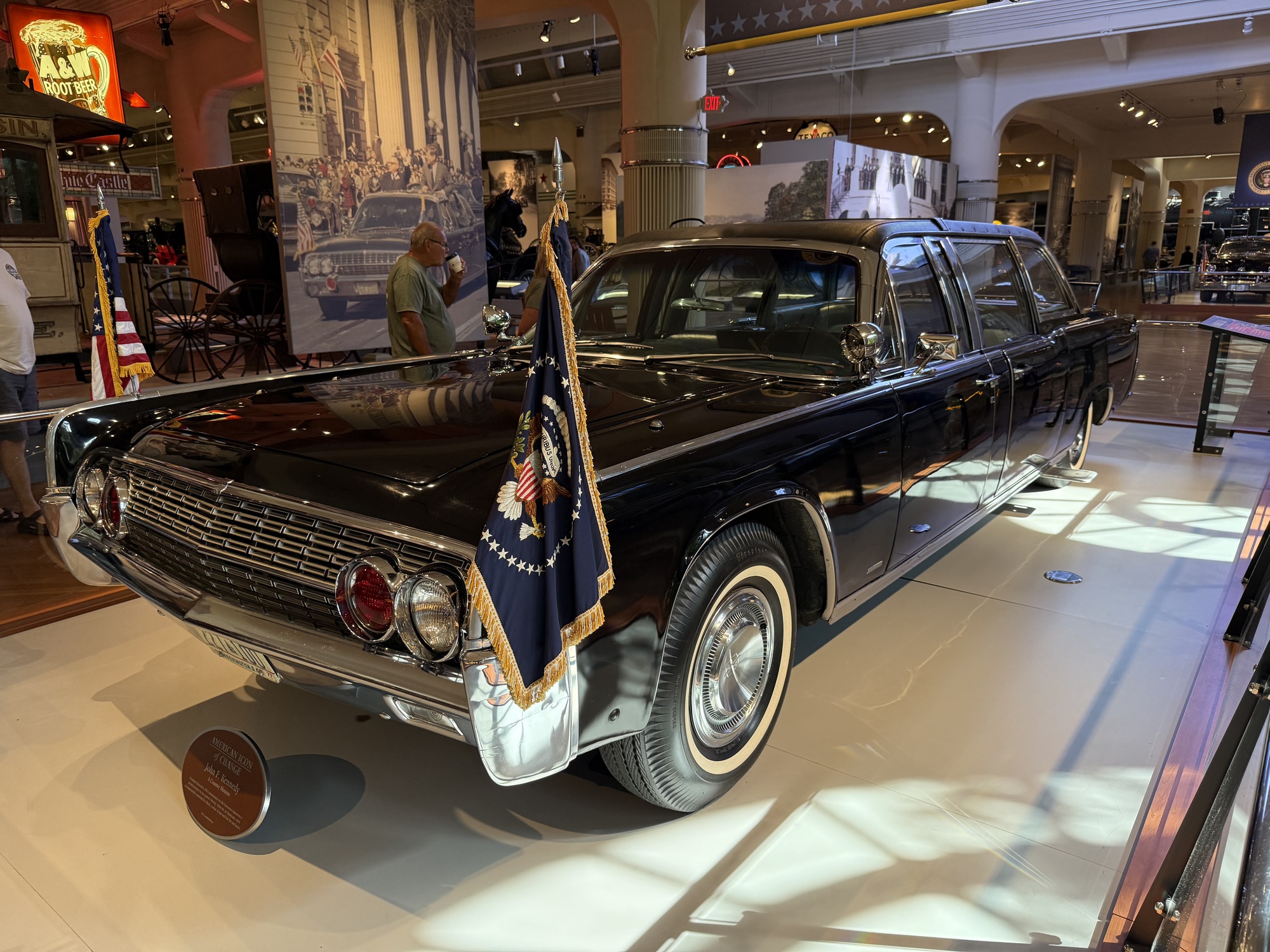
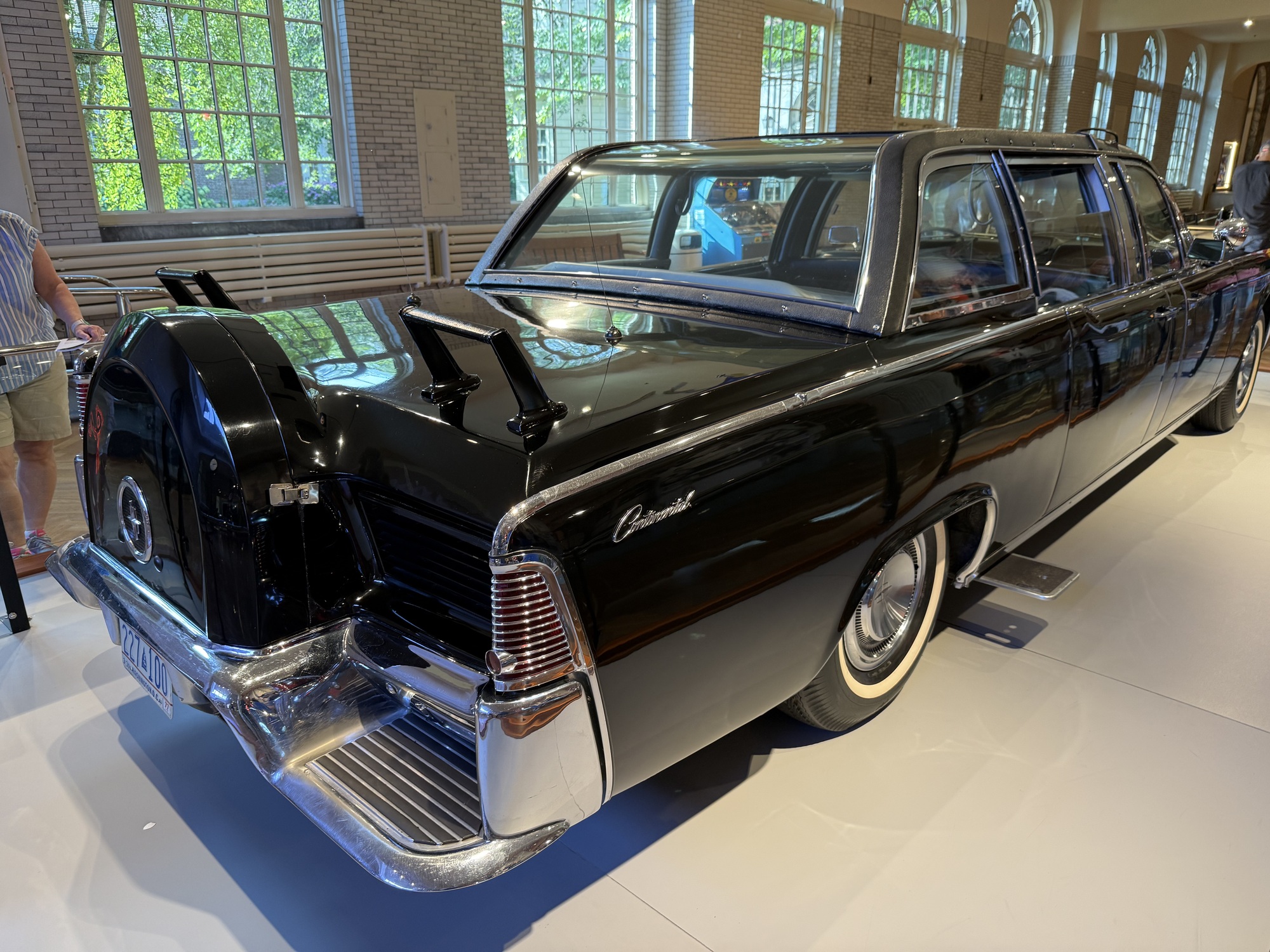
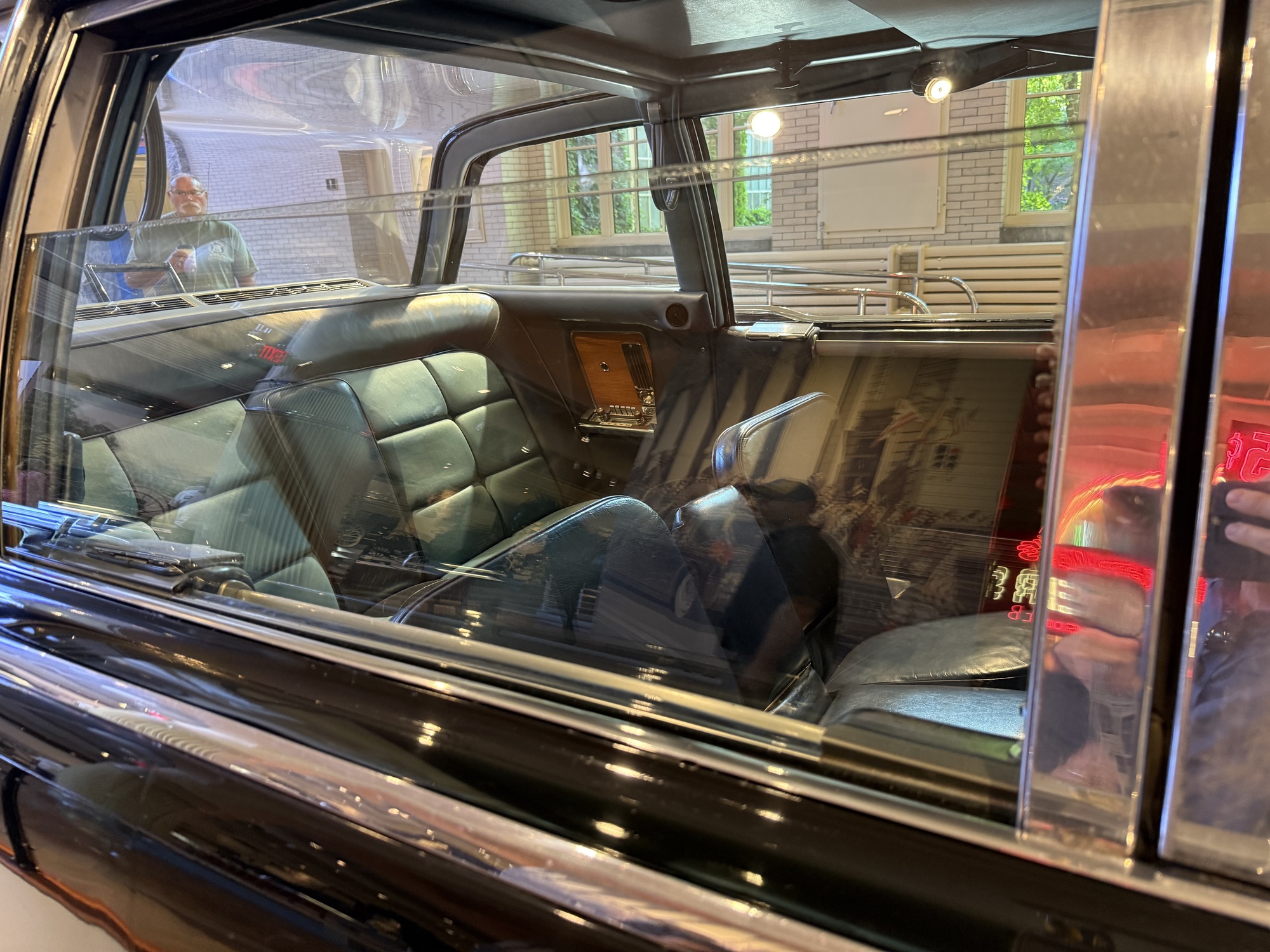
The is the actual car in which John F. Kennedy was assassinated.
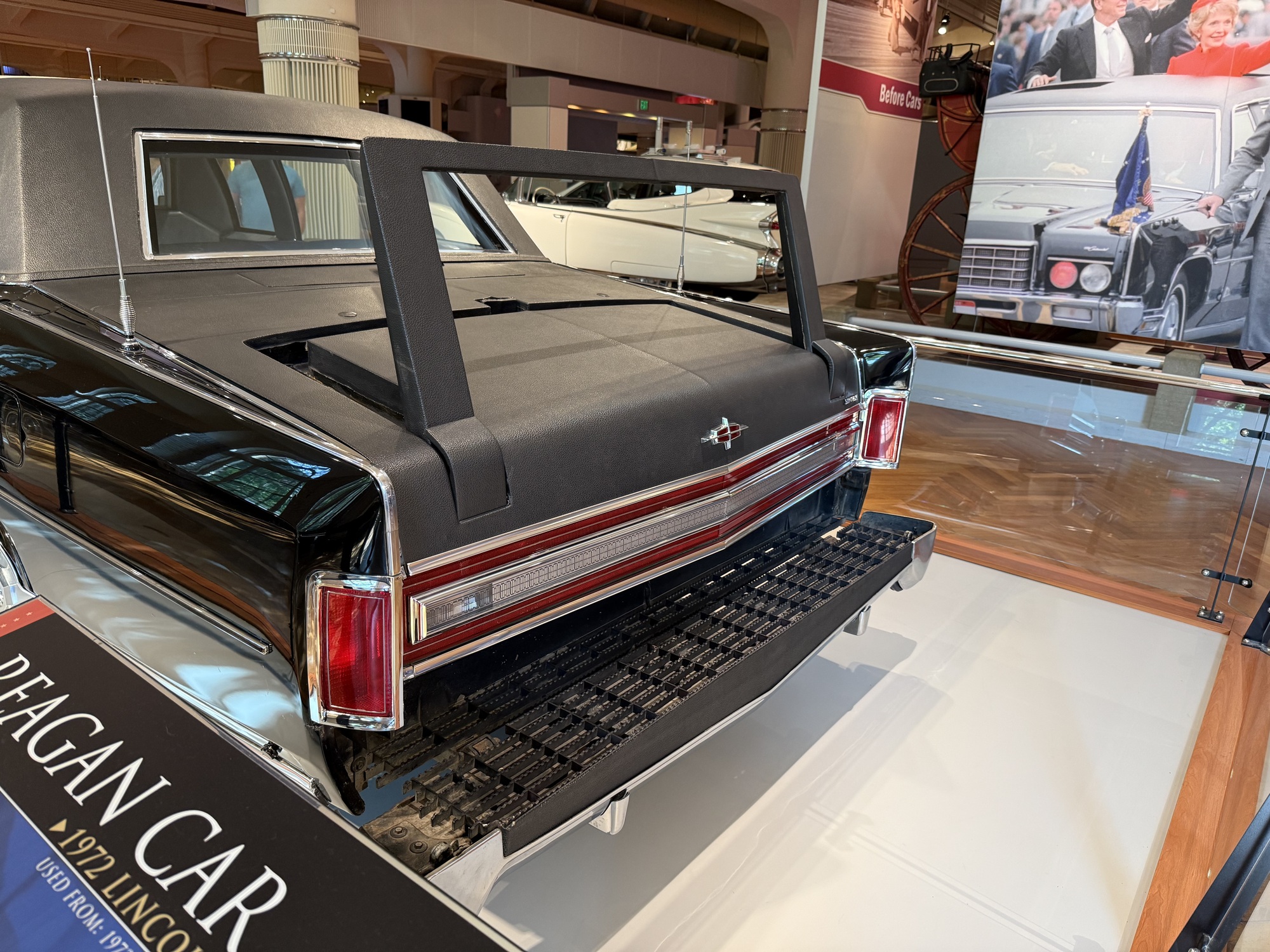
There were modifications after the assassination, but for several successive administrations there was always the tension between a President's desire to be seen and Secret Service efforts to protect him.
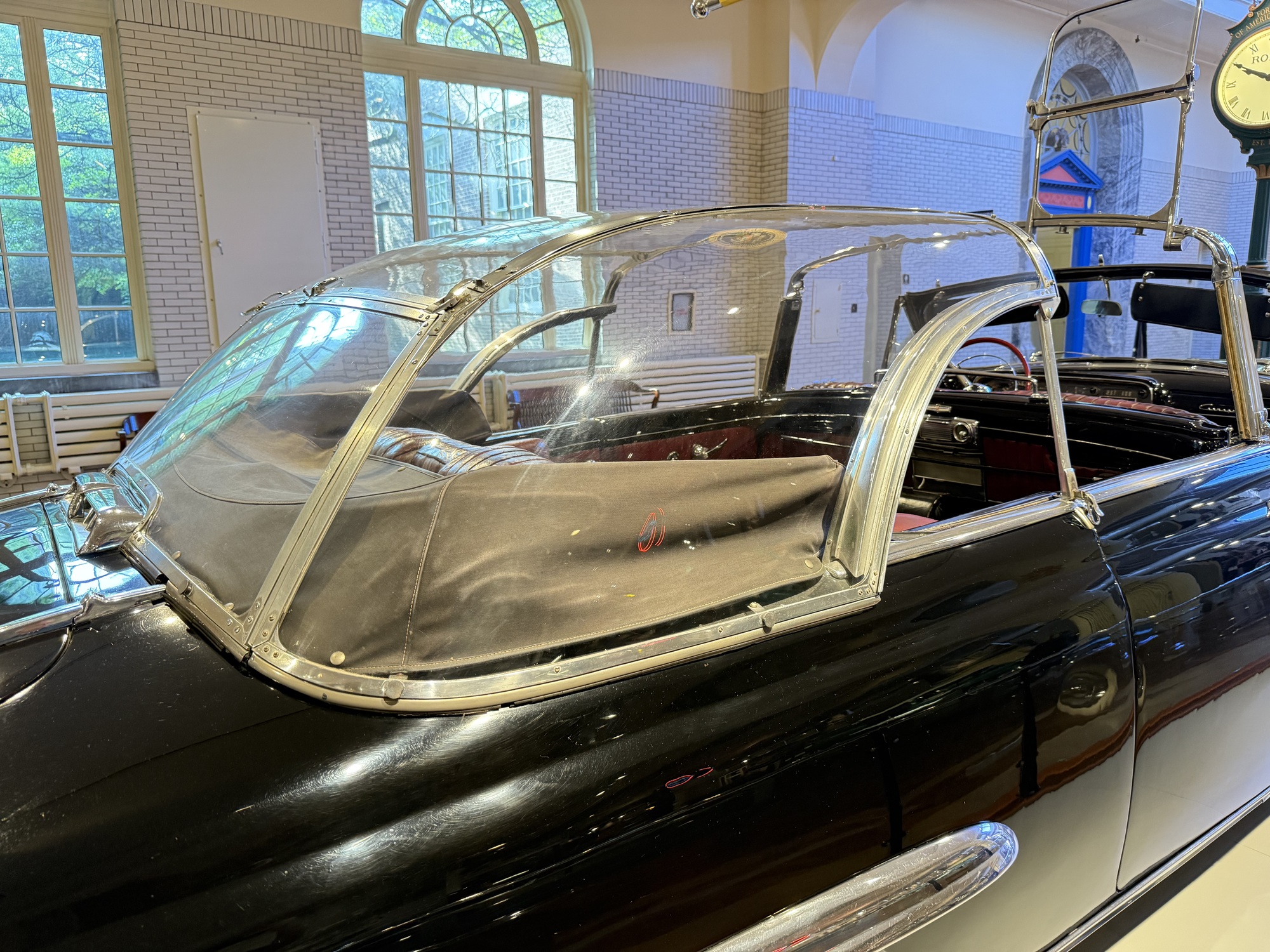
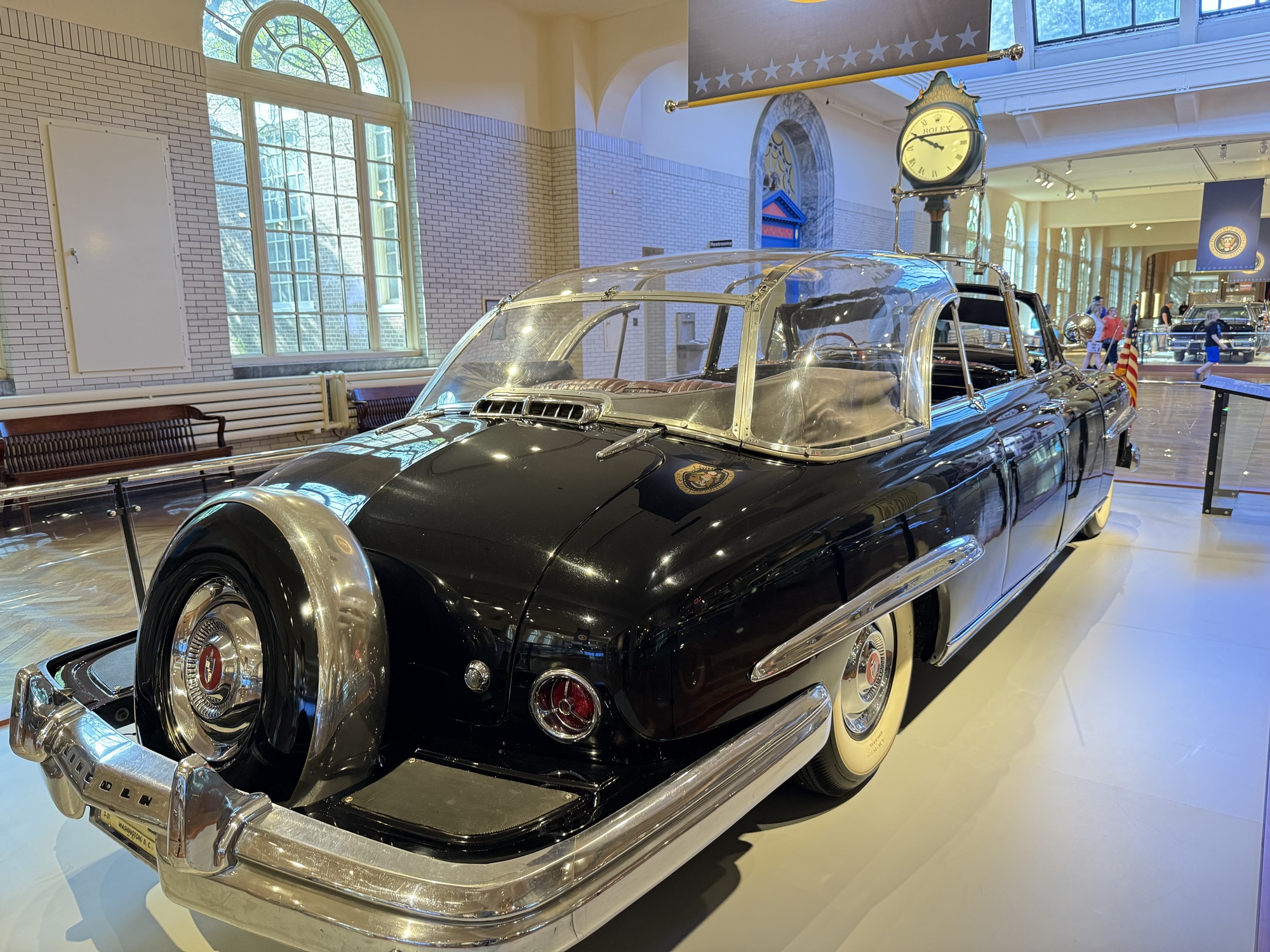
This was originally a flashy 1950 convertible used by President Truman. His successor, Eisenhower, added the removable "Bubble Top" (which is what the car came to be named) so he could still see, and be seen, in inclement weather.
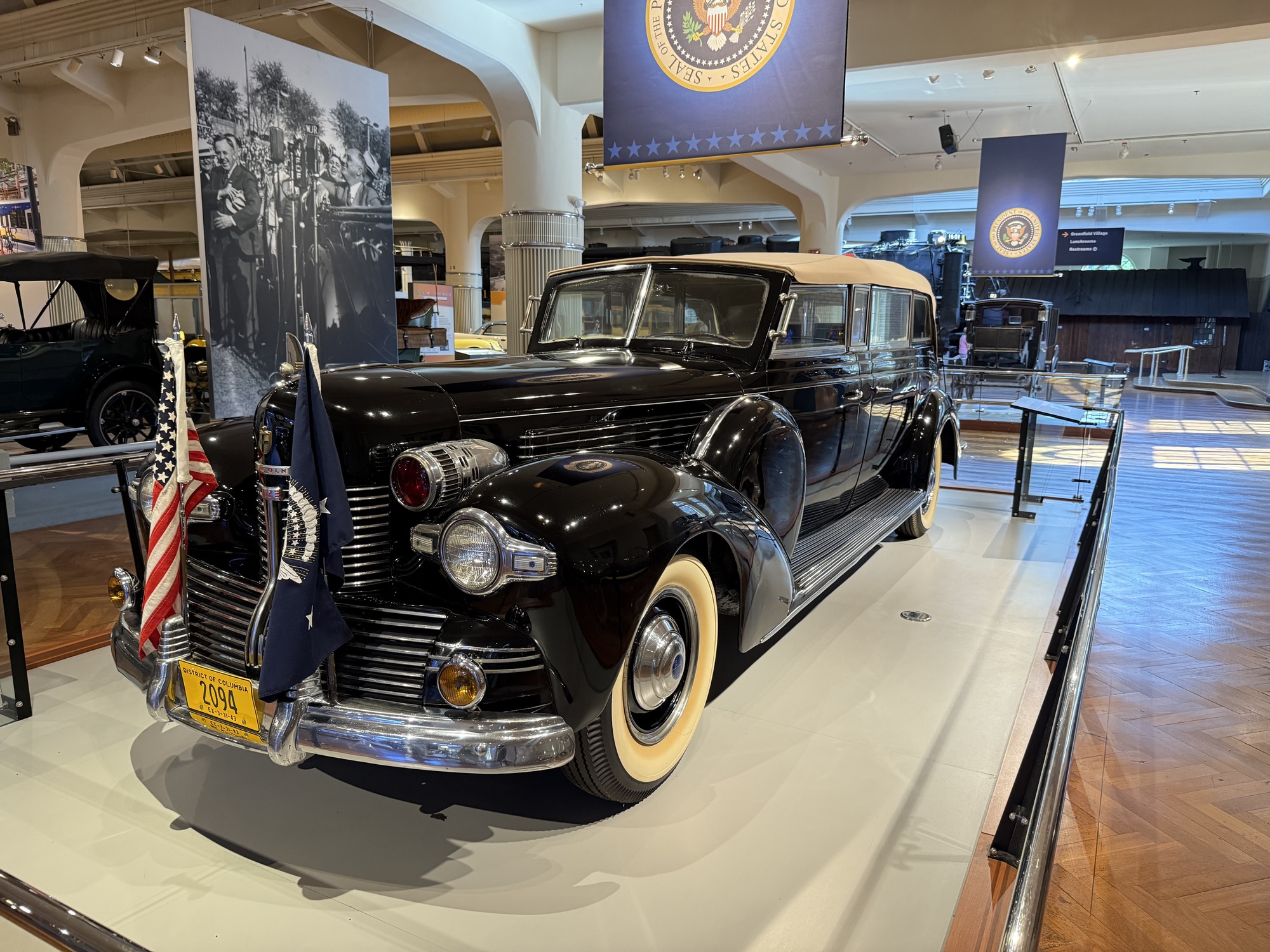
FDR's car, the "Sunshine Special," was the first car to be expressly designed and built for a President. World War 2 was looming so Roosevelt needed extra security, and after the Pearl Harbor bombing even more protective measures were added. Because of his paralysis, other features made it easier to lift him in and out of the car. This is also a convertible - Roosevelt enjoyed riding in public, and the top was often down so he could greet the crowds.
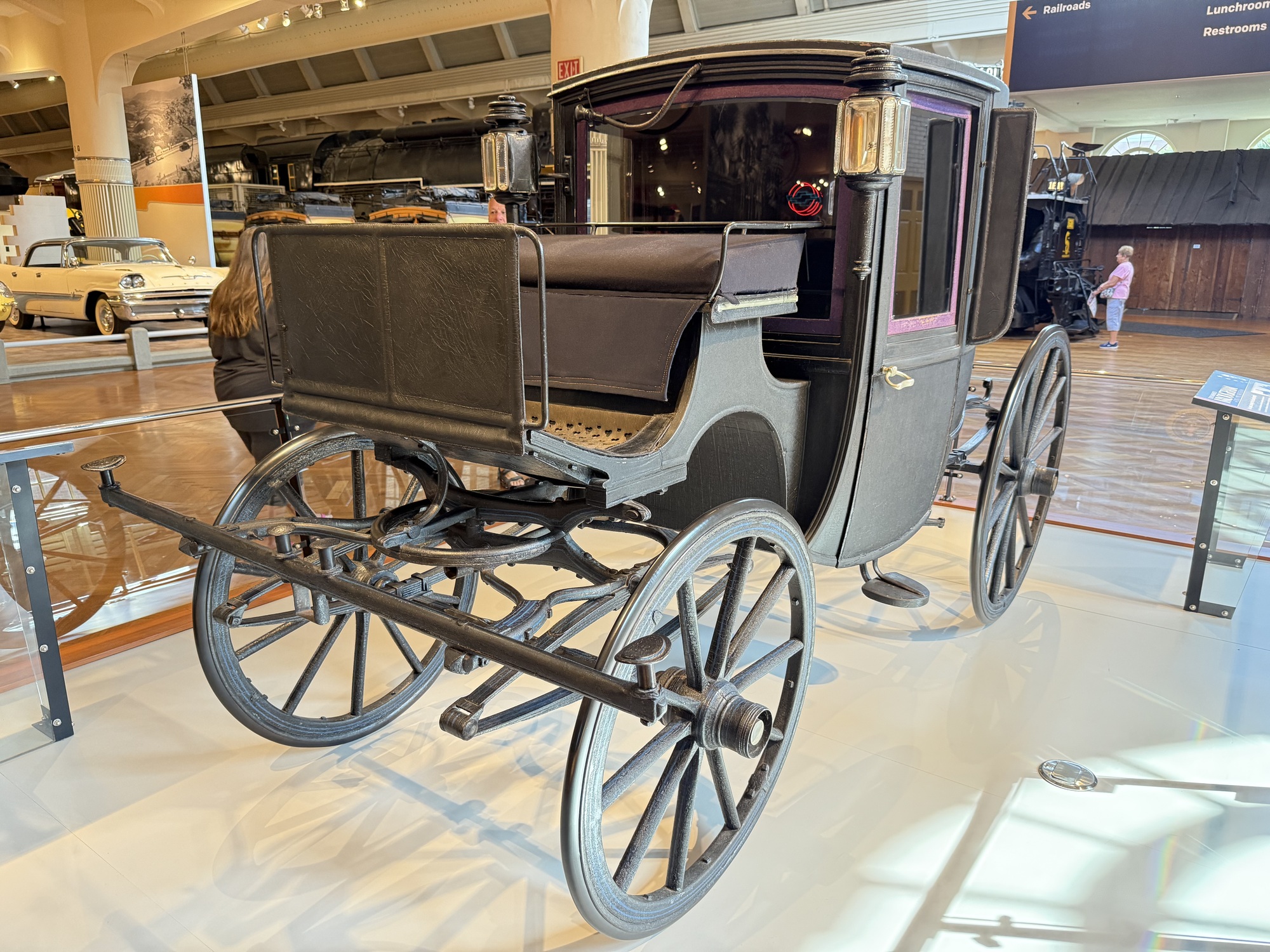
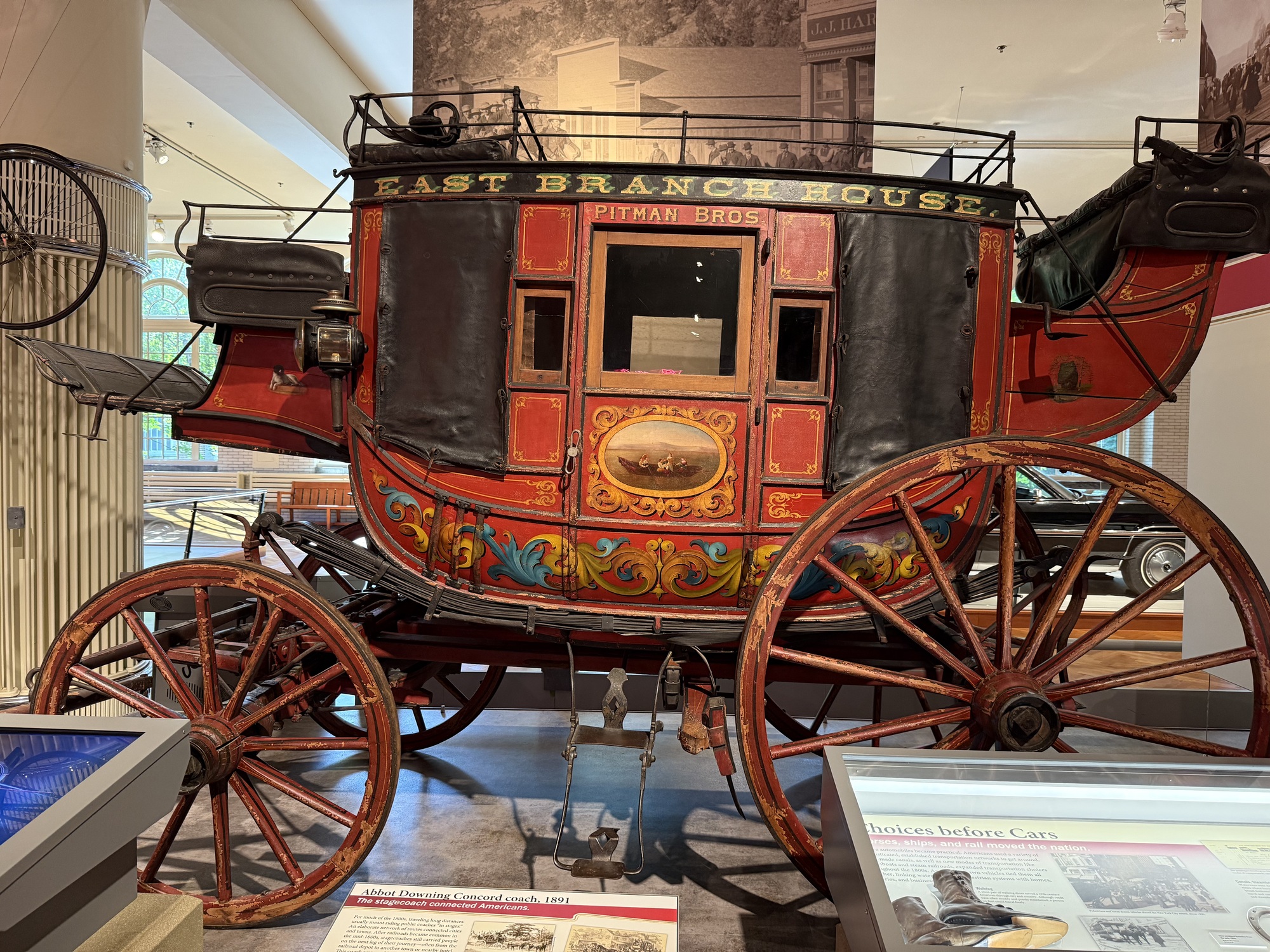
Teddy Roosevelt didn't particularly like automobiles, and rarely used them, preferring instead an old fashioned horse-drawn carriage. This one isn't custom-built, but simply the kind of transport used by people at that time who wanted to show off their wealth.
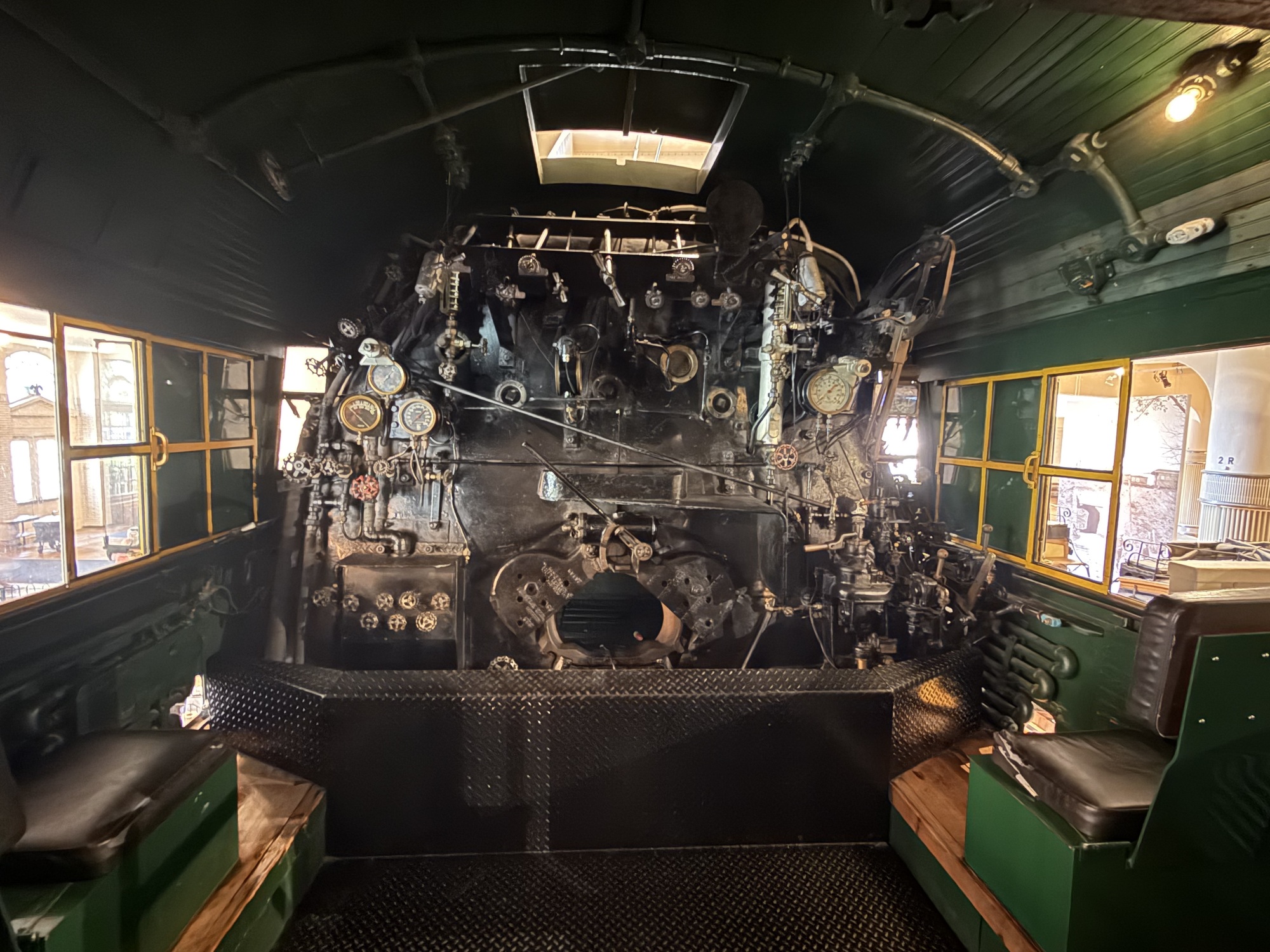
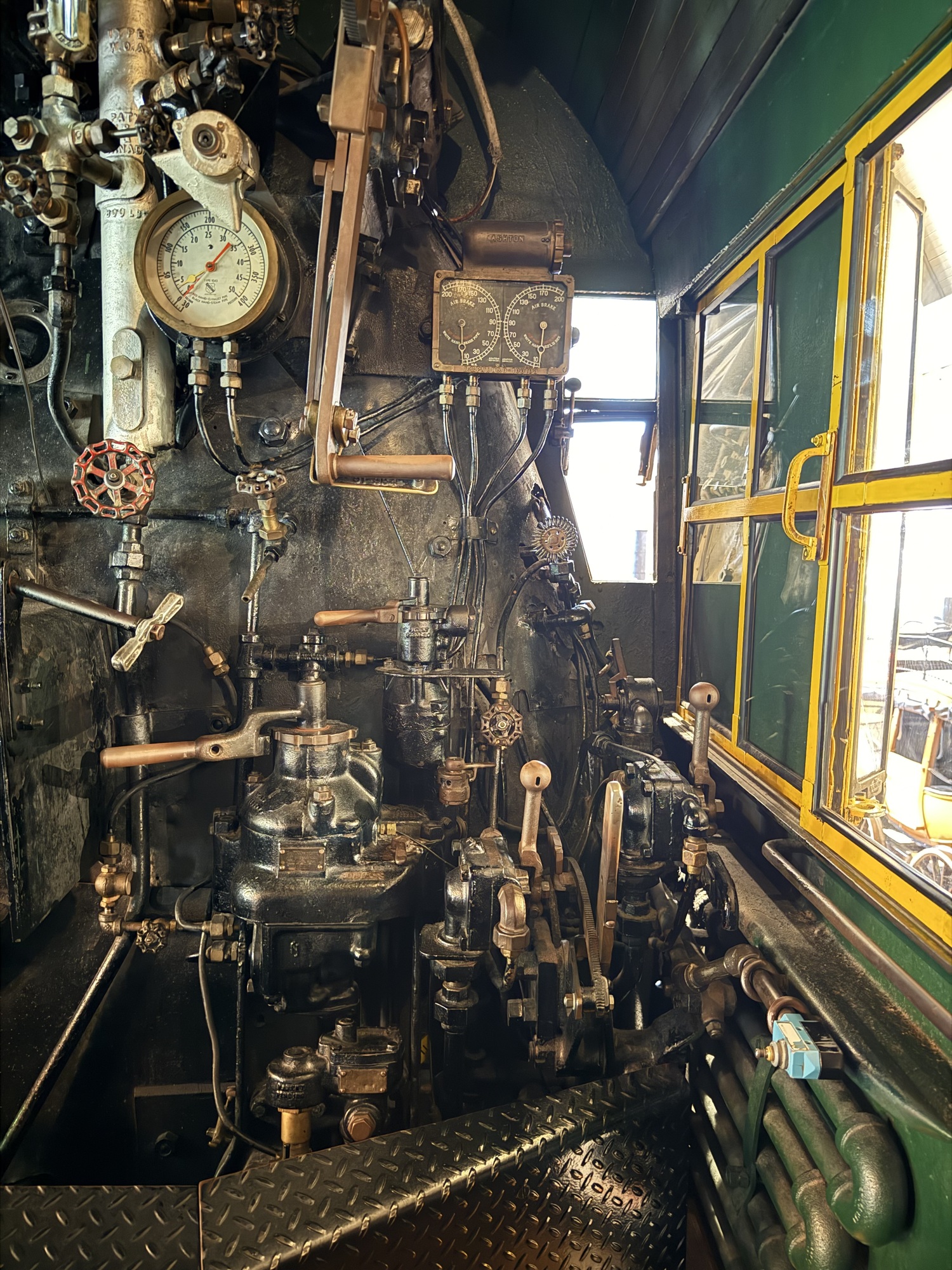
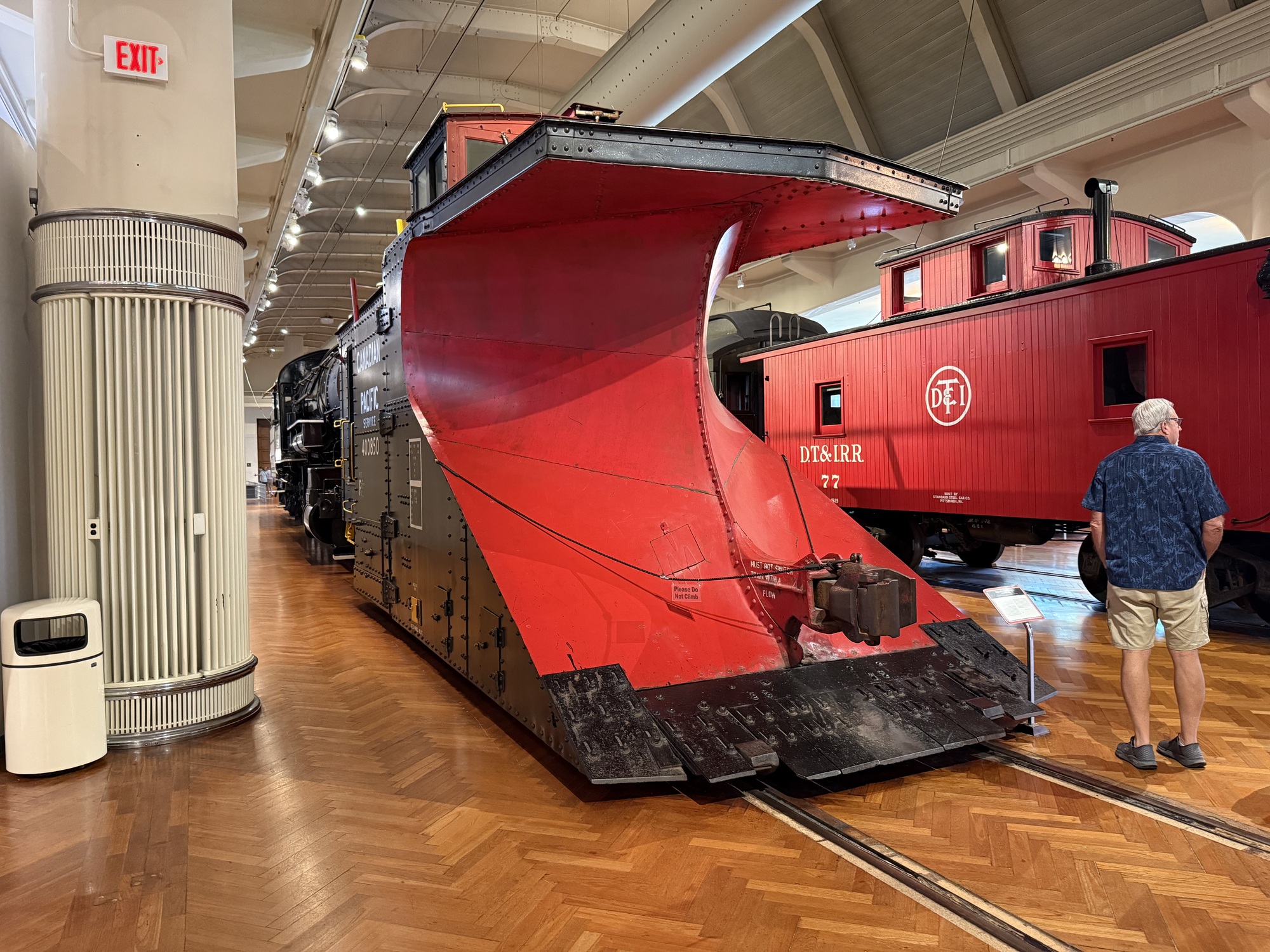
Karen PoretConductor or engineer? But, wow..I would like to see someone try to operate this and use their iPhone at the same time ..not.. Reply to this comment 5 months ago
Mark BinghamTo Karen PoretHa! Right! …and I don’t know enough about trains to tell the difference between a conductor and an engineer. Reply to this comment 5 months ago
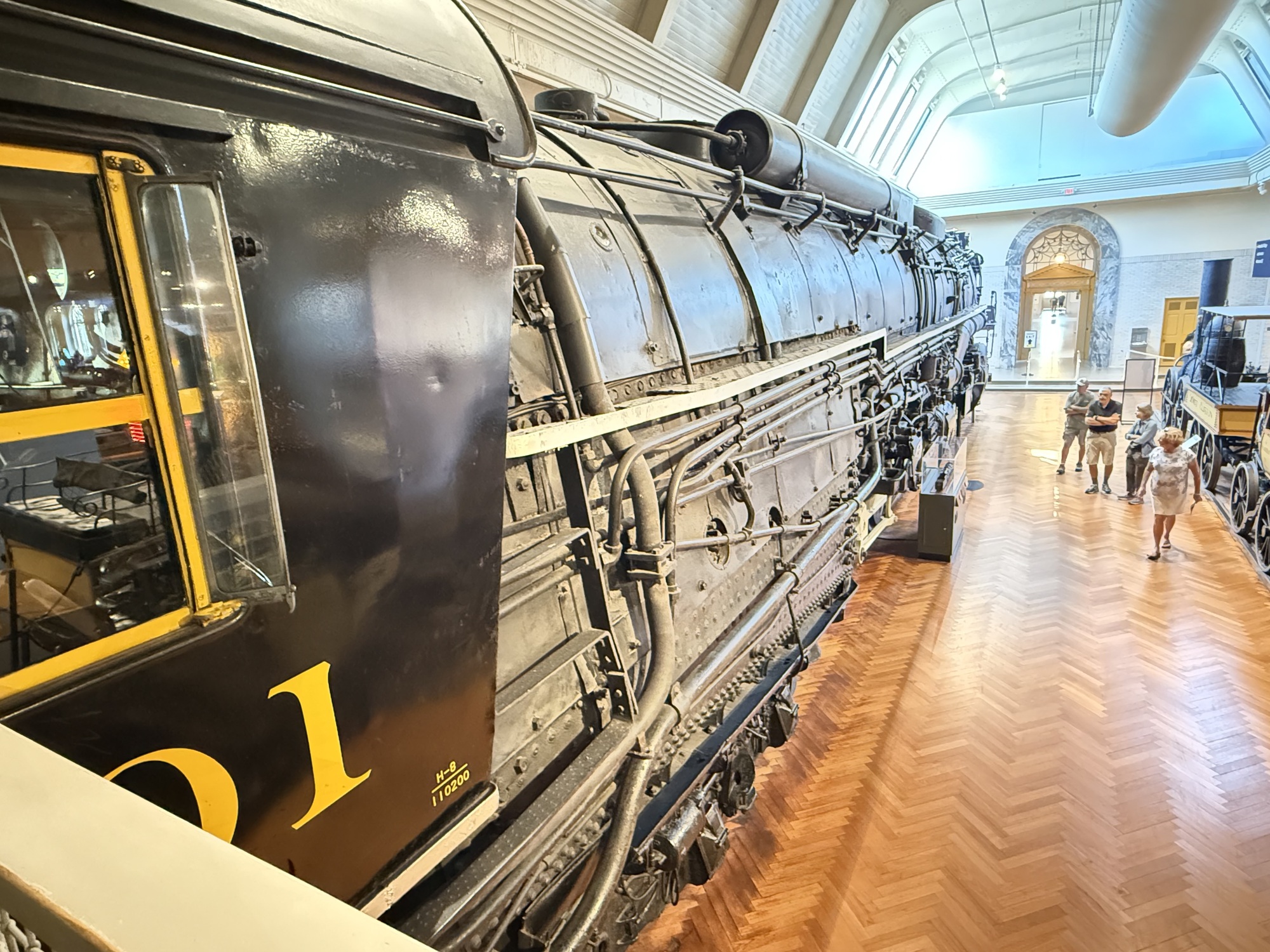
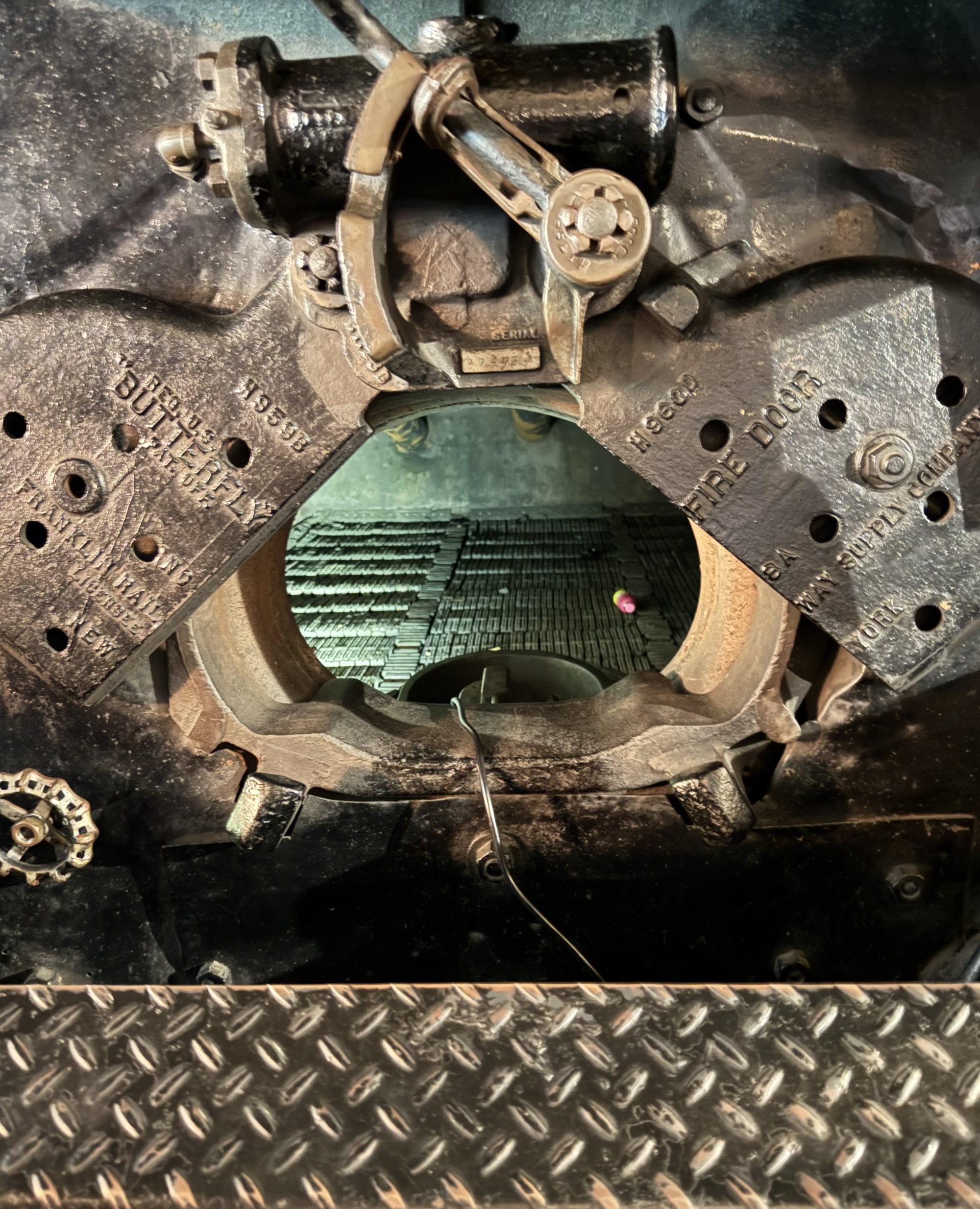
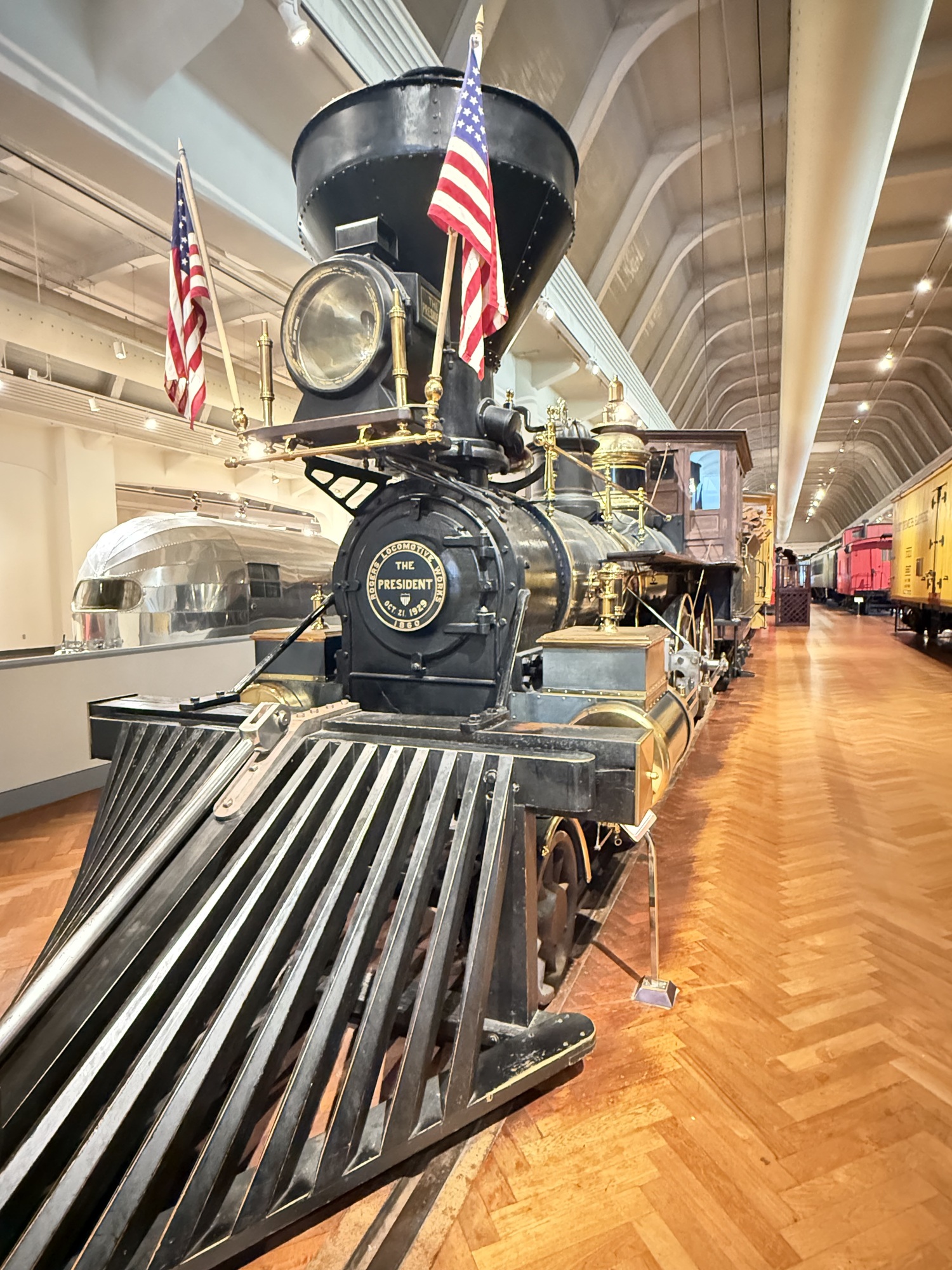
This 1858 Rogers is a bit smaller, but it'll clear anything off the track. Its last run was in 1929, transporting President Hoover to the opening of this museum, after which it was renamed "The President" in honor of Hoover.
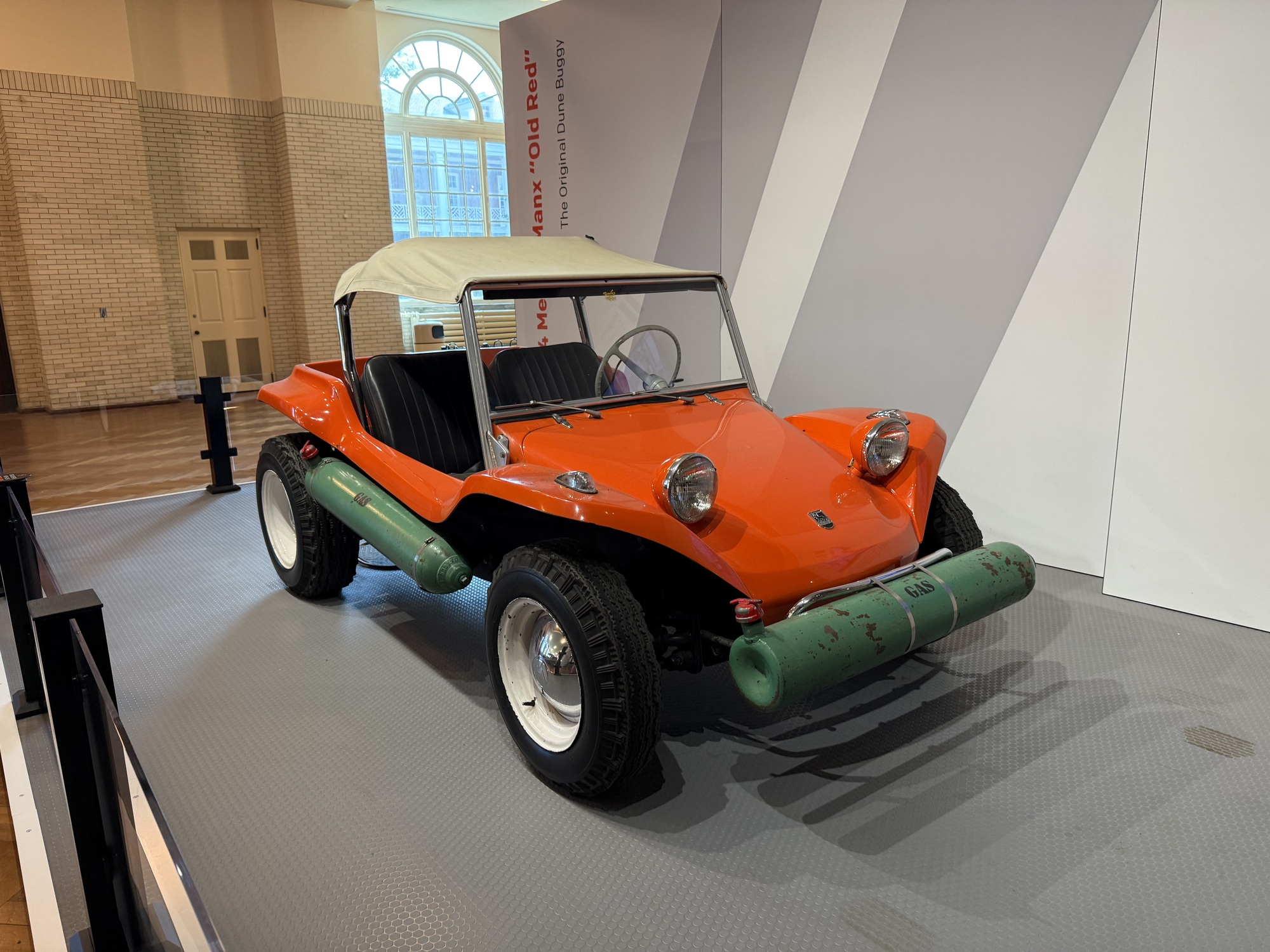
Bruce Meyers, a California native, developed the first Dune Buggy in the 1960s after watching people drive stripped-down cars over the state’s beaches. Using the engine and running gear from a Volkswagen Beetle, but with an open top fiberglass body that he built himself, he began selling conversion kits: a fiberglass body which included everything but the engine, running gear and chassis. Most buyers found used VWs for those missing items. He sold about 7,000 kits but imitators sold hundreds of thousands more, sometimes even using his body shell as a mold for their copies.
Bob DistelbergI REALLY wanted one of these when I was a teenager. Never happened though. Not that I lived anywhere near an ocean or a beach. Reply to this comment 5 months ago
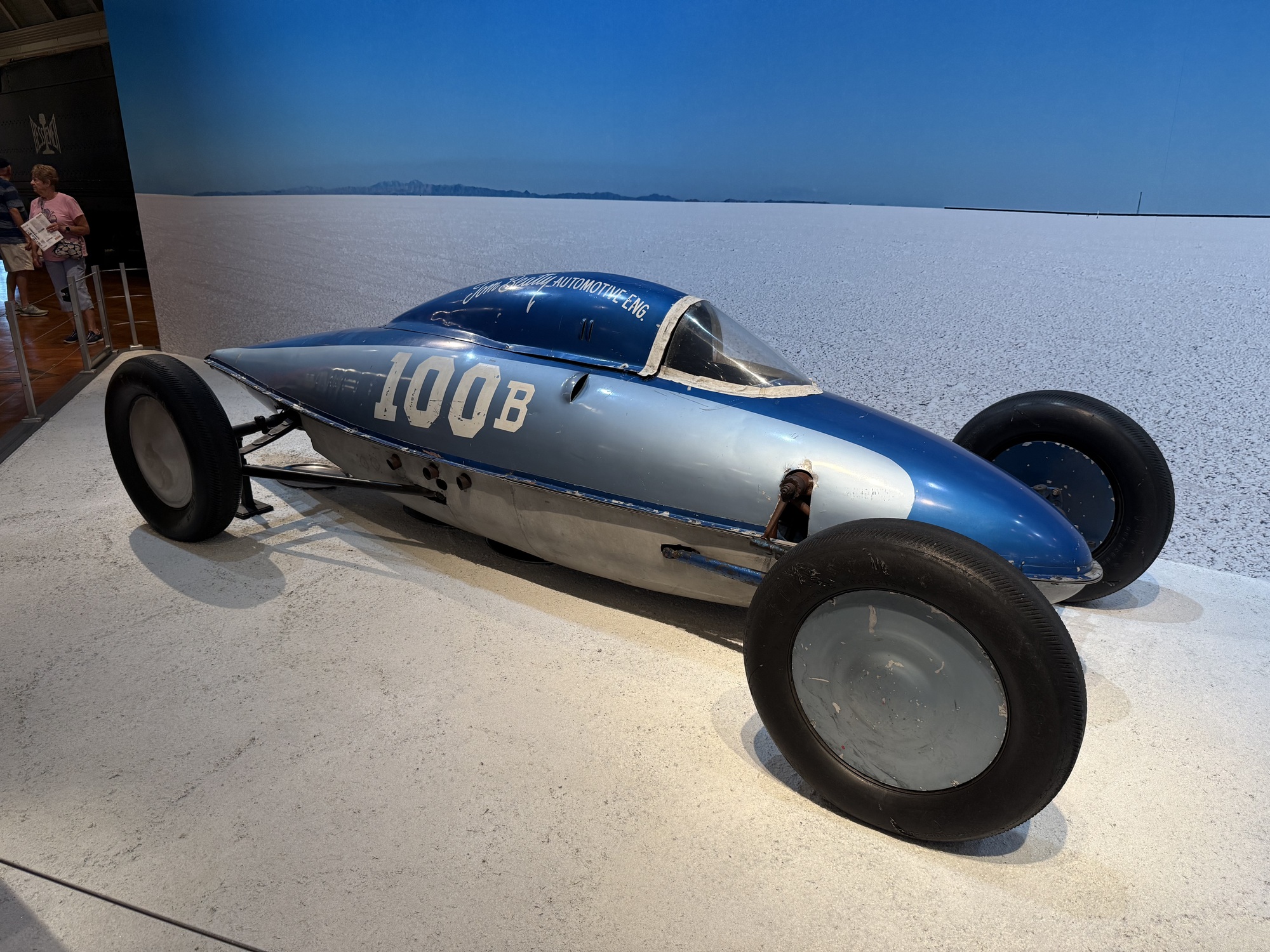
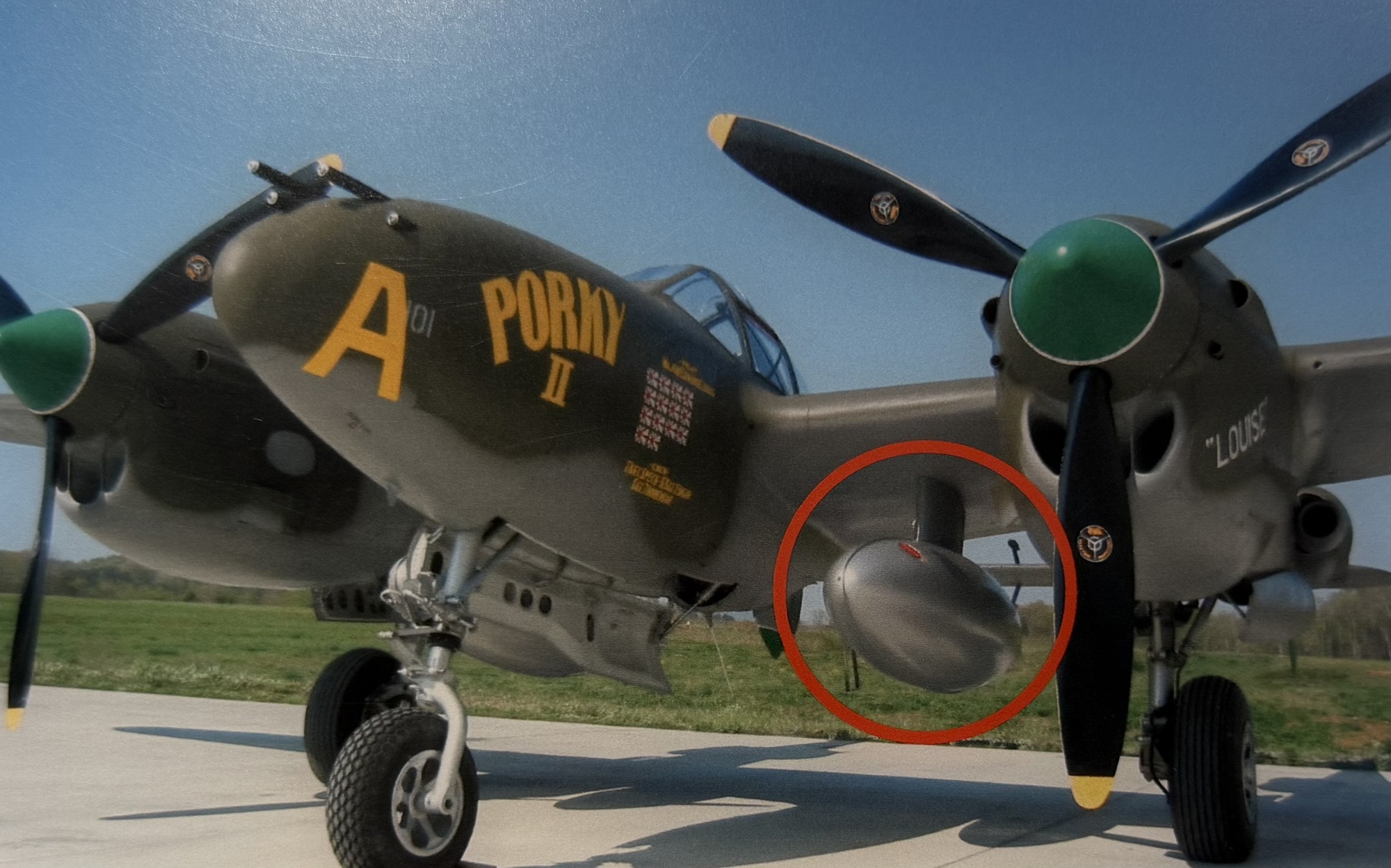
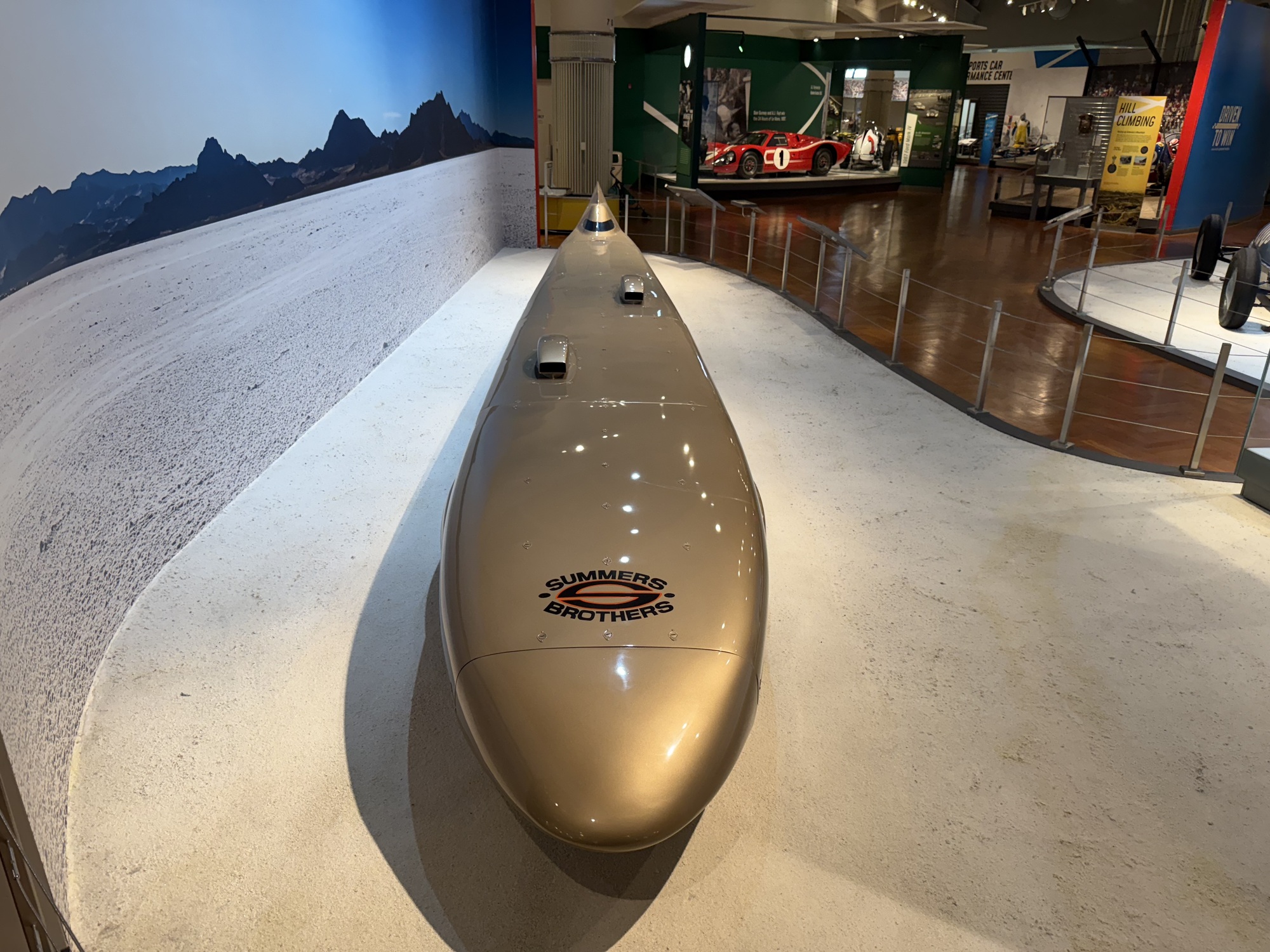
This type of car became popular after World War 2. The body is actually an external fuel tank from a fighter plane. This one was, for a while, the world's fastest fuel tank.
Karen PoretMy late Father in law built a small model of this for his son. He still has it. Made out of metal and solid rubber wheels. Reply to this comment 5 months ago
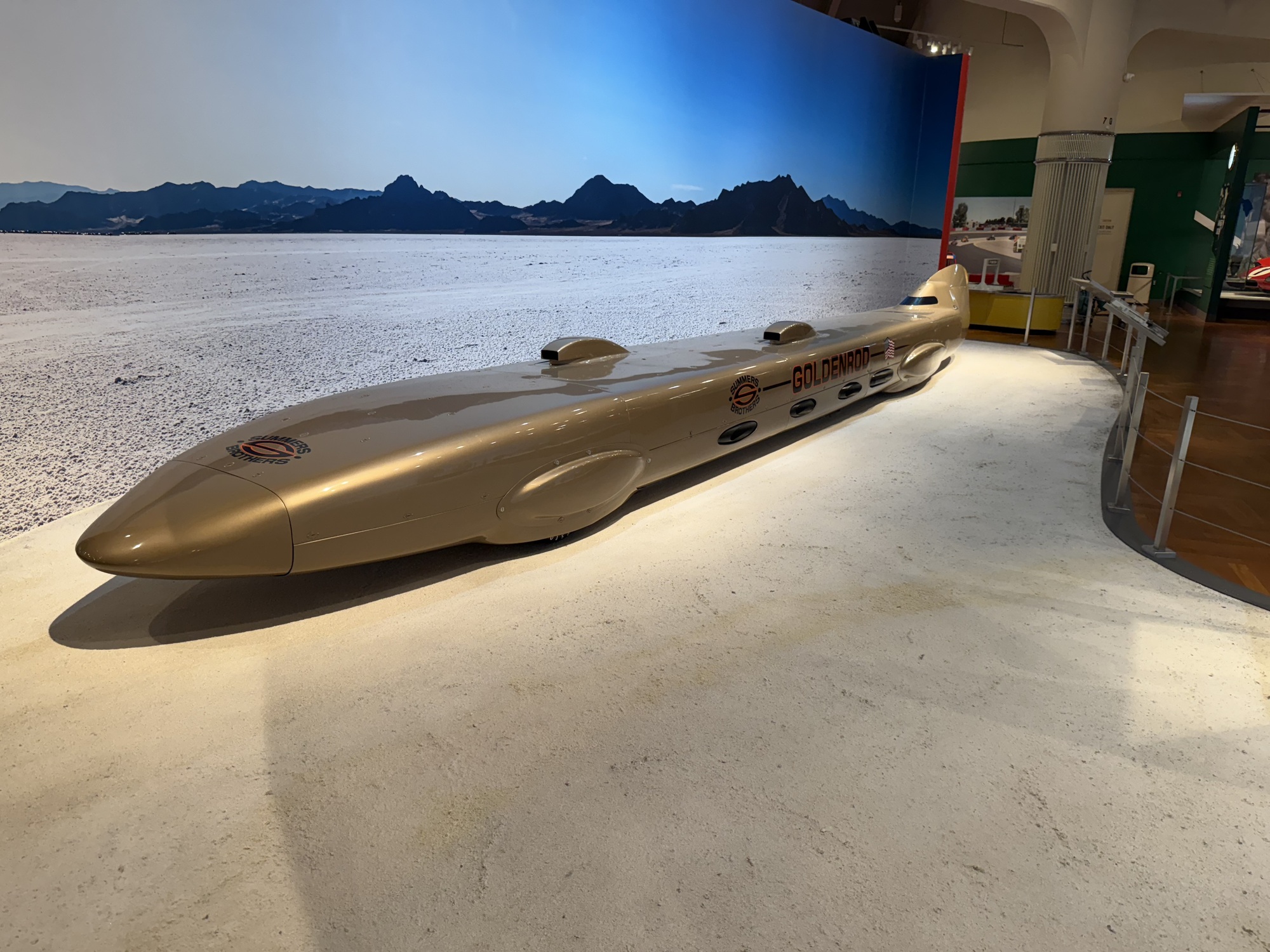
The long, slim shaped helped, but the engineering requirements to squeeze in four massive Chrysler engines and the machinery to drive all four wheels is what made the difference. Goldenrod held the record for an amazing 26 years.
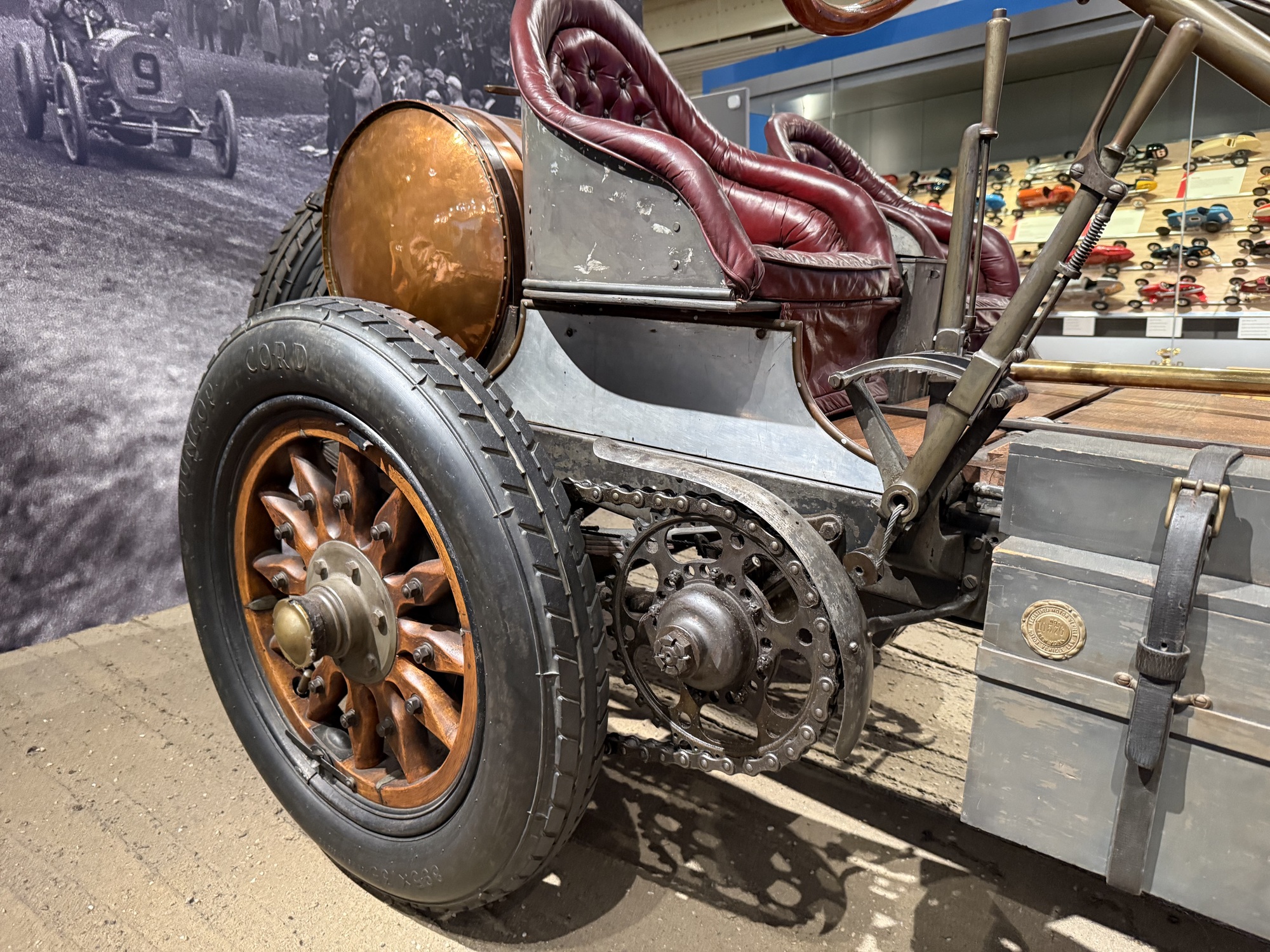
I'm mainly including this photo because of the impressive chain. This car was the first American winner, in 1908, of the Great American Race (previously won thrice by French vehicles), a contest through the streets of Long Island in New York in which, inevitably, one or more of the 250,000 spectators was killed. These deaths helped shift racing to purpose-built tracks.
There were a lot of interesting automobiles, even for someone like me who isn't a "car guy." Some of the cars I’m not posting pictures of: 1926 Rolls-Royce Phantom 1961 Chevrolet Corvette 1916 Woods Dual-Power - a hybrid car which used electricity and gas, in 1916 1931 Duesenberg Model J - Many claim this to be the "world's finest motorcar." Only 481 were built, and no two are alike. 1975 FMC motorhome - Charles Kuralt’s last motorhome from the 27-year-run of On The Road 1958 Edsel 1948 Tucker - Only 51 were built. The center headlight turns with the front wheels and the taillights are visible from the side for safety, safety not being a high priority back in the day.
a little fancier than the ones I've seen in movies, and with no bullet holes
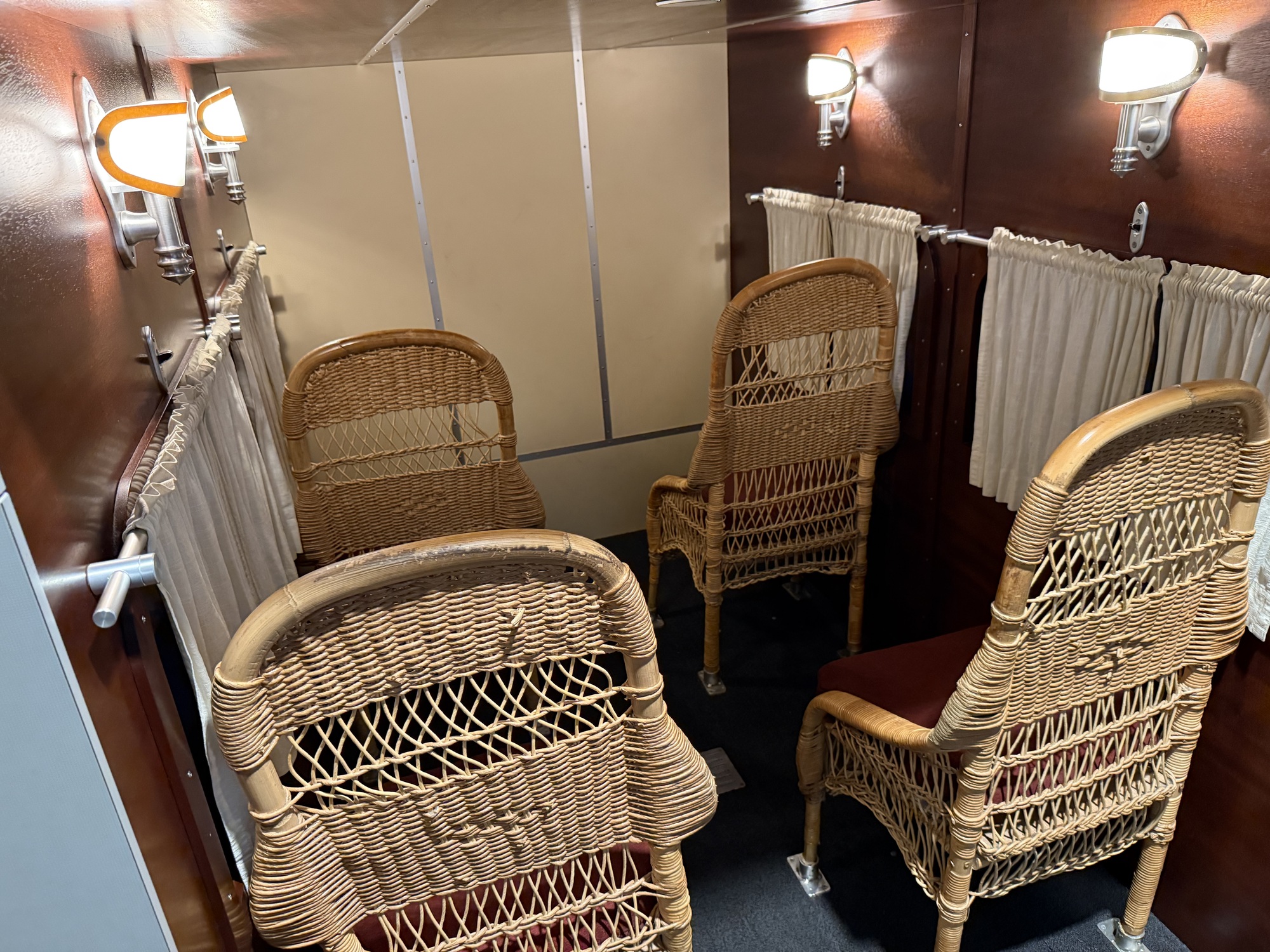
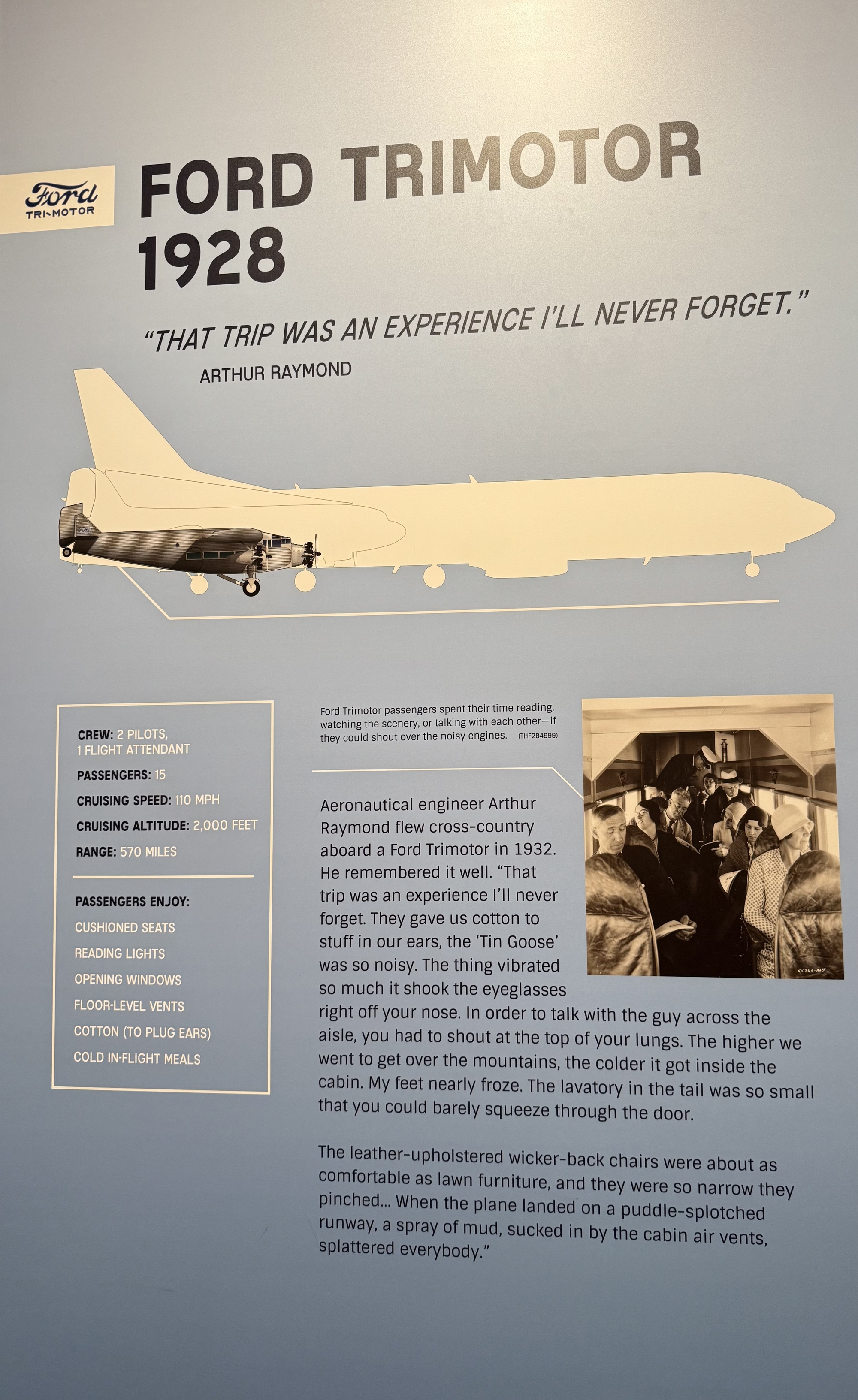
This Tri-Motor, aka "Tin Goose," is the plane that 6-year-old Neil Armstrong first went up in when he was passing through Warren, Ohio (not THE plane he we went up in, but one like it). It's the first all-metal airplane, and the one Charles Lindbergh carried Henry Ford in for his very first flight. Ford traveled in an airplane only a few times in his life, and Lindbergh mailed him a letter thanking him for the honor.
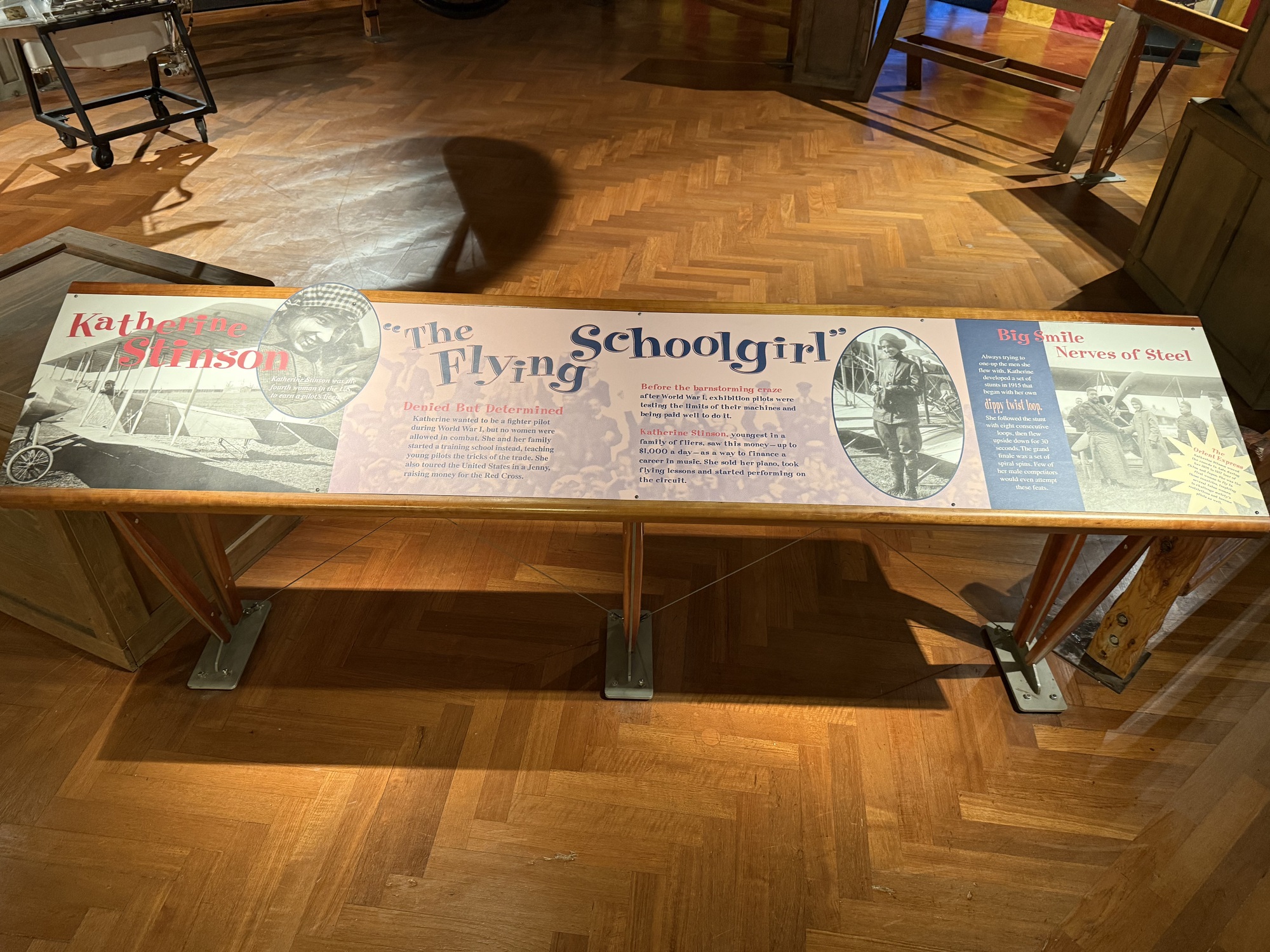
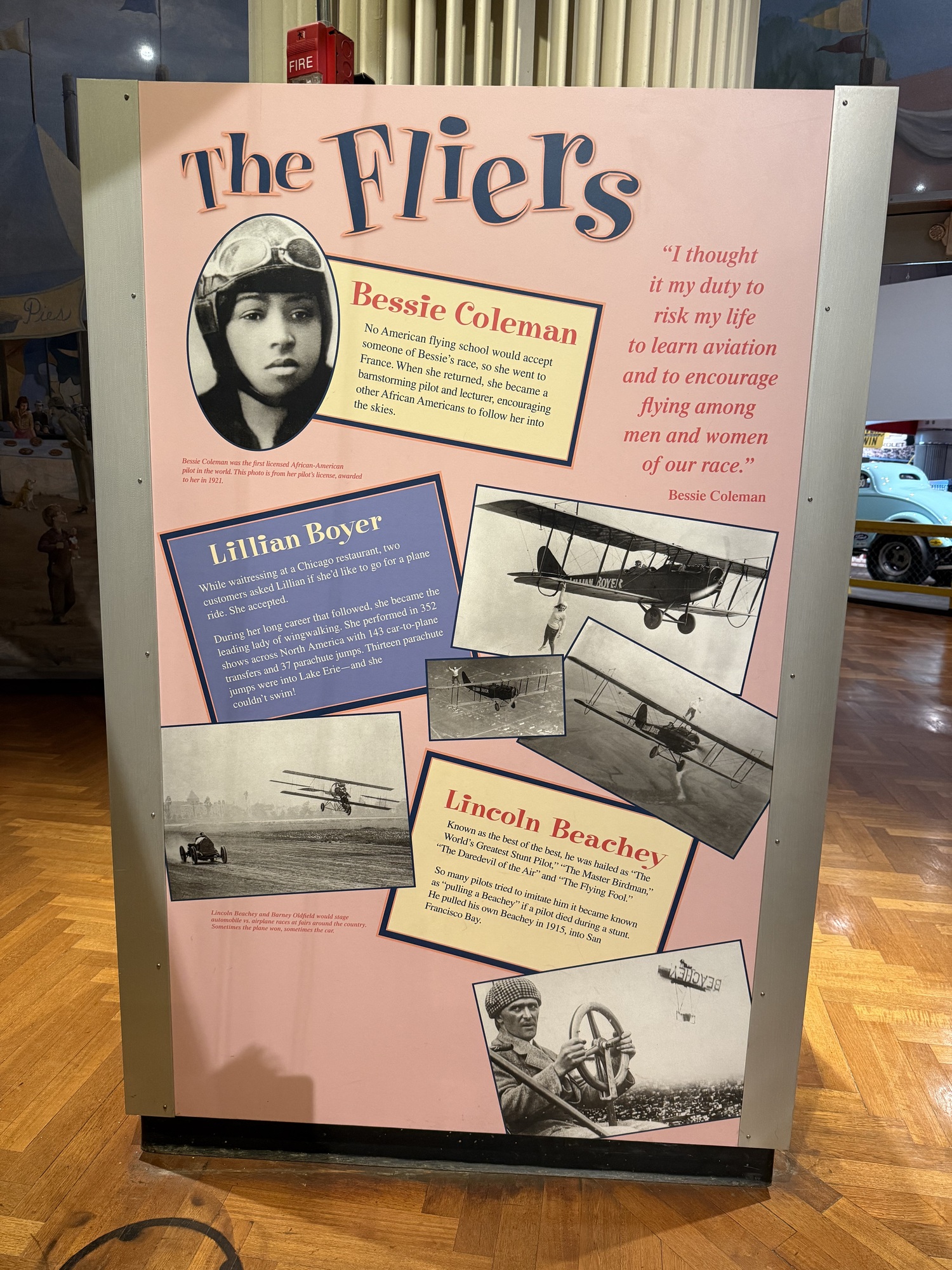
When WW1 ended, thousands of surplus planes became available, and nearly 10,000 pilots were suddenly out of a job. Many of them started flying exhibitions, but the "barnstormers," i.e. the spectacular shows with stunts, tricks, and fast flying, really took off.
For many people, it was the first time they'd ever seen a plane. Of note: (1) there were no brakes, so you couldn't land too fast or you'd end up in a ditch, (2) the landing wheels were attached to the plane by bungee cords, so when you did land it would be bumpy, and (3) the planes sat outside in all kinds of weather, and the fabric covering would rot and tear, the wires would rust, and the glue would dissolve.
Even so, there were daredevil fliers. It was even more difficult for women to break into the field, but some became experts.
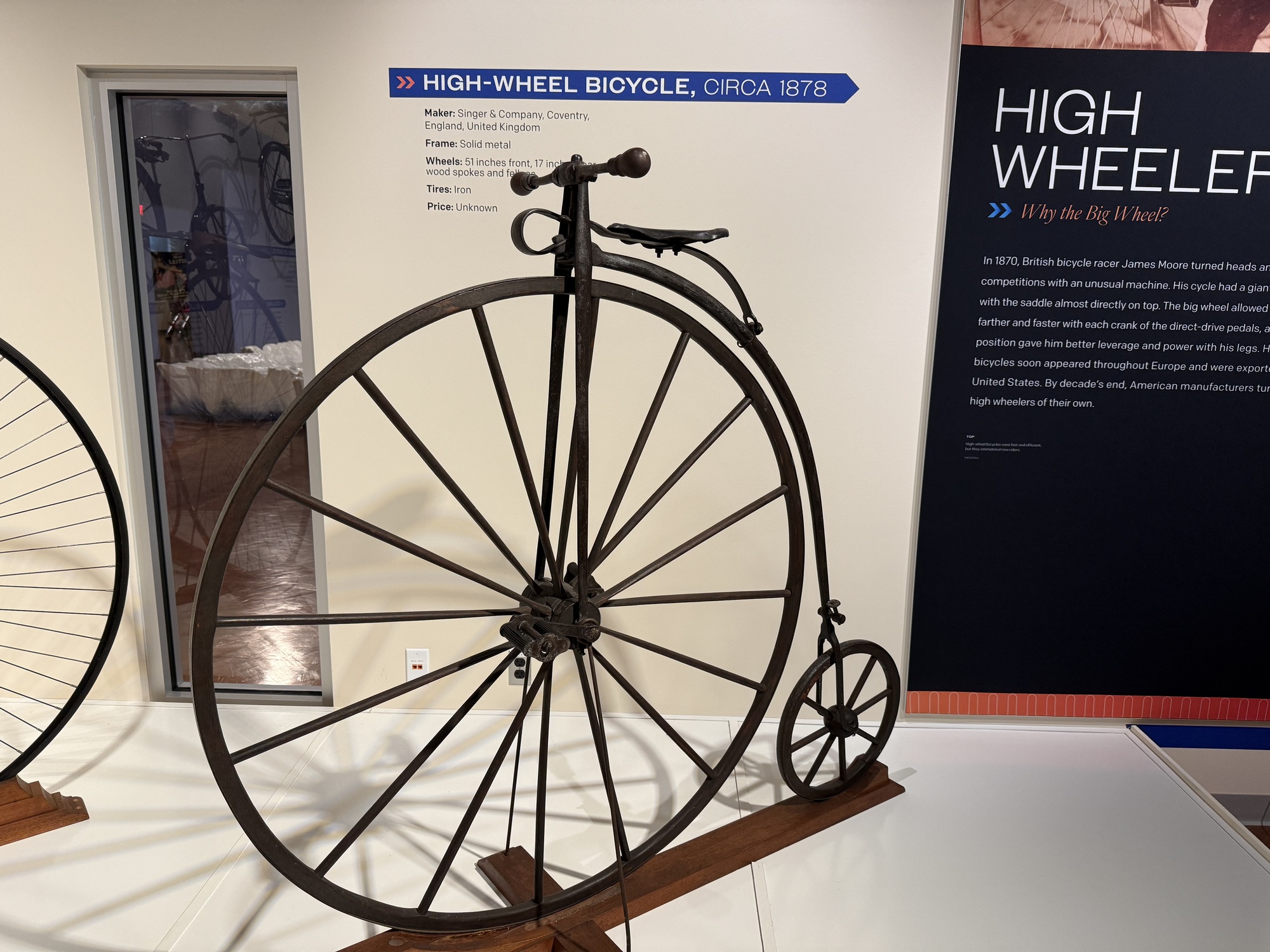
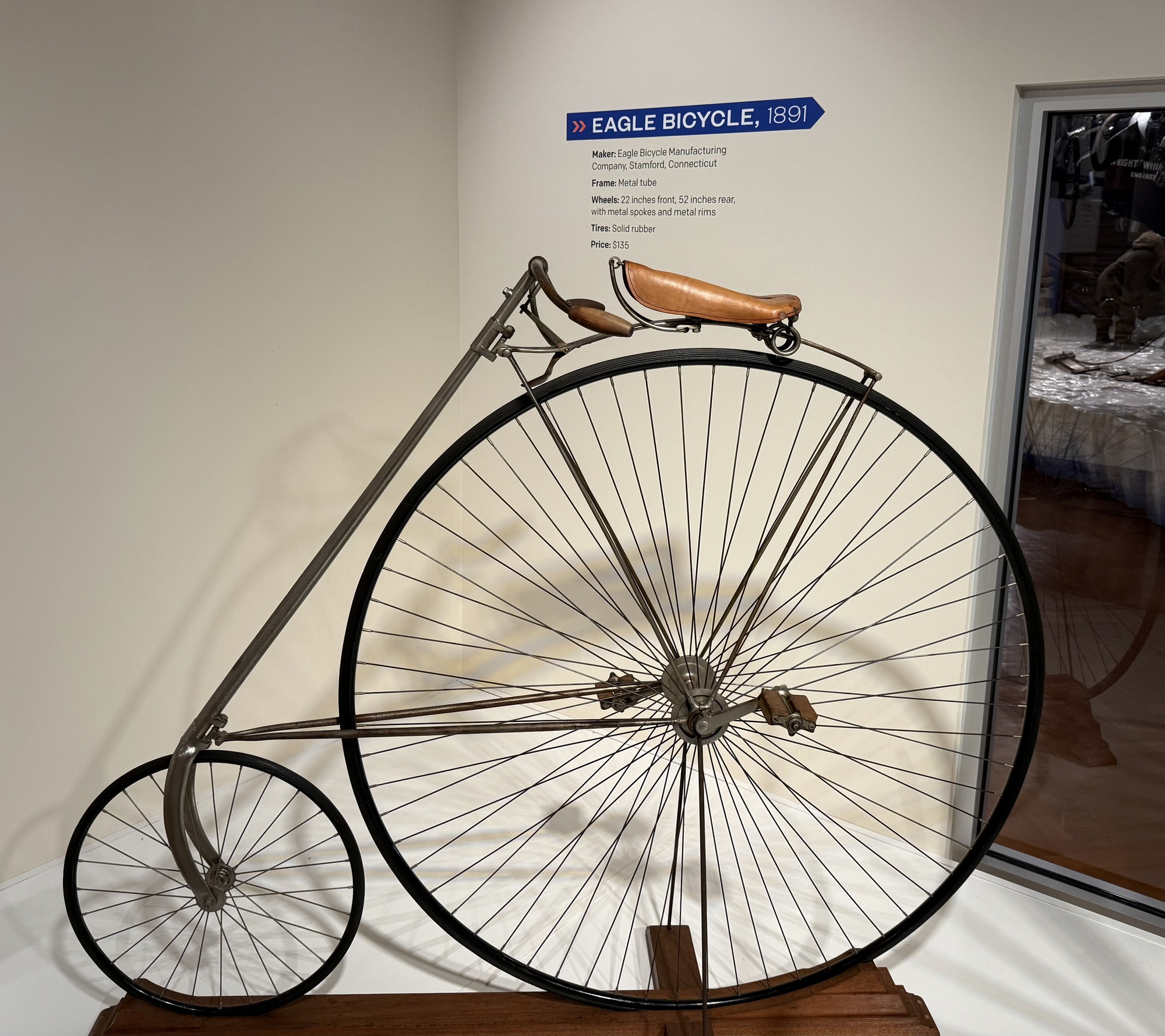
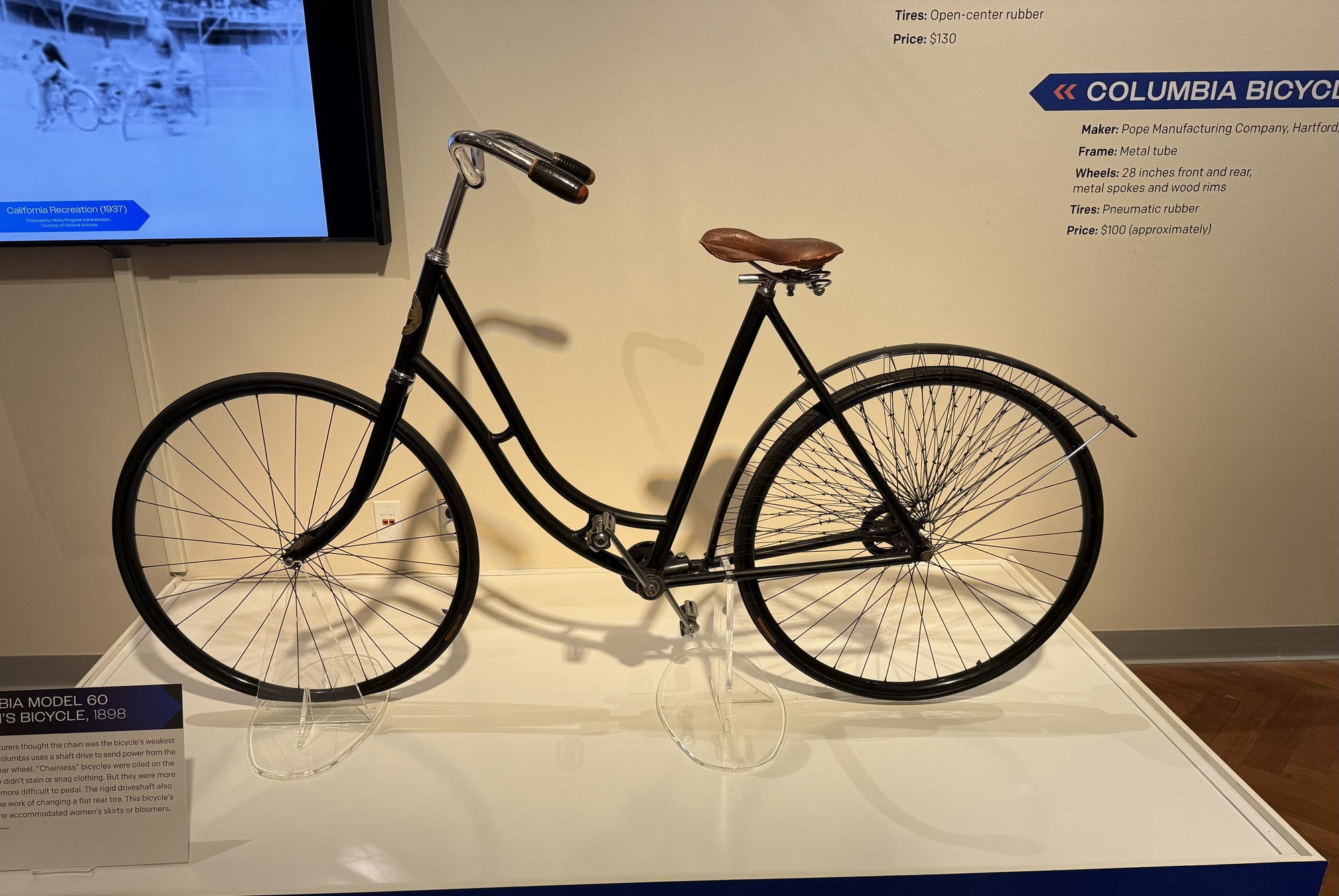
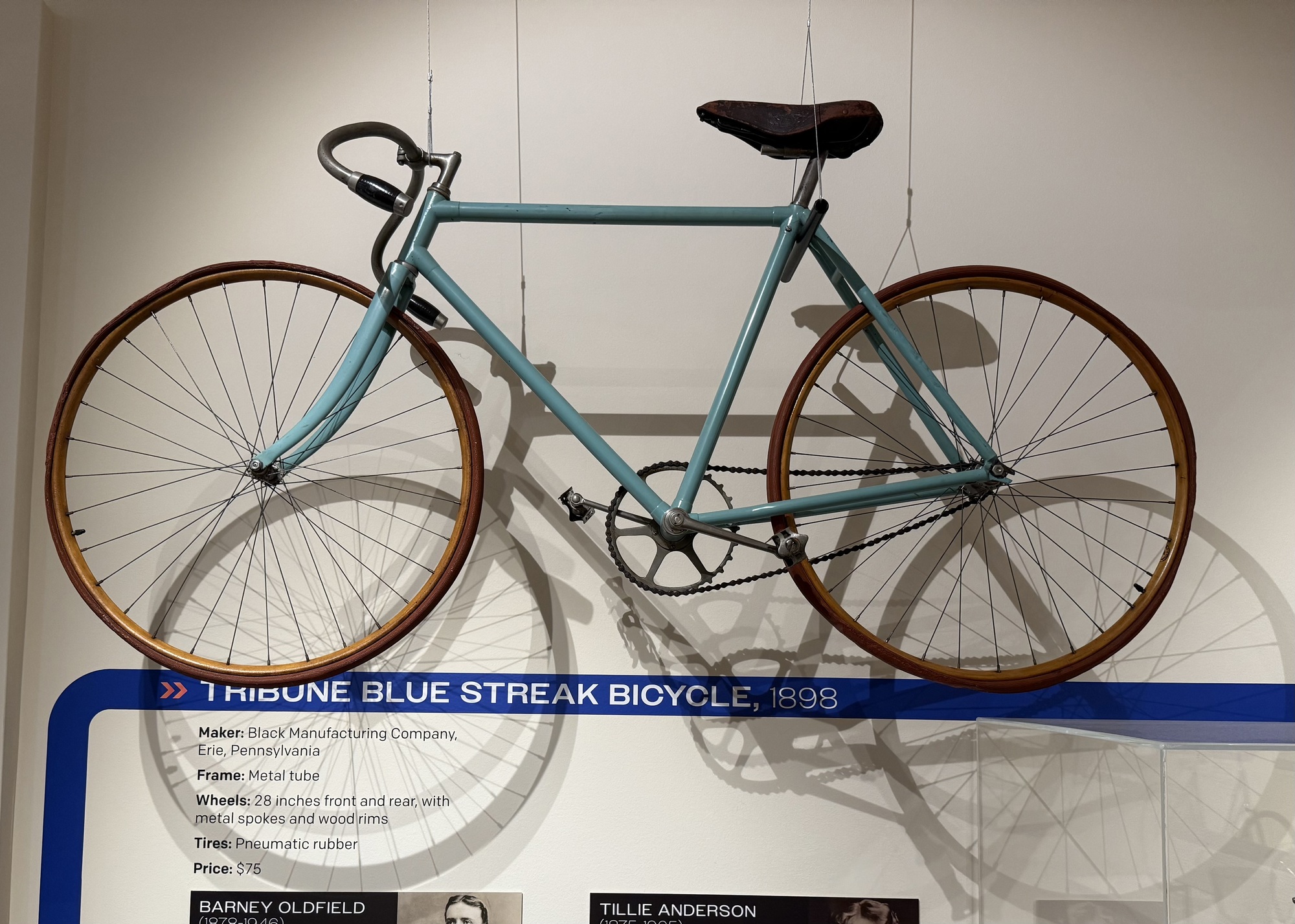
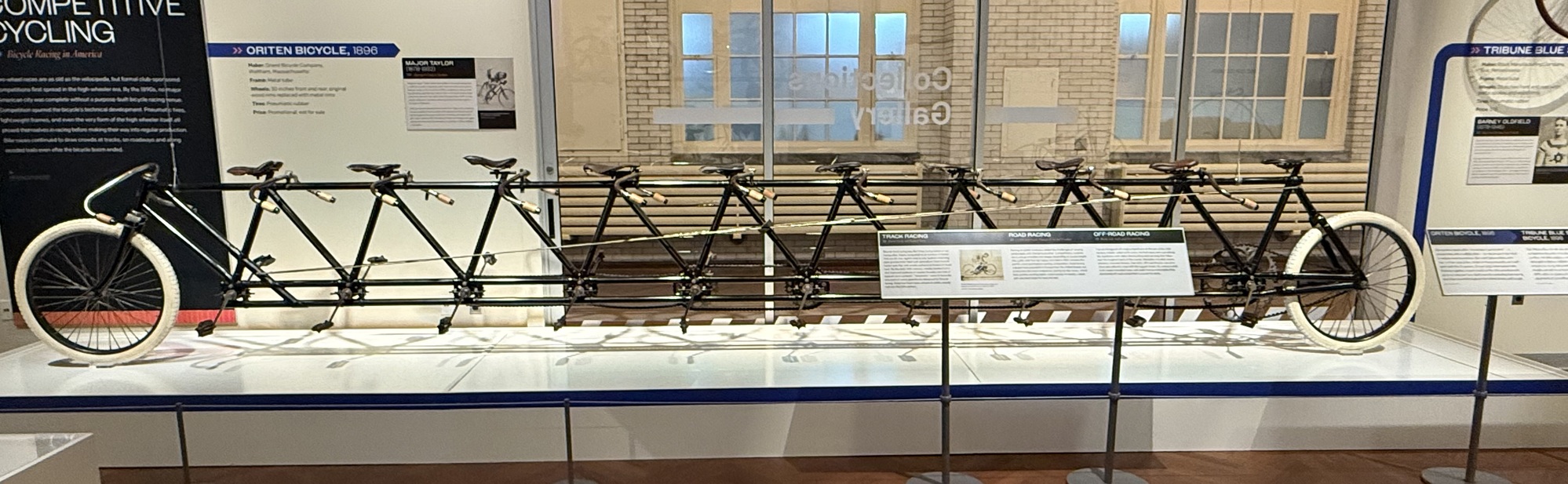
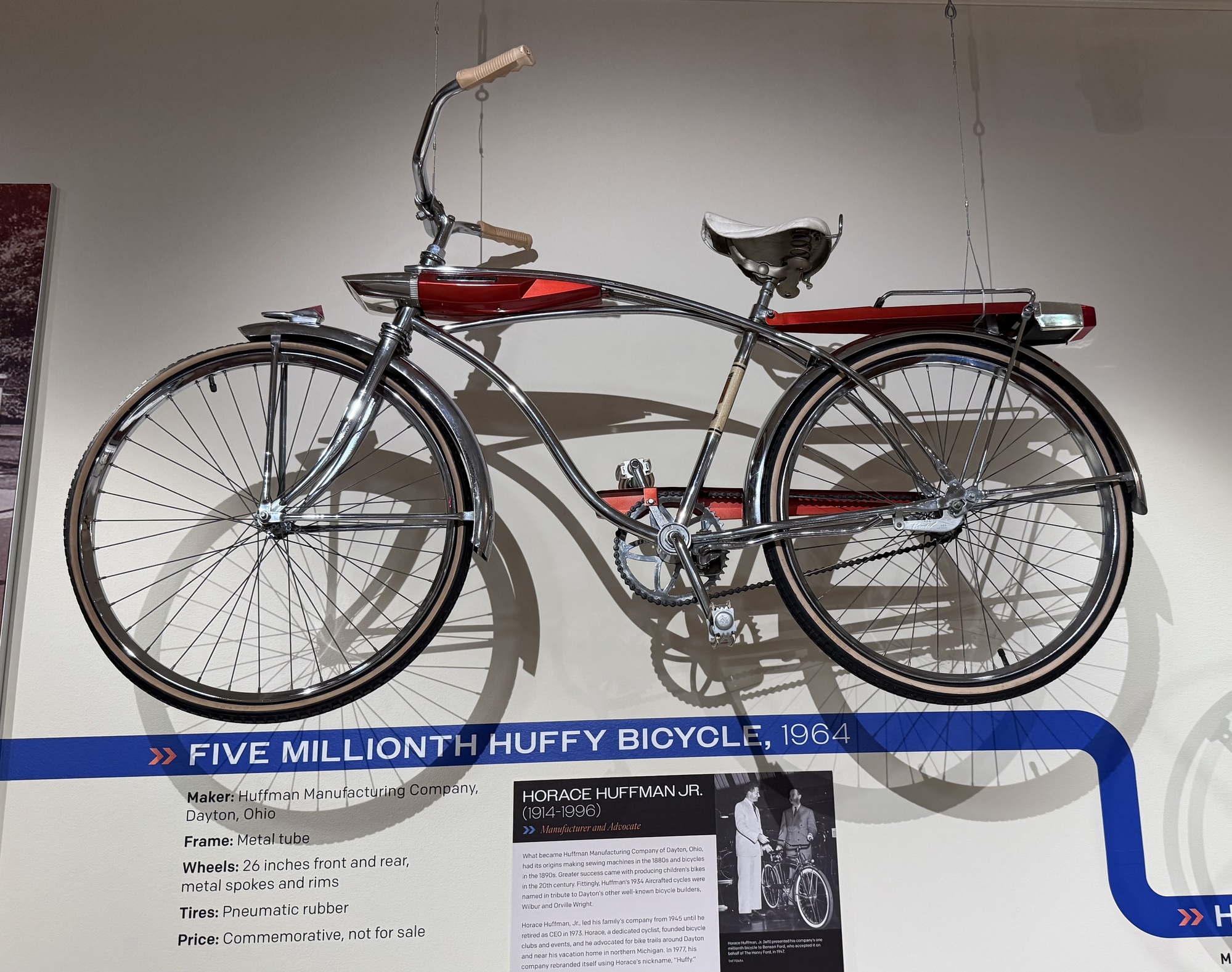
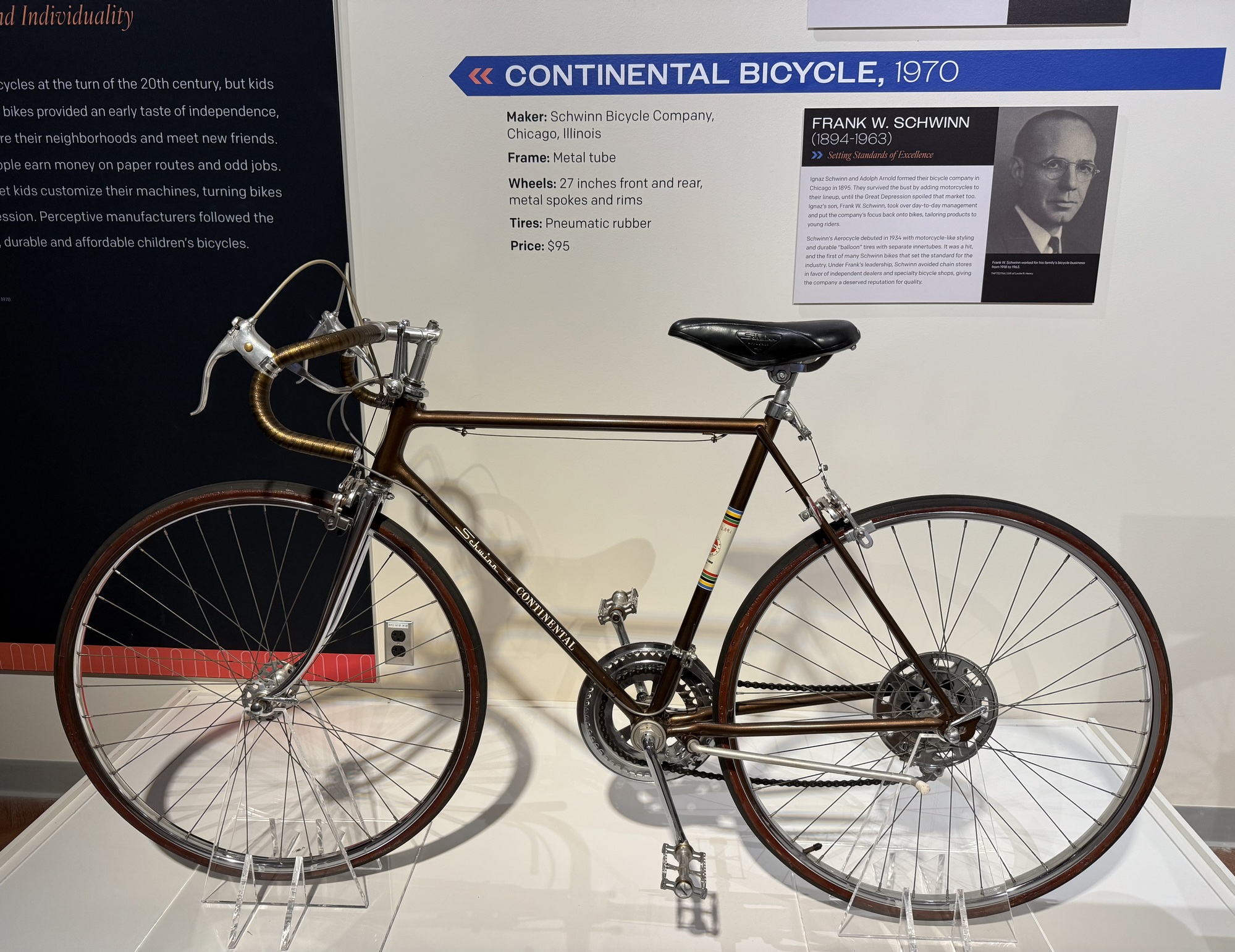
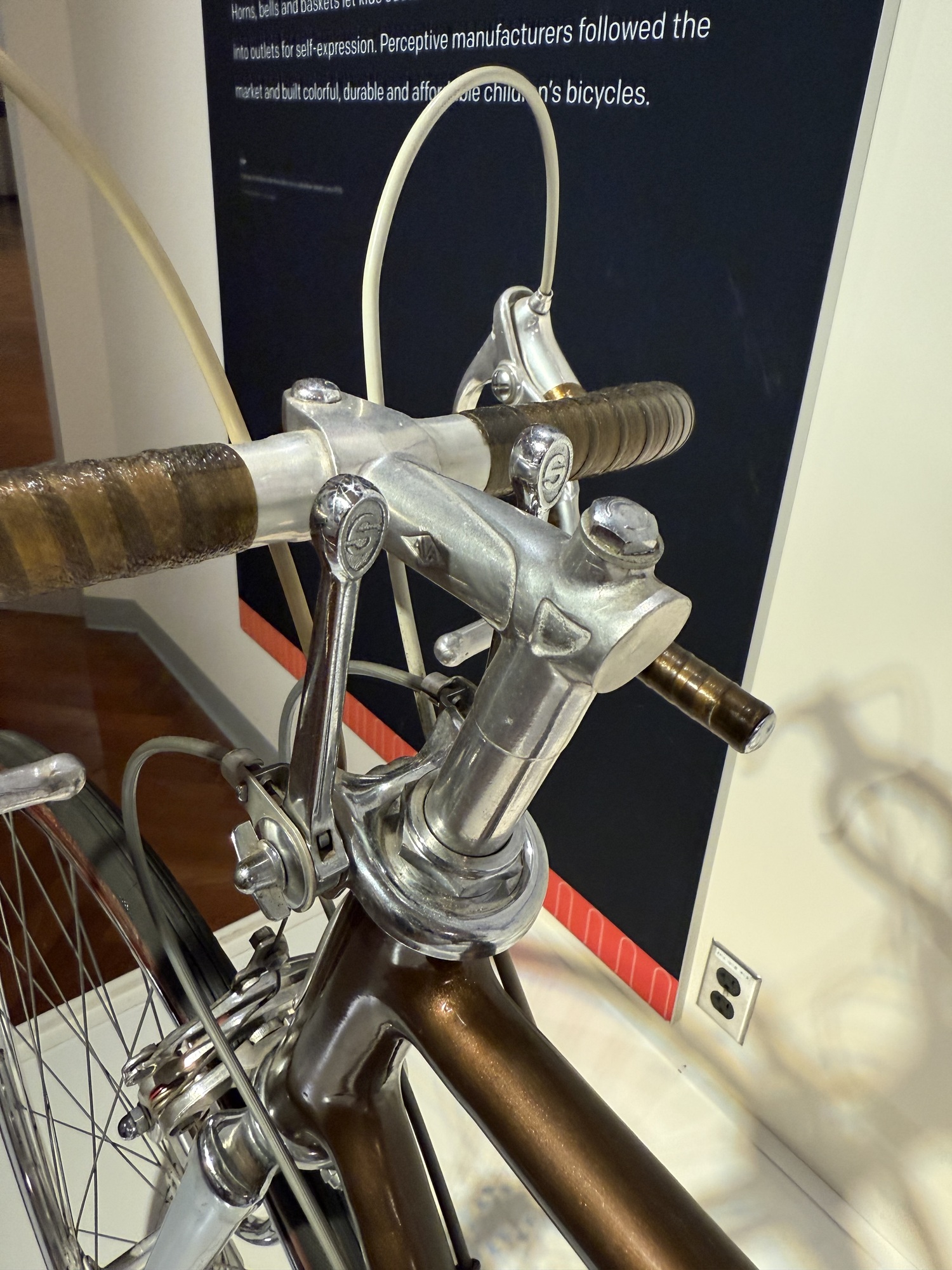
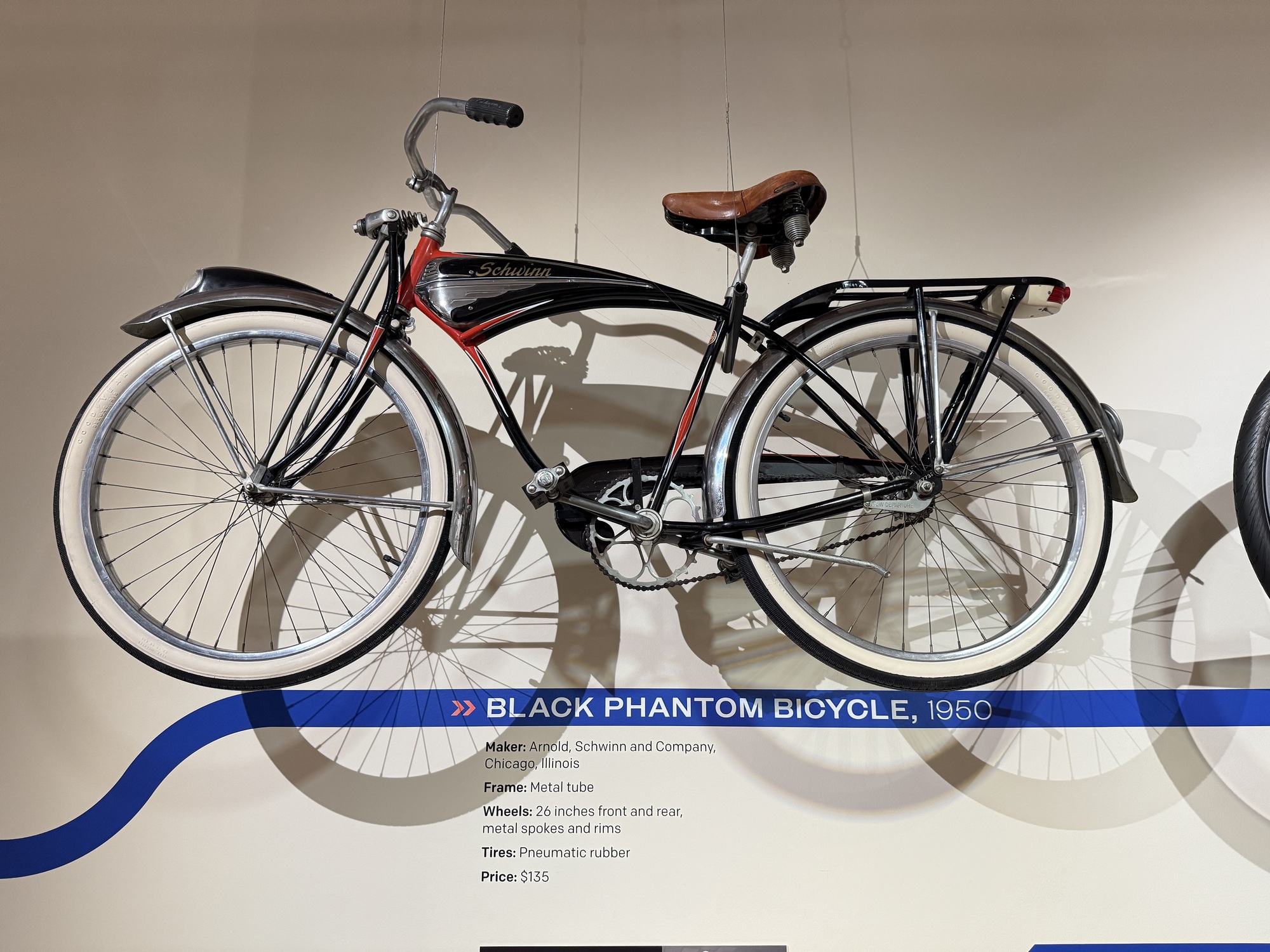
Part of the reason I came to the Henry Ford Museum of American Innovation was to see the Bicycle section.
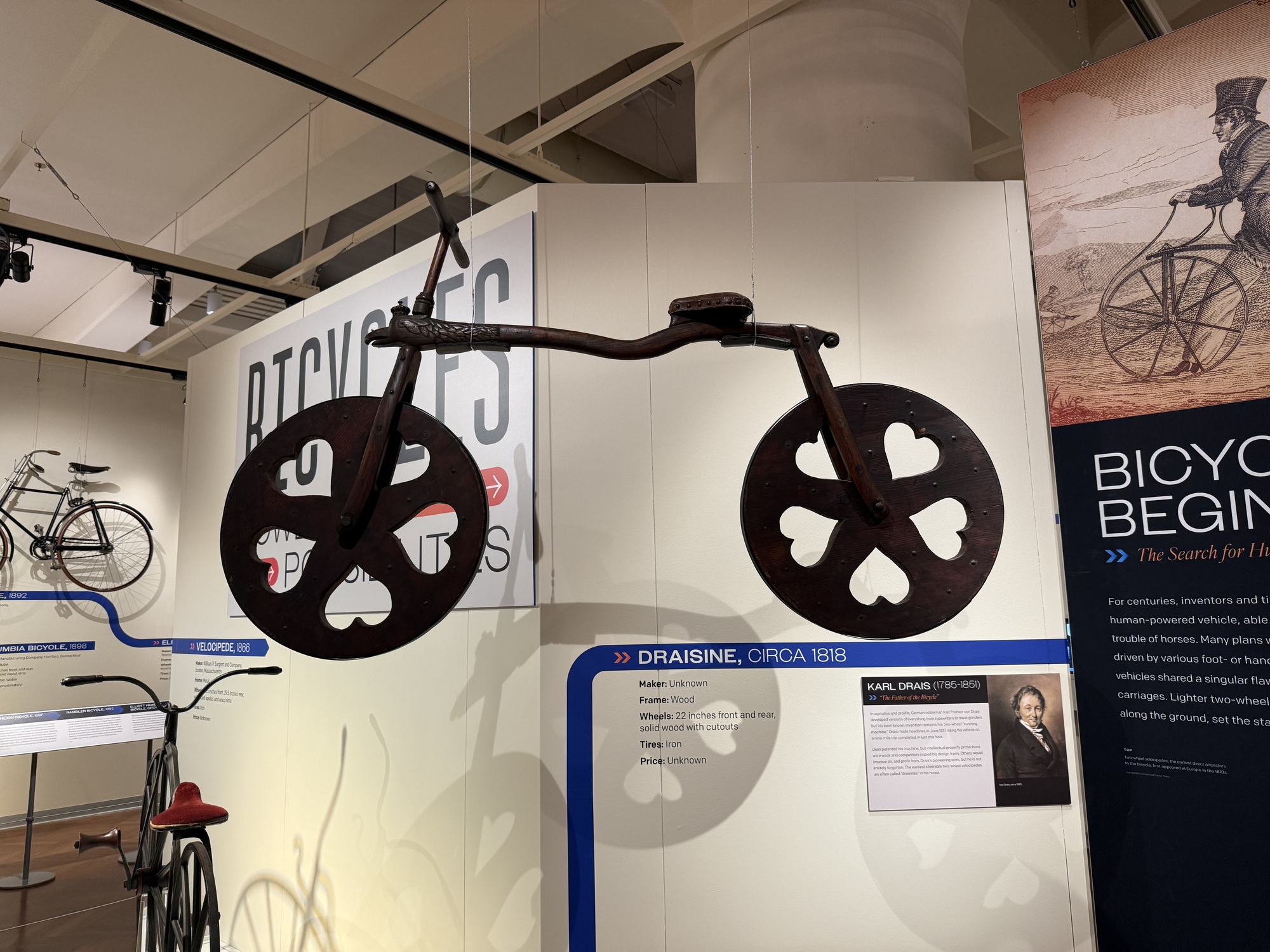
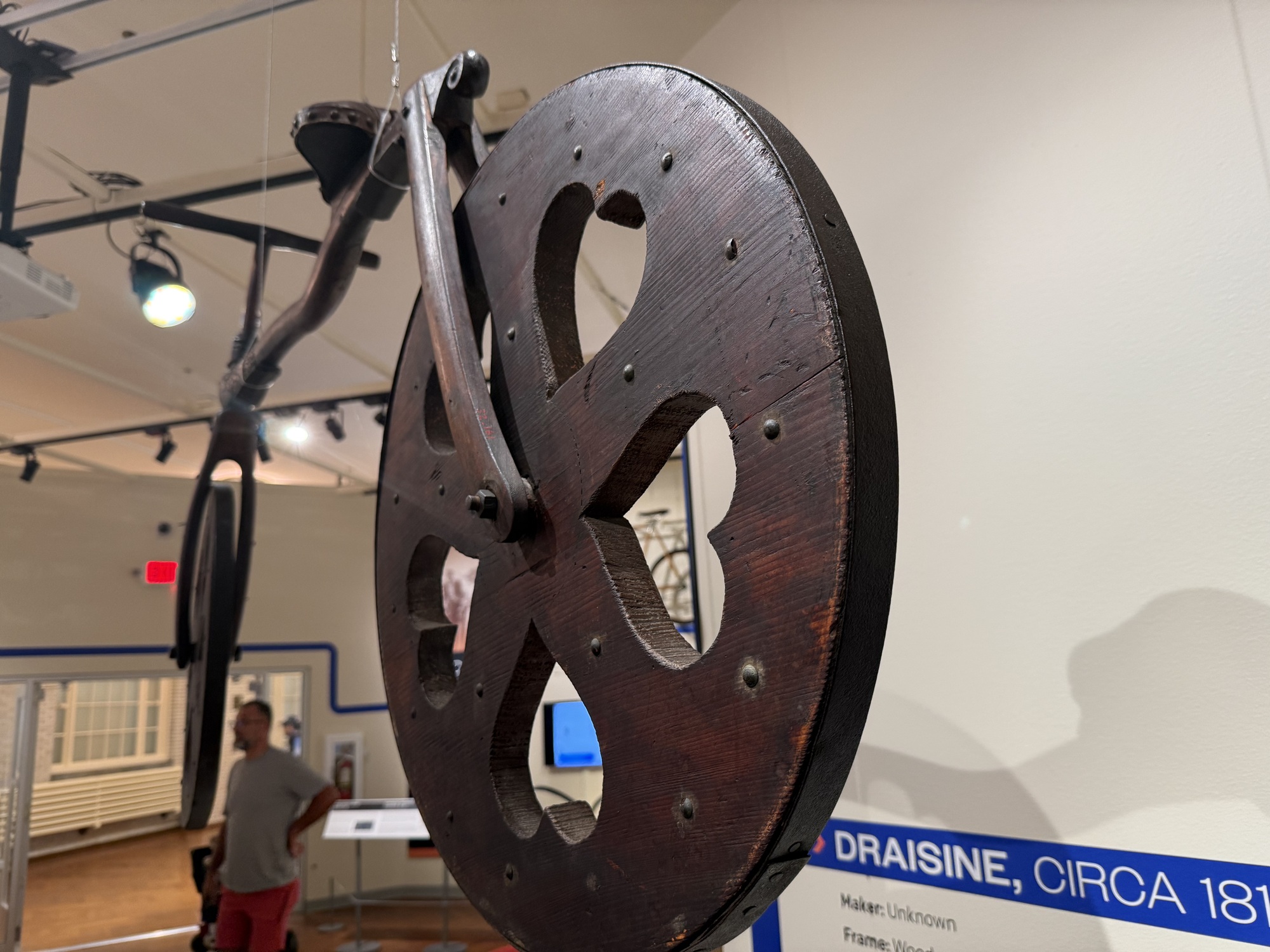
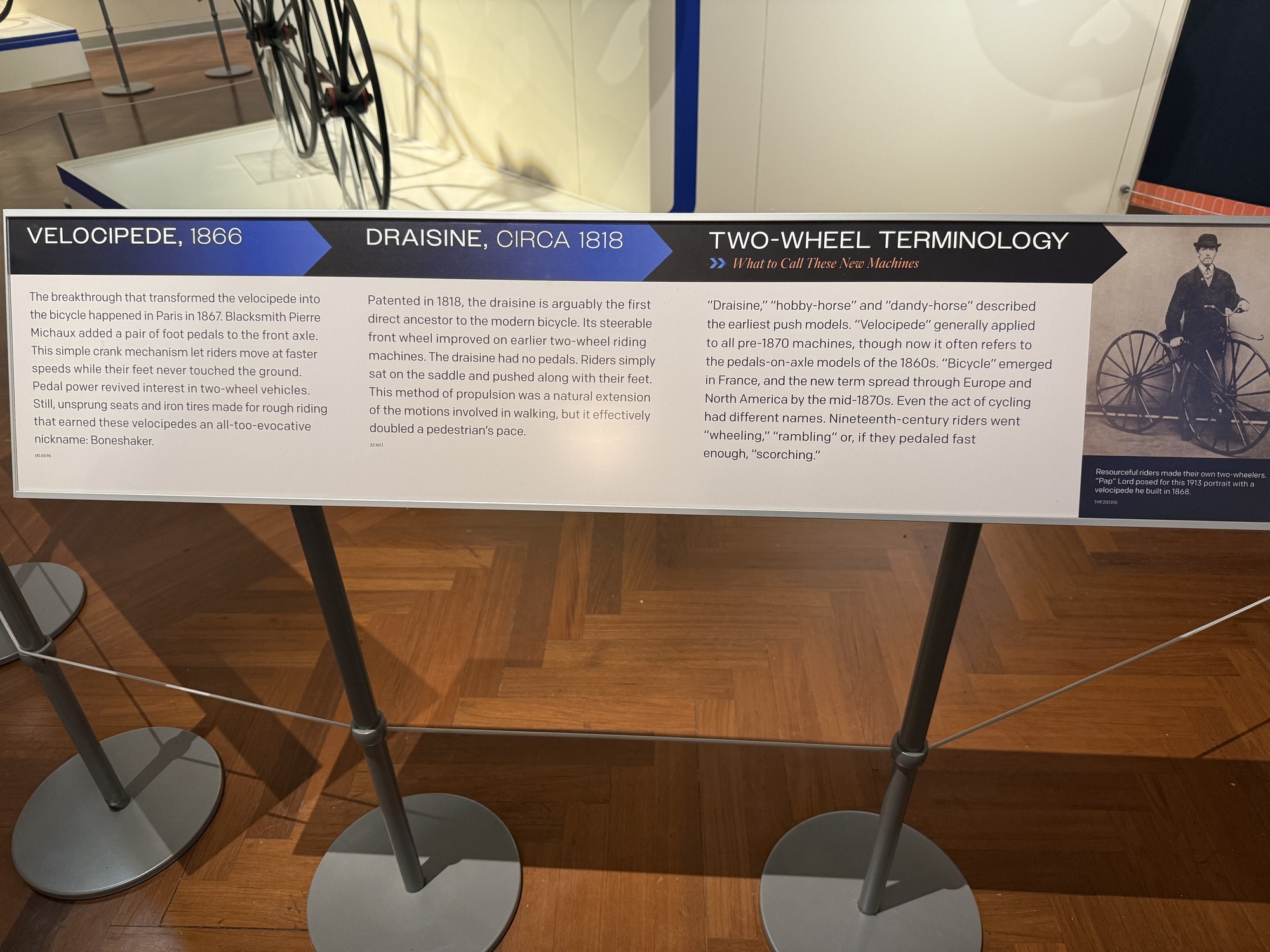
The velocipede, which the inventor Charles Drais called a "running machine," was used as early as 1817. He himself completed a 9-mile course in under an hour, something I'm not sure I can do on my bike today.
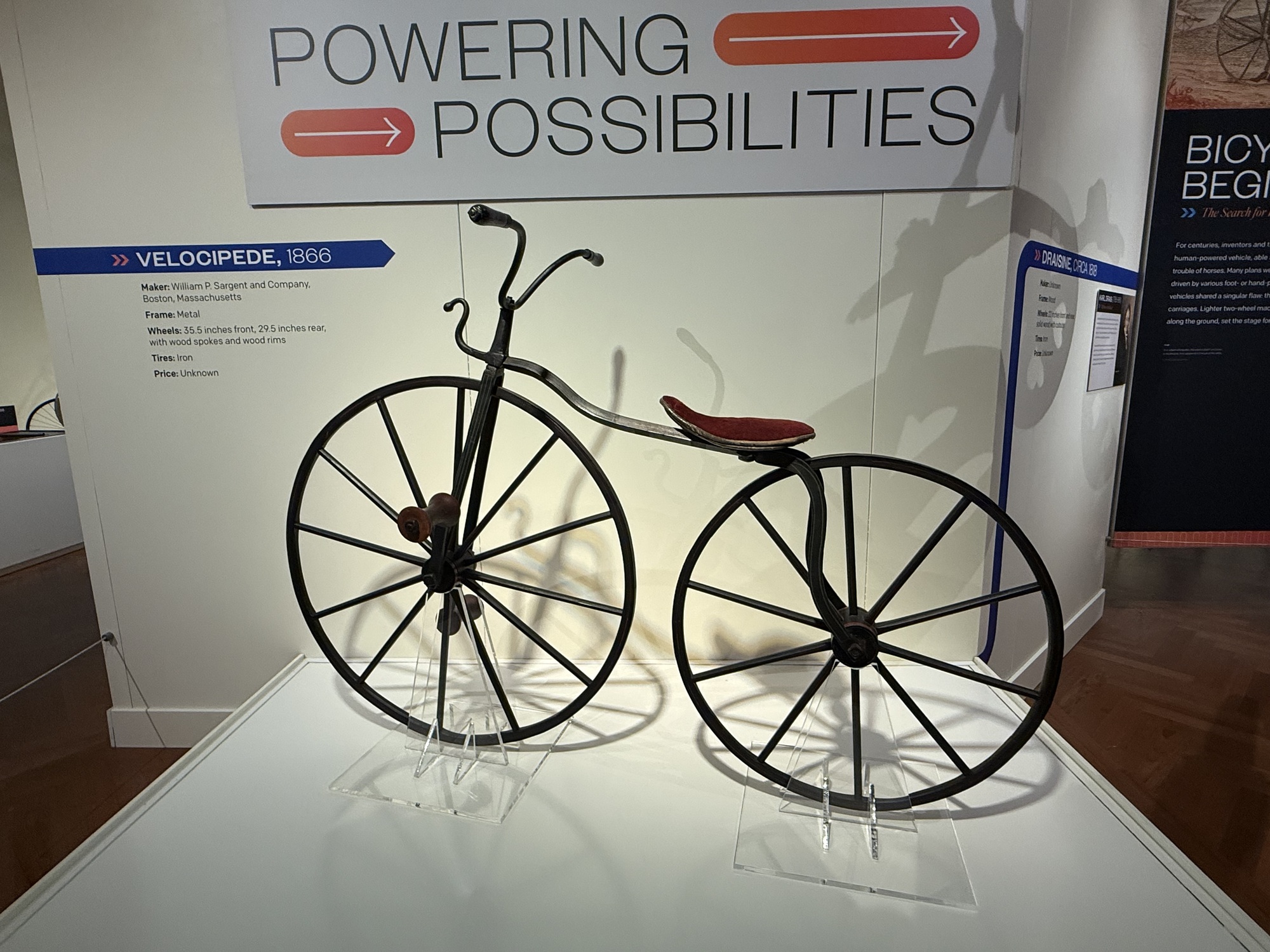
I won't just copy this entire panel, but the breakthrough from a "running machine" to a "bicycle" happened when a blacksmith, Pierre Michaux, added a pair of pedals to the front axle in 1867.
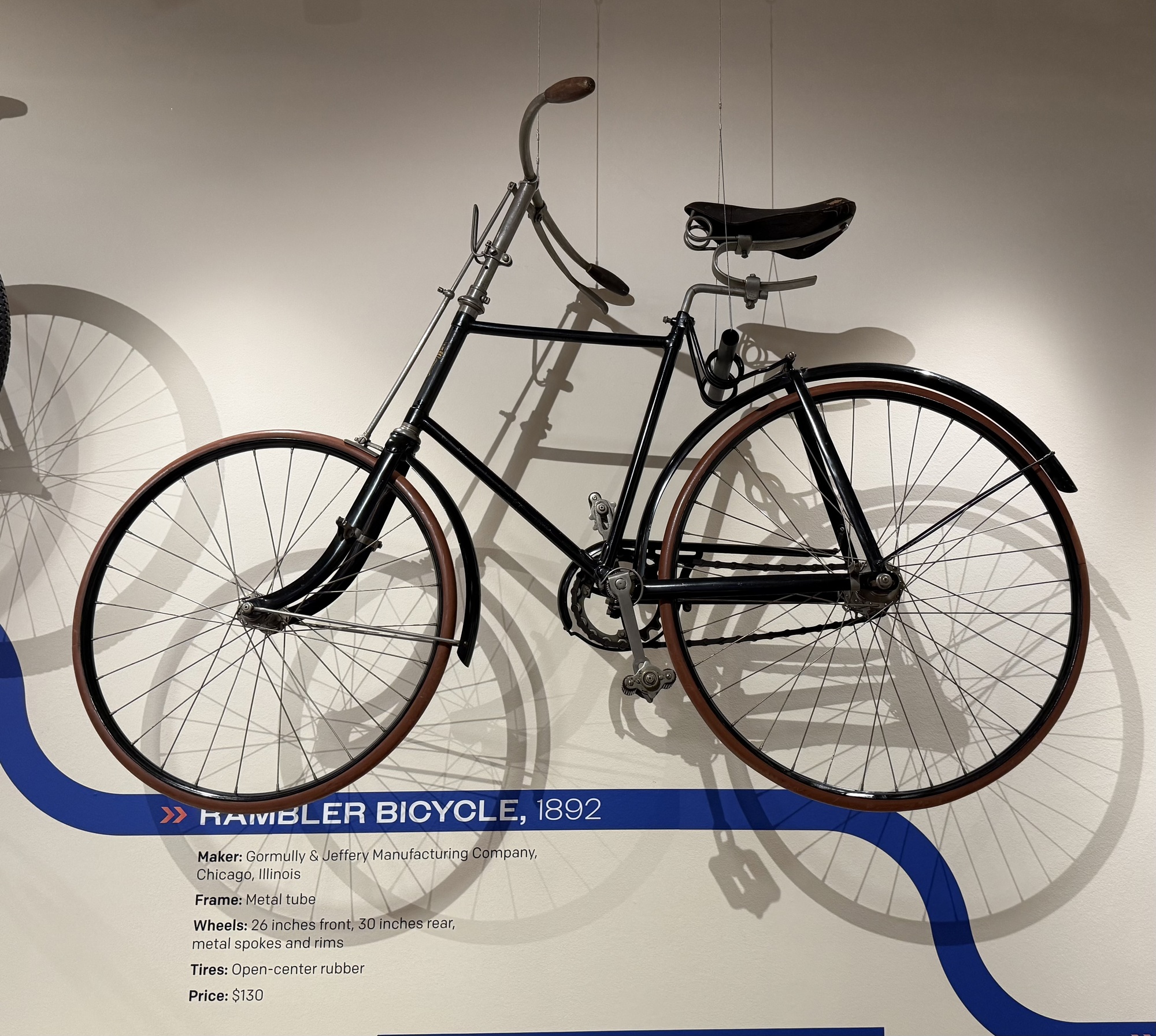
The Rambler has a hinge near the bottom bracket and behind the saddle, allowing a smoother ride. It also has hard rubber tires, all of which made for a smoother ride.
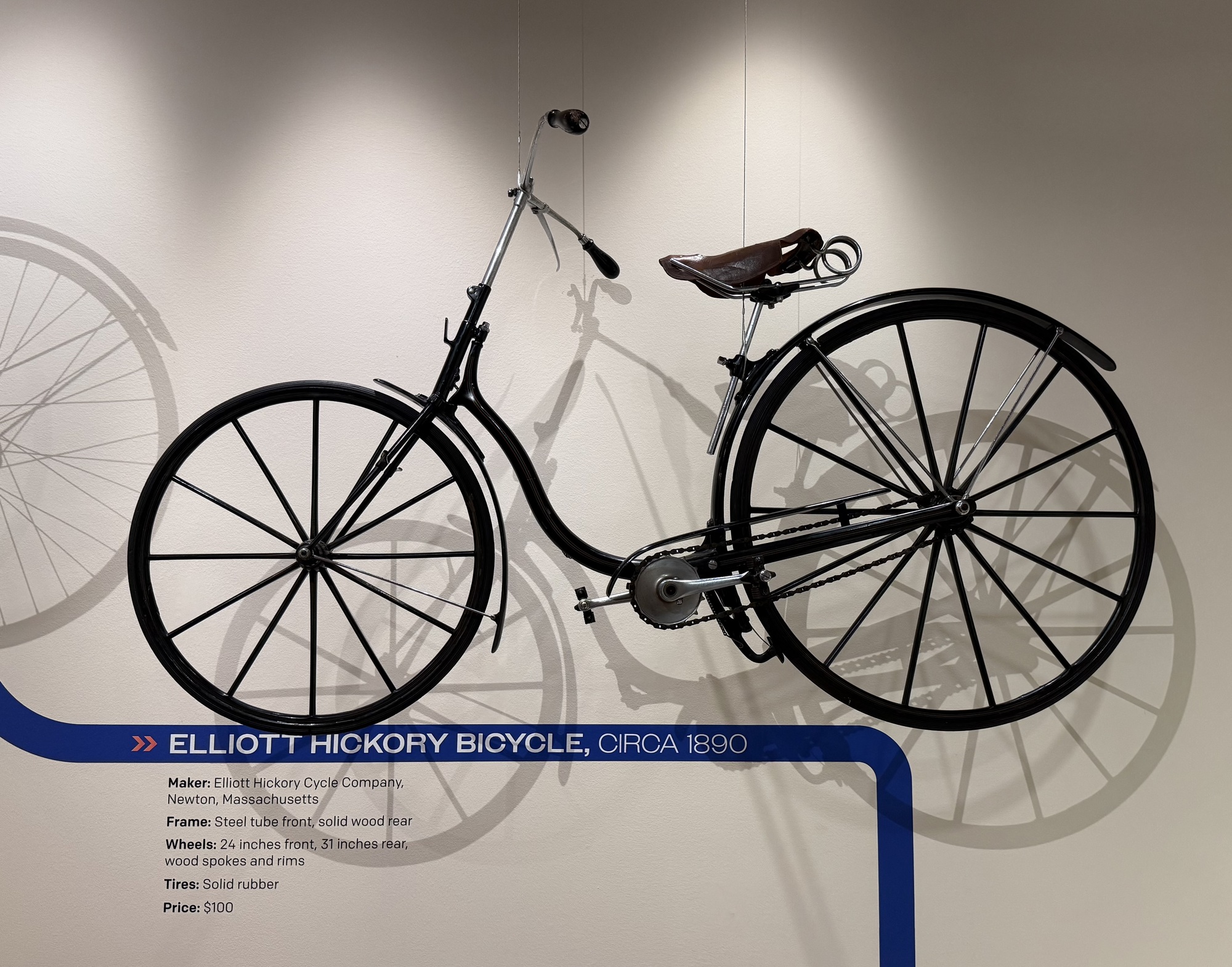
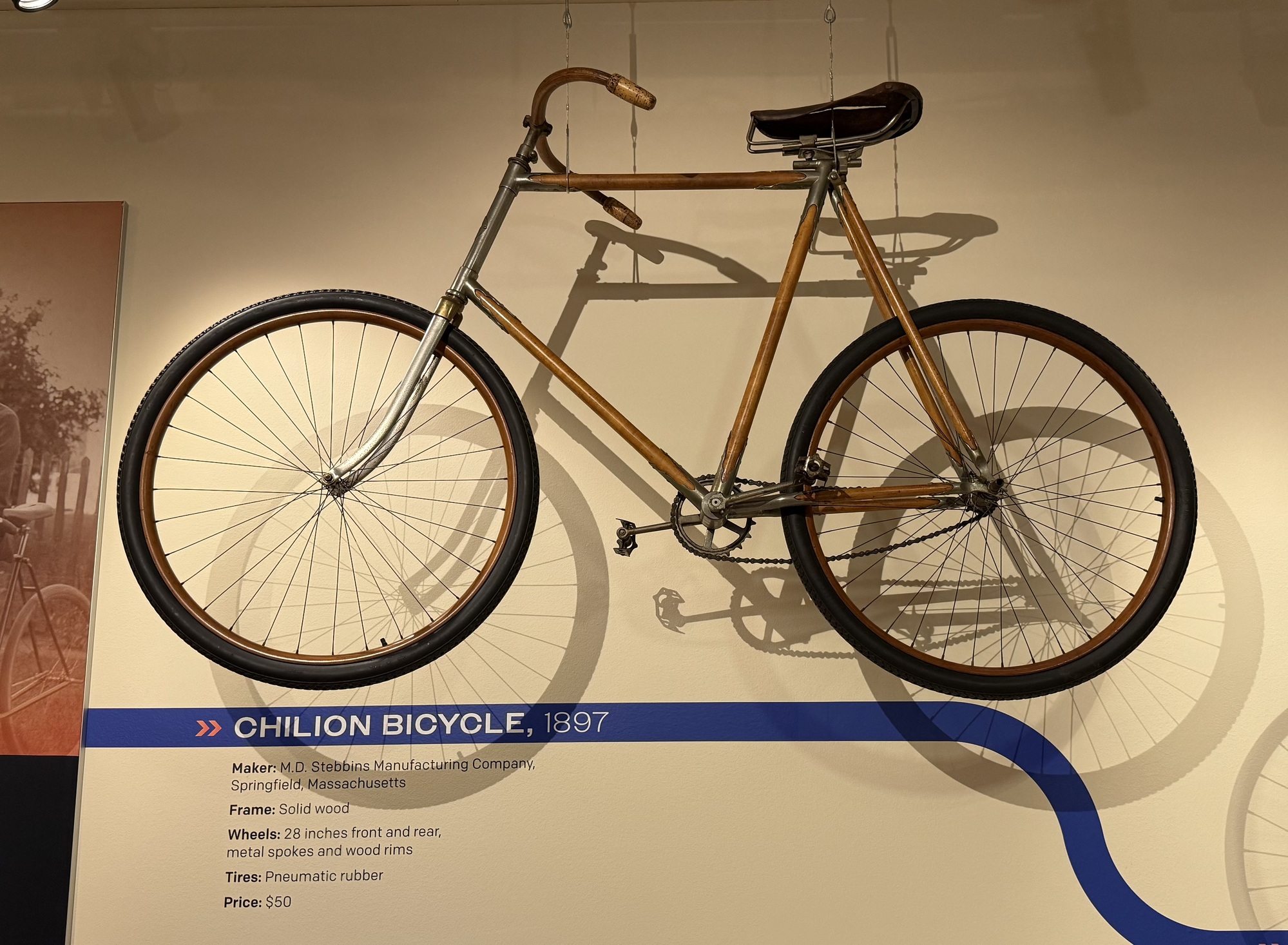
Makers of the Chilion stressed that it has a hickory frame, and therefore wouldn't rust or buckle like others made at the time. It has no brakes, and the crank doesn't freewheel, so the rider has to backpedal in order to stop. It's also one of the first bikes to have air-filled tires, which offered a more comfortable ride but were easily punctured.
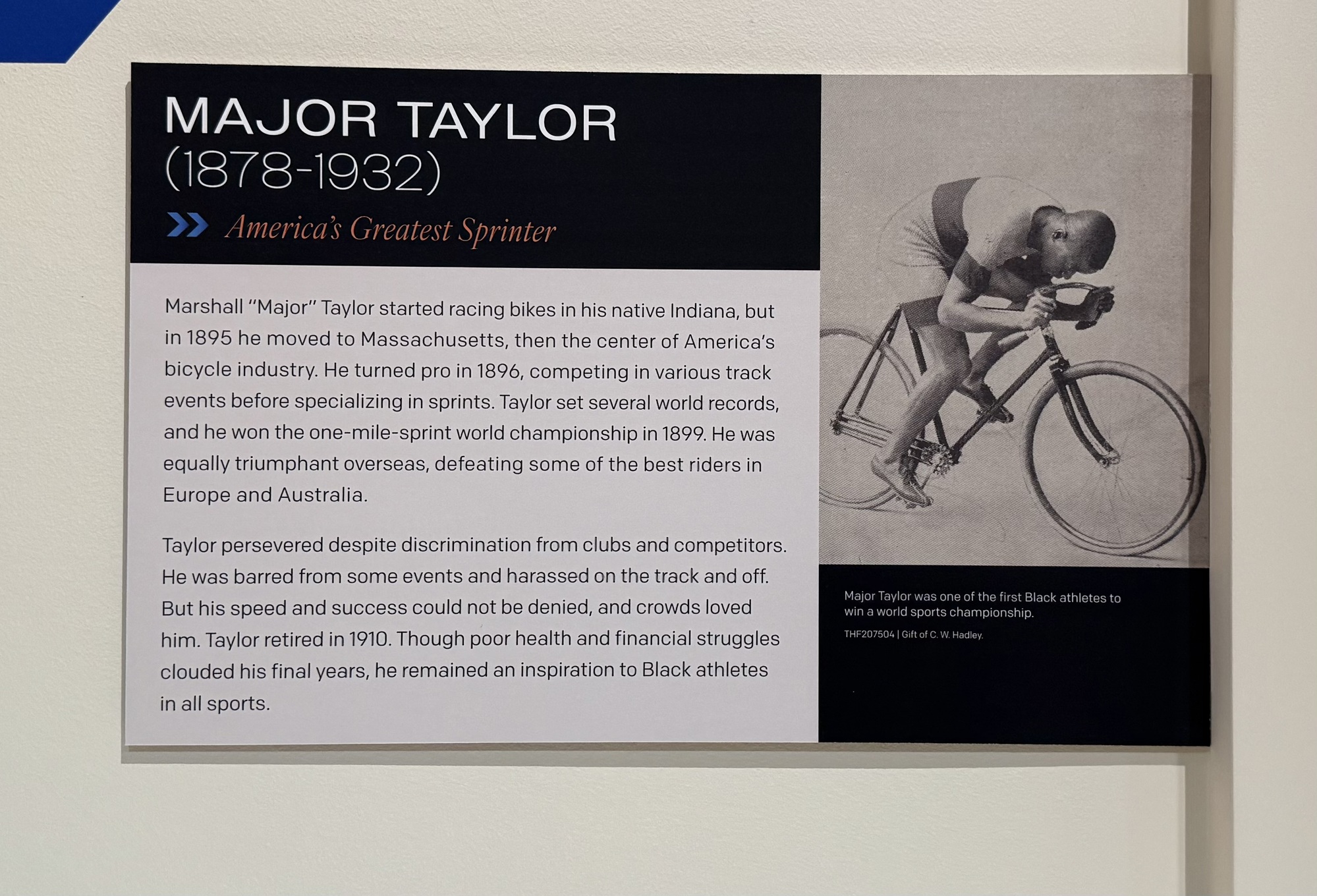
I wanted to add this poster because I'm a fan of Major Taylor. When he was 13 years old, he worked at the Hay & Willits bicycle shop, performing cycling stunts in order to promote bicycle sales. Mr. Hay, his employer, insisted that Taylor compete in a 10-mile handicapped road race organized by his store, thinking that watching this black kid "race" would be entertaining to the crowd. Never having raced before, Taylor was reluctant, but his boss insisted and, despite his lack of experience, won the race by six seconds, collapsing from exhaustion after crossing the finish line and receiving his first gold medal. This victory set the stage for his remarkable career in professional cycling.
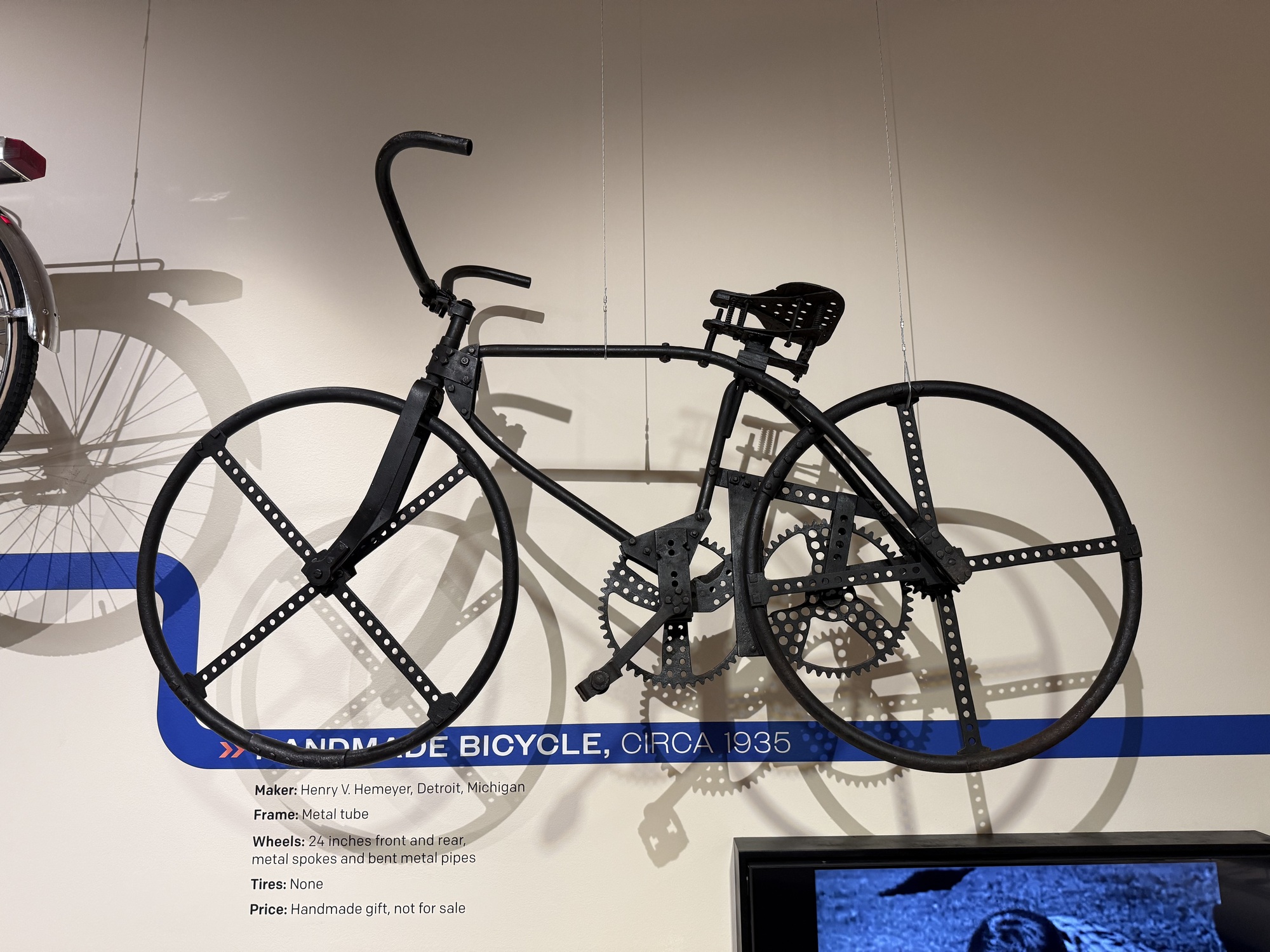
This bicycle is made from galvanized water pipe and flat steel, shaped with an electric drill, a hacksaw, and files. There are no welds or brazed joints, and the 70-pound bike is held together with nuts and bolts. Instead of a chain, gears power the rear wheel. Having no money to purchase a bicycle, Henry Hemeyer crafted this gem for his son after being laid off during the Great Depression.
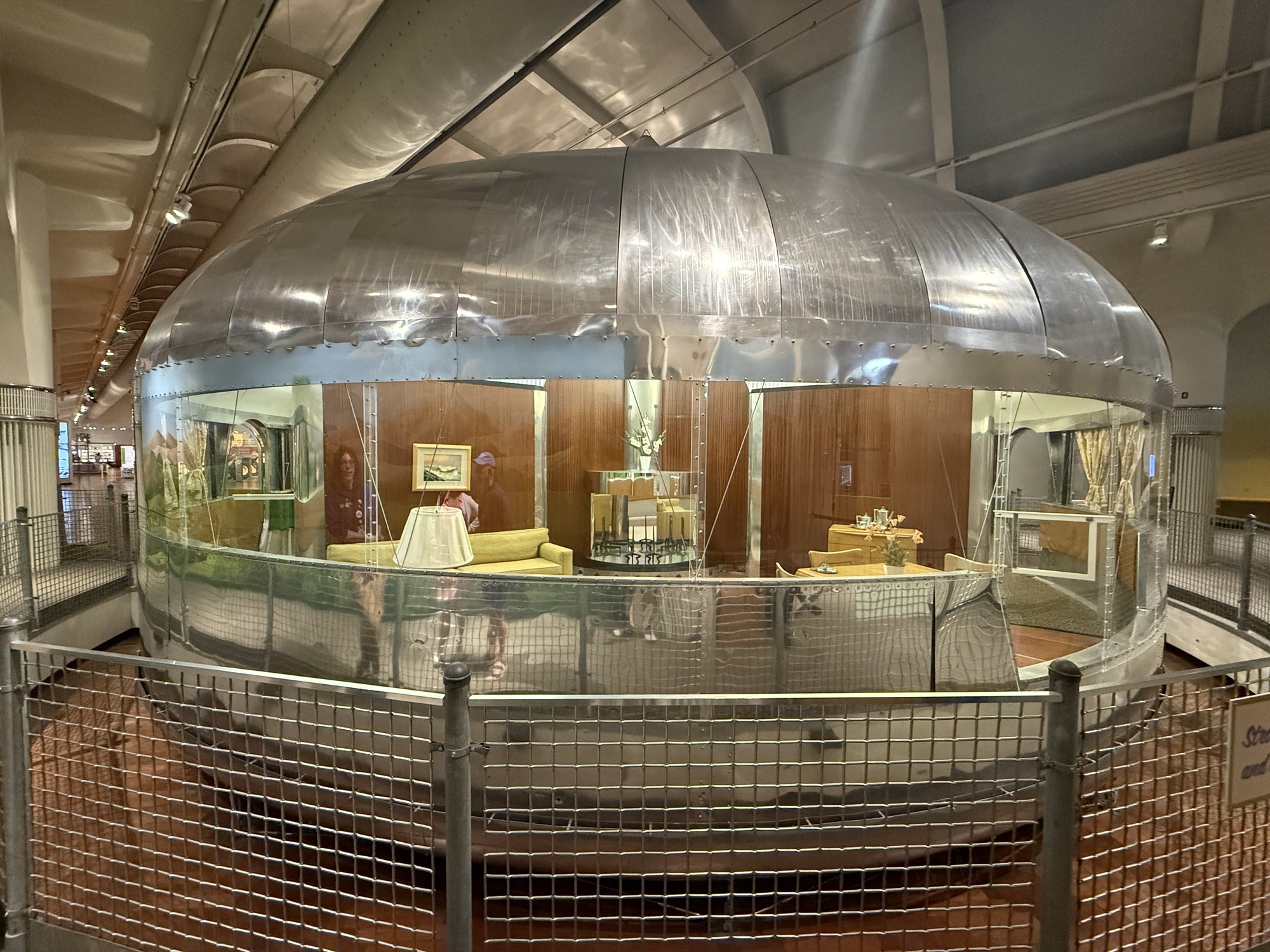
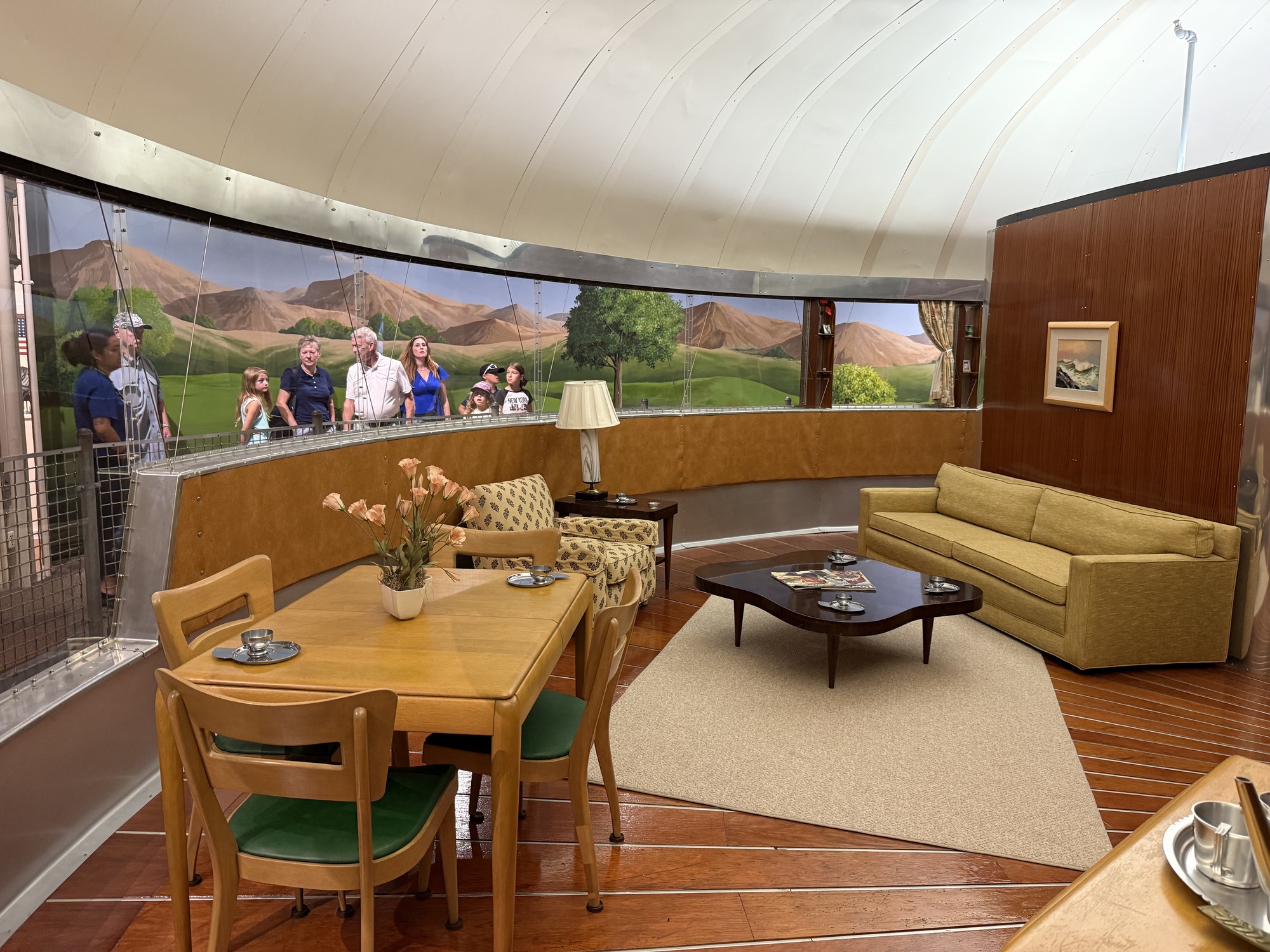
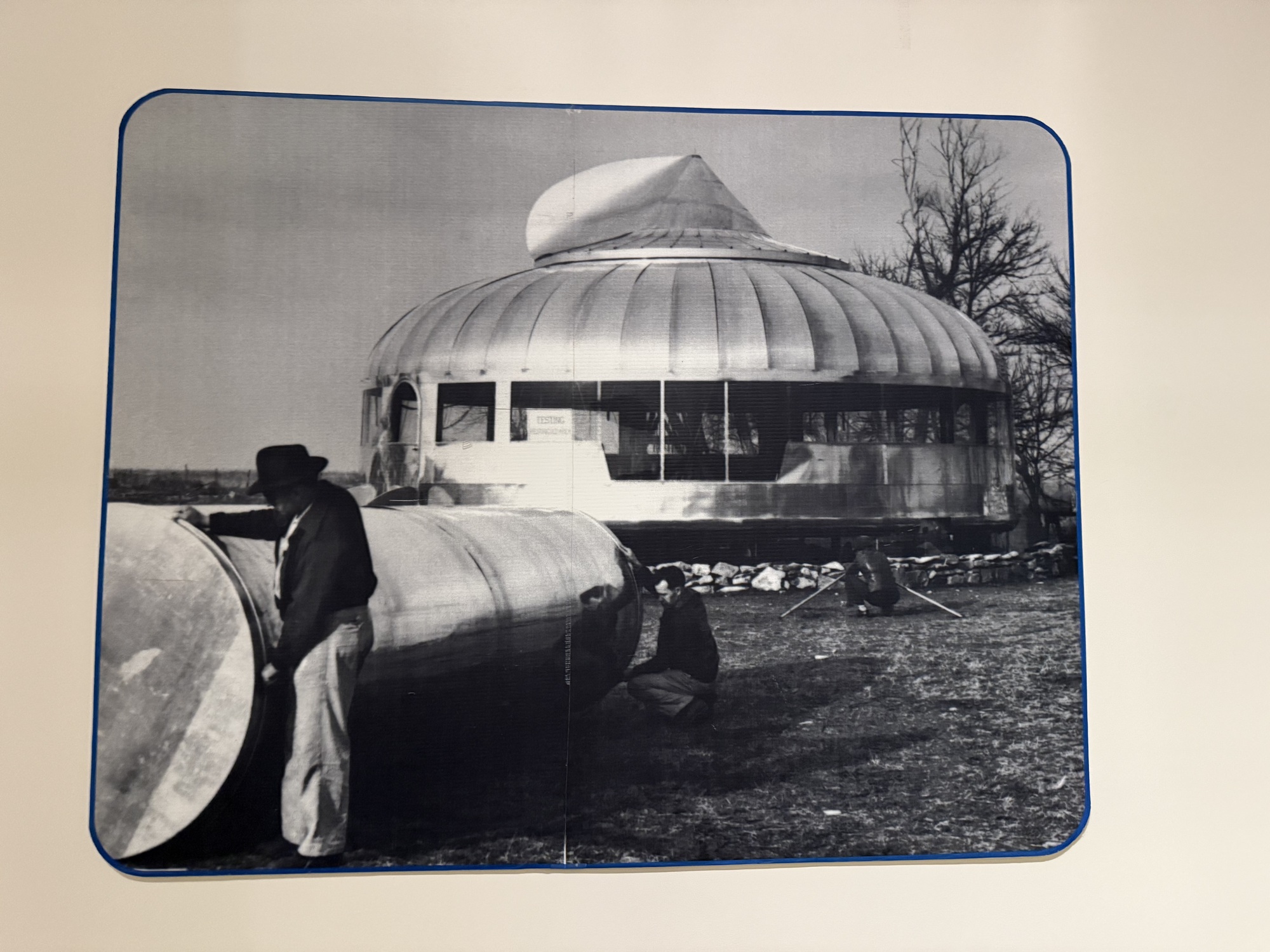
I'm only including a few pictures of the Dymaxion House, of which only two were built. Although the house and its story are fascinating, the pictures are flat and uninteresting.
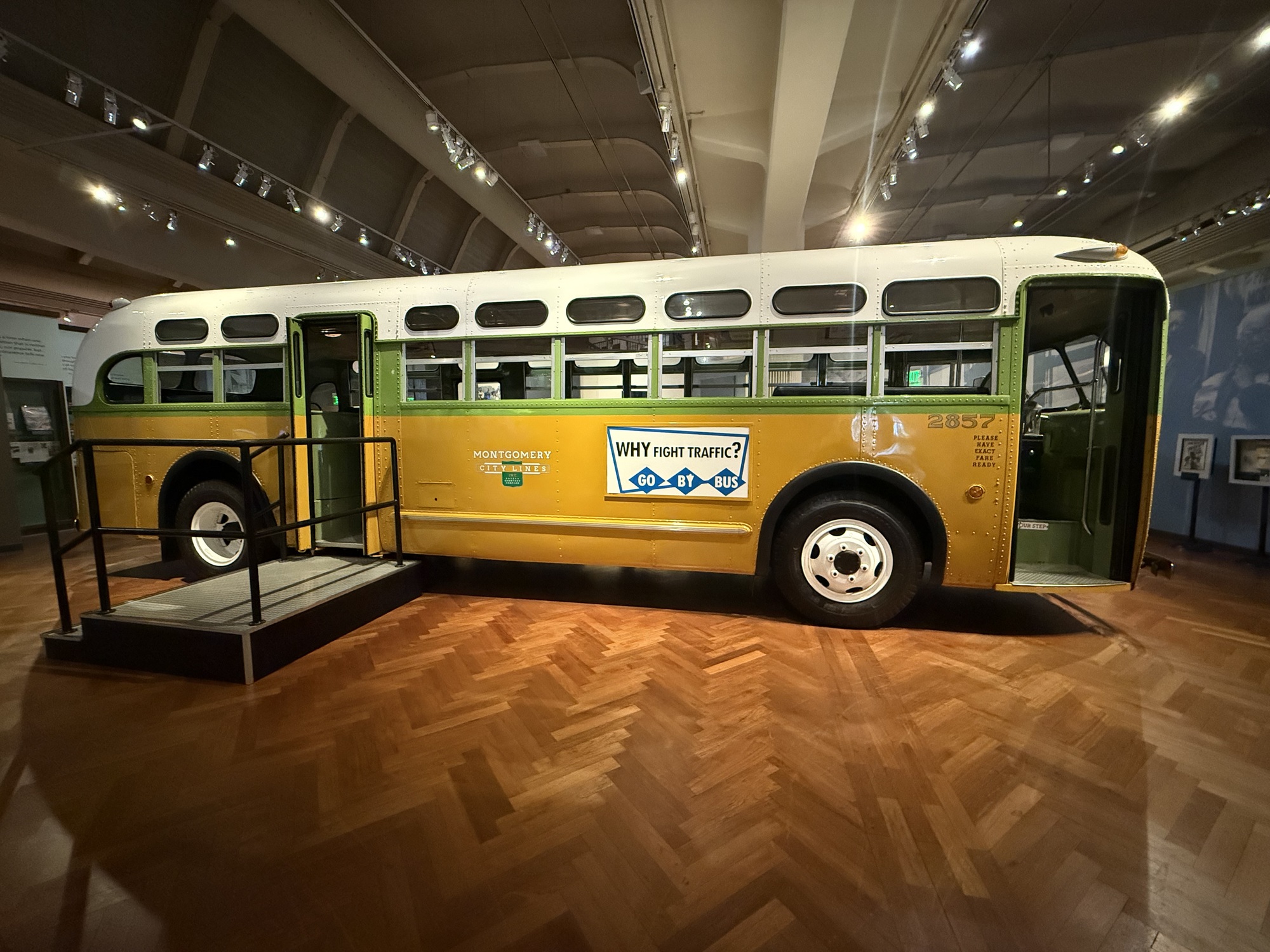
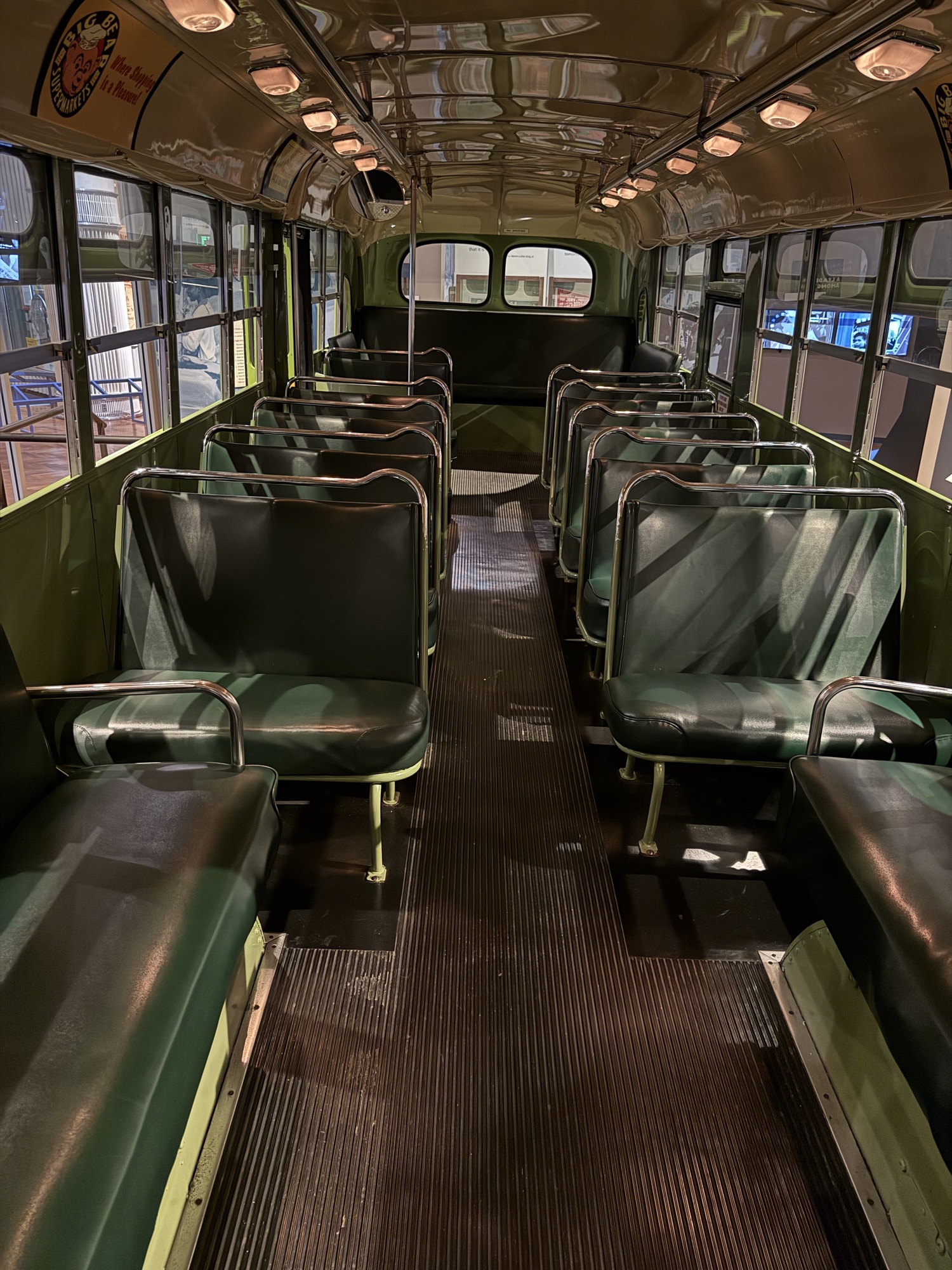
Rosa Parks refused to move to the back of this very bus, sparking the Montgomery Bus Boycott which lasted for 381 days and became a pivotal event in the American Civil Rights Movement.
I was expecting the Henry Ford Museum to be all about cars, with some biographical information about Henry, and a lot of Ford vehicle promotion. I was quite wrong. My time spent there was interesting and, I believe, worth the $45.00 cost.
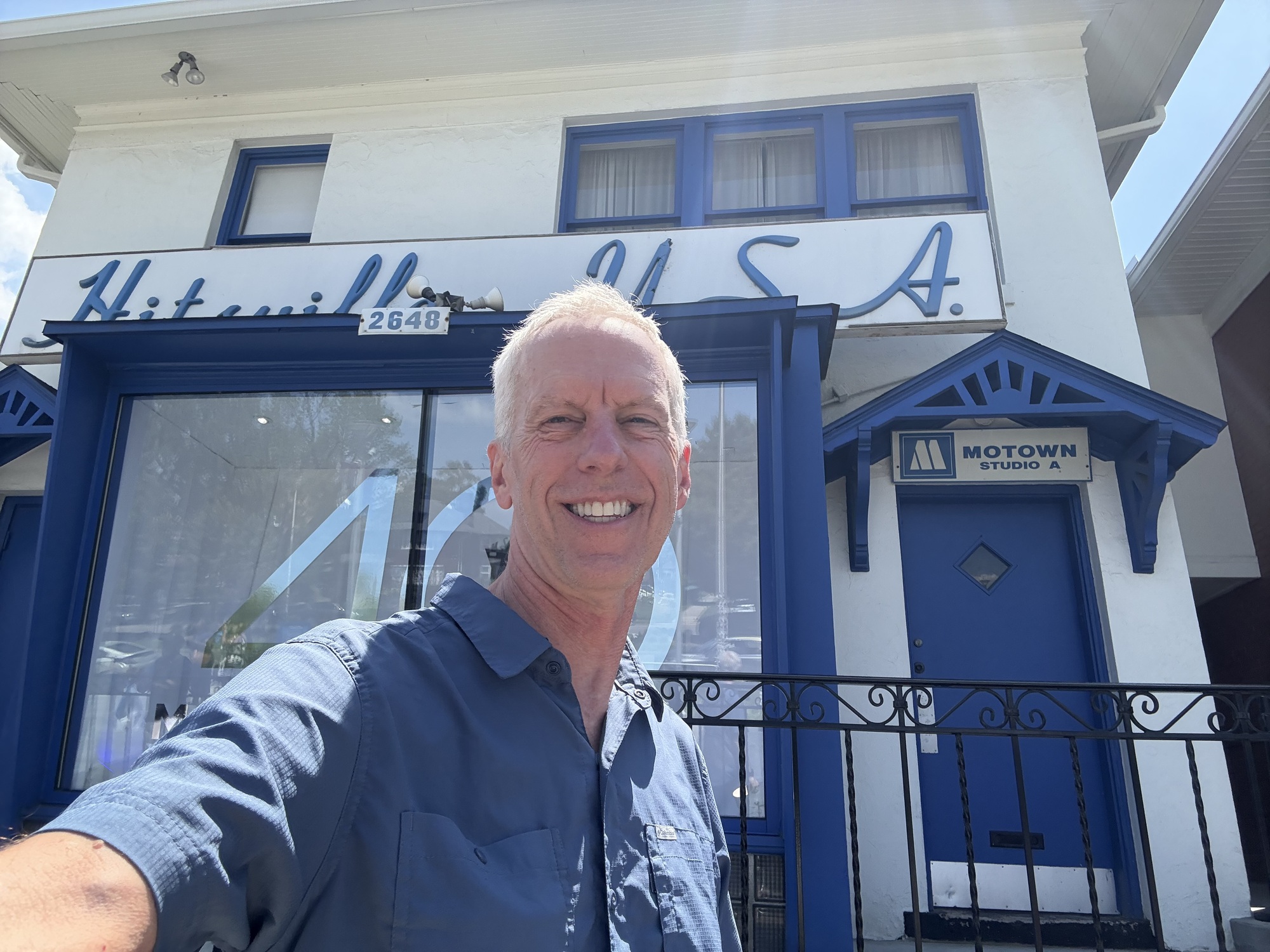
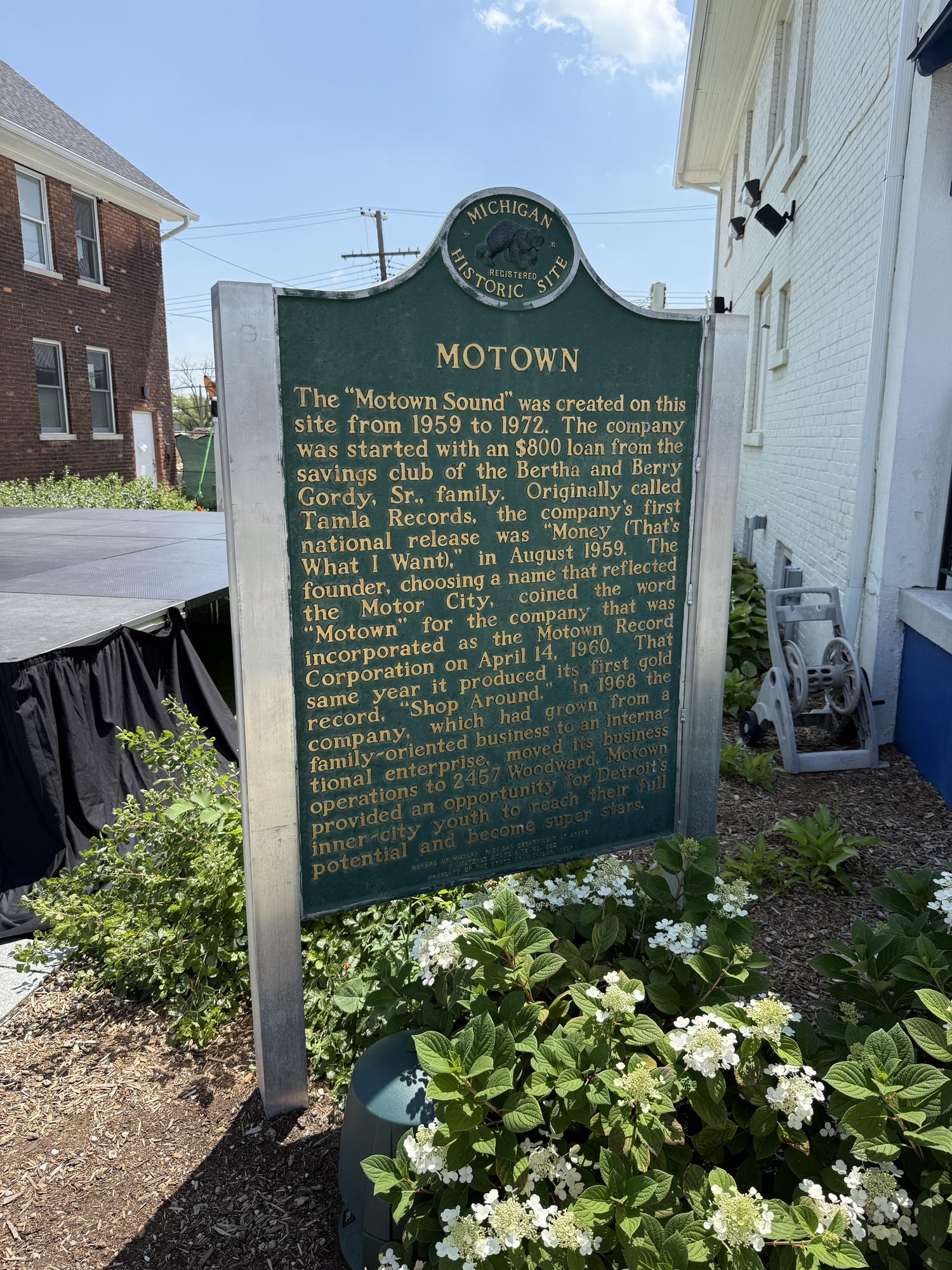
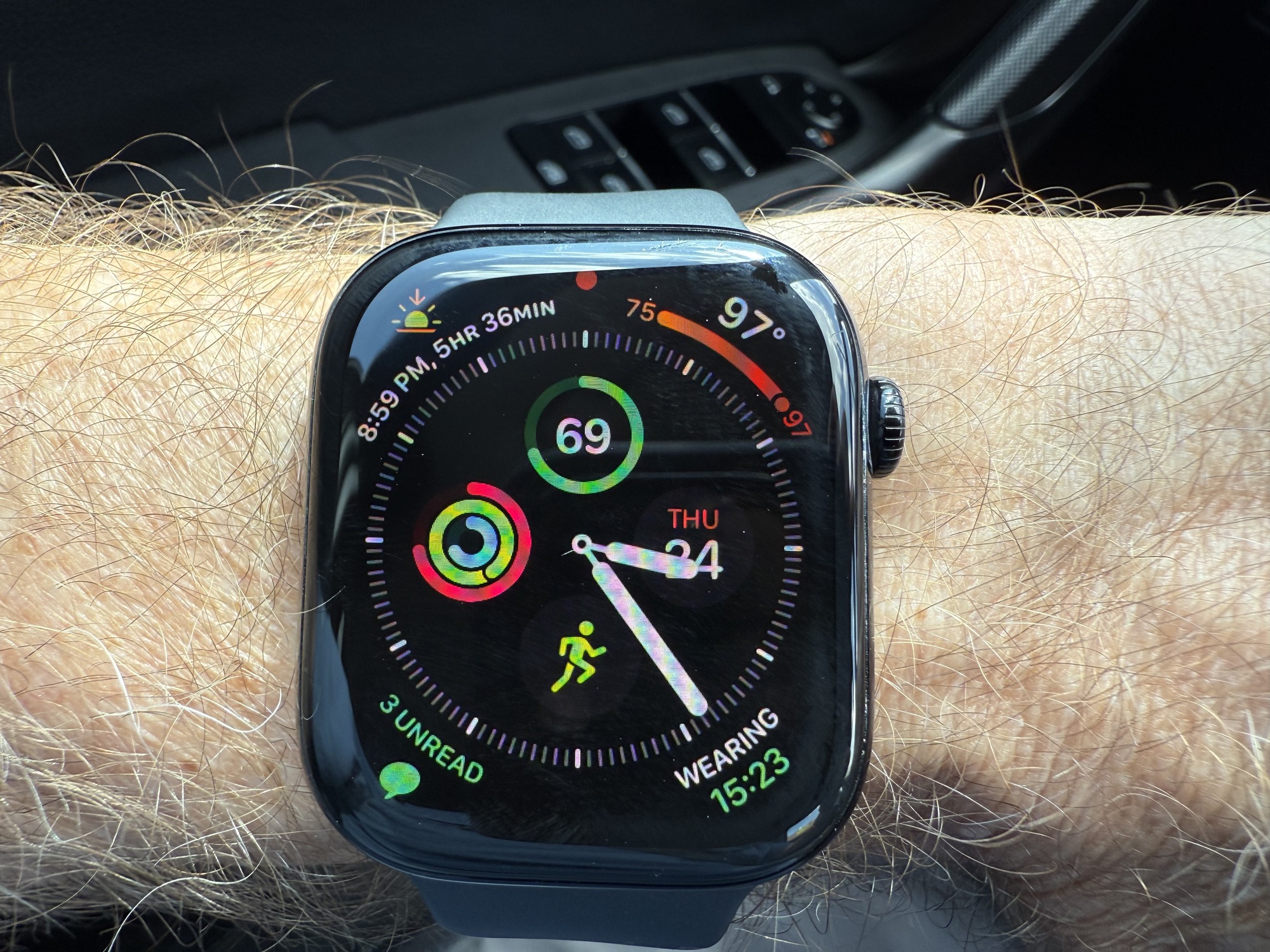
When it was past time to leave I raced out the door, only to find myself on the exact opposite side of the building in 95-degree heat, so I spent 15 minutes finding my car, then driving to the Motown Museum. There was a long line, outside, and I just wasn't up to hanging out in that furnace for that long, so I snapped a few pictures and left. Another time, though.
On June 17, 1969, Richard Davis was delivering a pizza. When he pulled up to a dark house, lit by a single bulb, instead of walking to the door, he called out, “Did you guys order a pizza?”
From the dark: “Yeah, bring it around back.”
Richard pulled a .22 revolver from his waistband and held it under the pizza box. When he walked around the side of the house there were three men waiting, one of them pointing a nickel-plated automatic at his face. When he saw the guy’s finger tightening on the trigger, Richard fired from beneath the pizza box, hitting the man in the jaw. Four of his six shots hit their targets, and he badly wounded two of the three men. Richard himself sustained a deep bullet wound in his thigh, and a glancing shot off his glasses lacerated his temple. Out of ammunition, he rushed back to his car and drove himself to the nearest hospital for treatment.
While in the hospital, he began thinking about the frequency of deaths by gunshot and, in particular, how many police officers were killed in the line of duty.
He wondered if flak jackets, used in Viet Nam, might be of benefit, and when he was discharged he started researching. Flak jackets were composed of ballistic nylon, but because they frequently included steel plates they were simply too heavy for everyday wear. At that point, he began testing body armor with just the ballistic nylon, and eventually found the right combination of fabric and layer count. His jacket would stop .22s, .25s, .32s, .38s and even the .357 magnum.
Unfortunately, no one believed that it would be effective. He took it to numerous local police departments, but no one would bite. He even took some people to the shooting range and shot the body armor while they watched. The vest stopped the bullet, but the dent left in the clay block it was “protecting” caused them to think that their hearts would explode, or that their ribs would shatter, sending bone fragments into their lungs.
Richard then did what any rational person would do: he shot himself in the chest. But first, he found a videographer and announced just before pulling the trigger, “If this works it could save a thousand men in the next ten years. If it doesn’t, they will die as I will.”
The shot knocked him onto his back, but he bounced up, then shot three bowling pins that had been set up on a nearby table.
After that, police were lining up to use his “Second Chance Body Armor.”
Hopefully by now you've read about my Firsts. Because of this story, I decided to get a pizza delivery job and get shot. Unfortunately, I couldn't figure out a way to do that in the short amount of time I had so I dispensed with that idea and, committed as ever, decided to put on a bulletproof vest and shoot myself in the chest.
After a comprehensive 15-20 second google search I wasn’t able to find any body armor, so I bought a pizza for lunch instead.
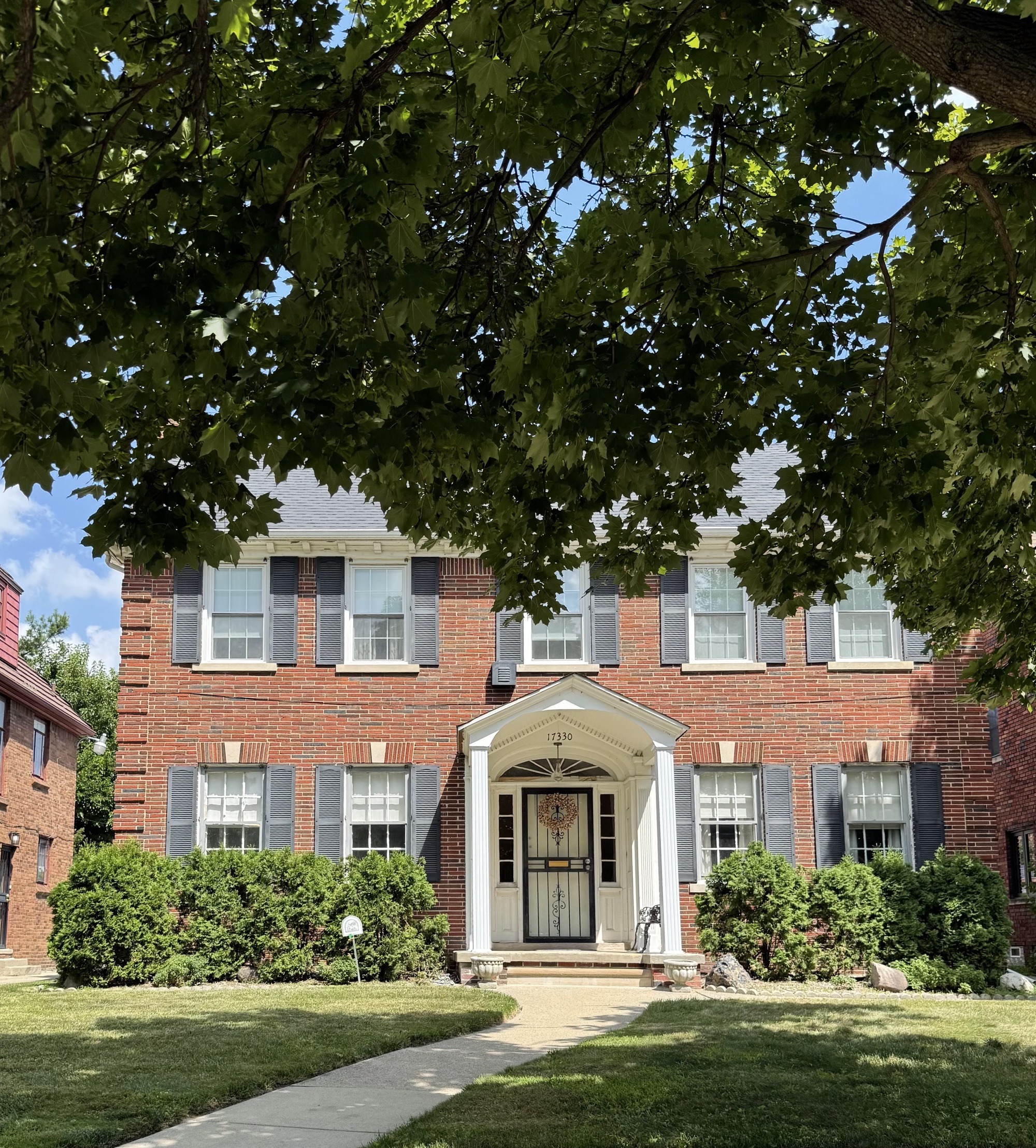
Speaking of National Shrines, as I was figuring out a route to my 6:00 tour, I discovered that Gilda Radner was born and raised in Detroit. This is her childhood home.
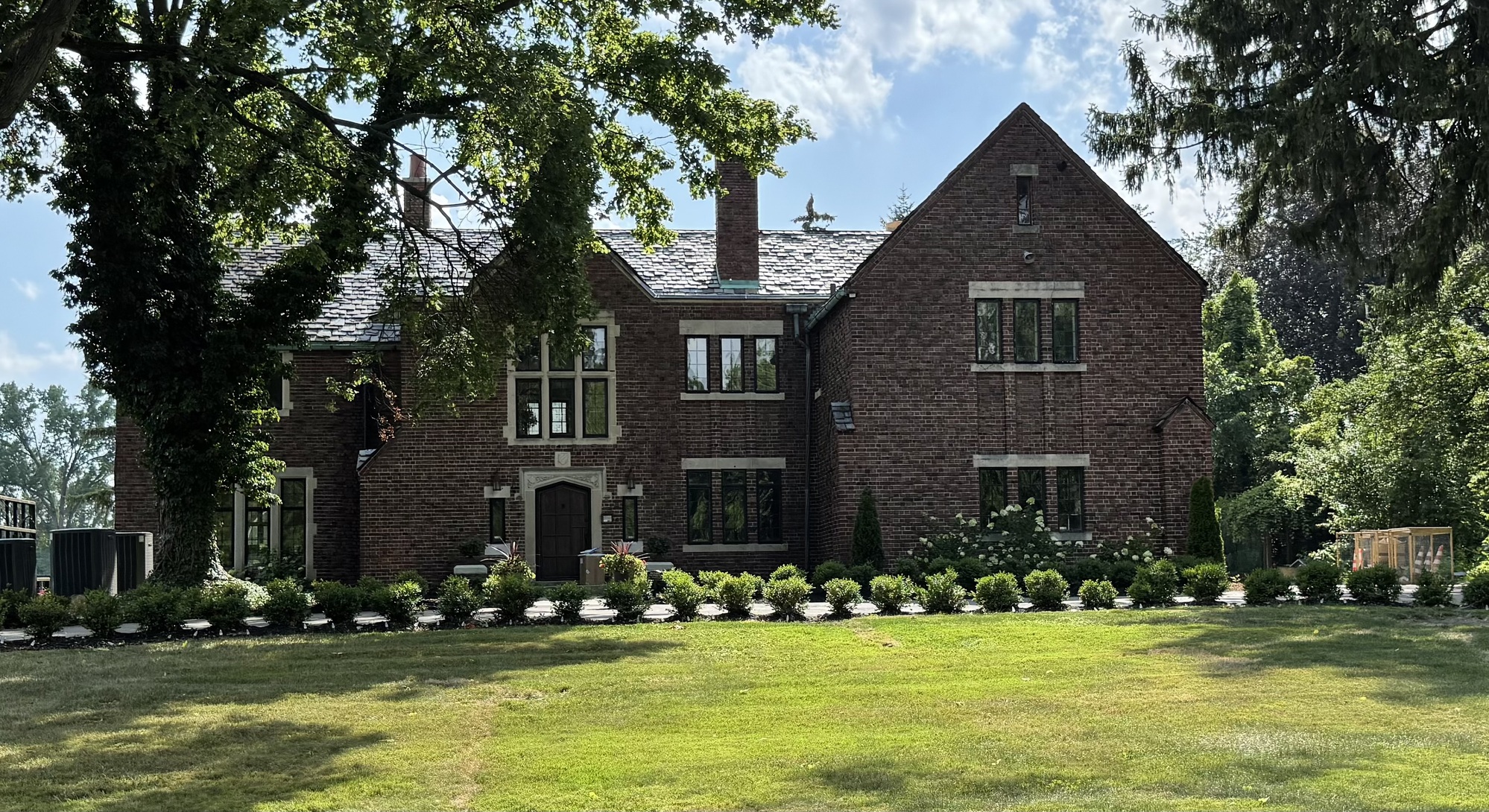
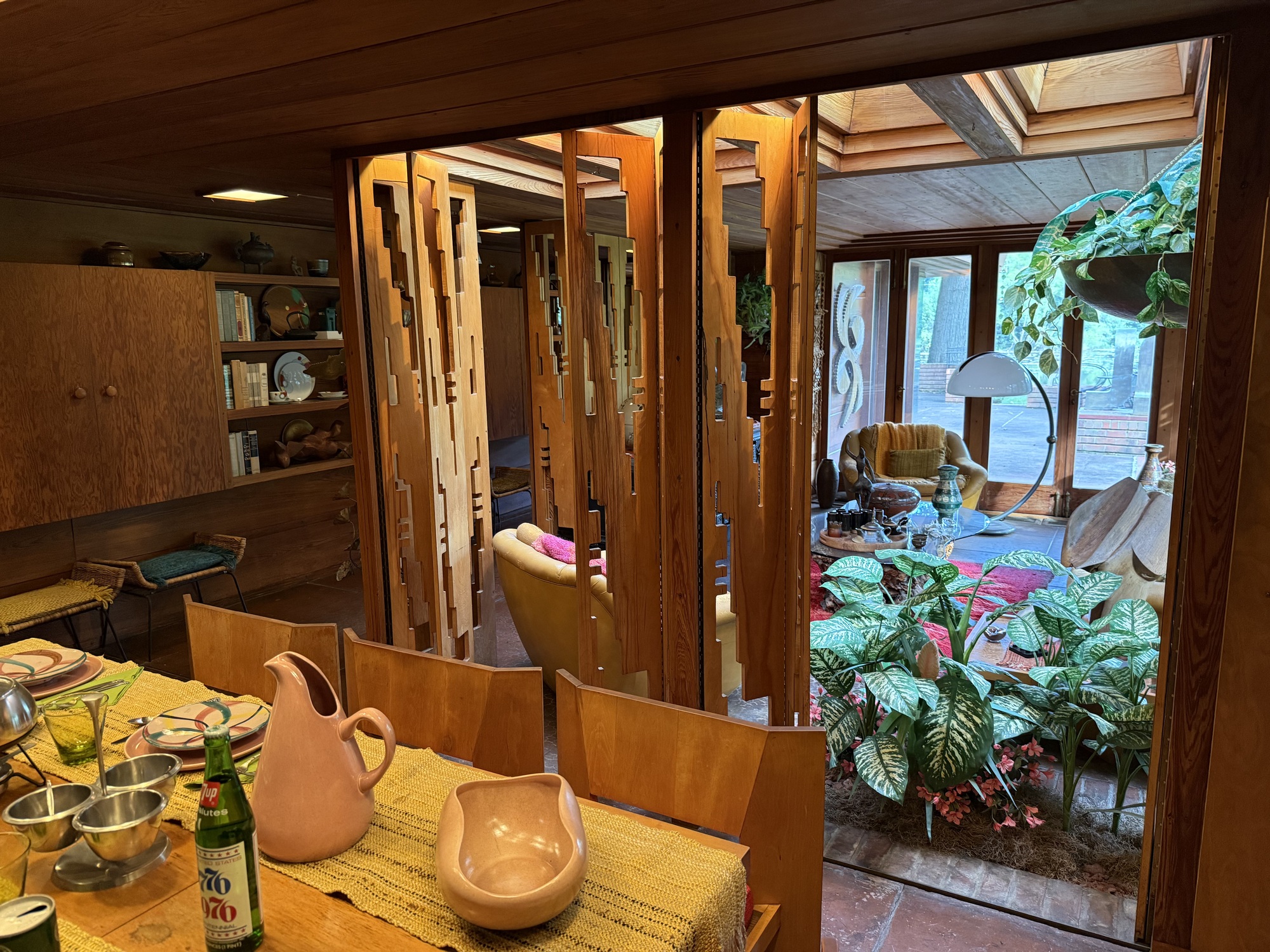
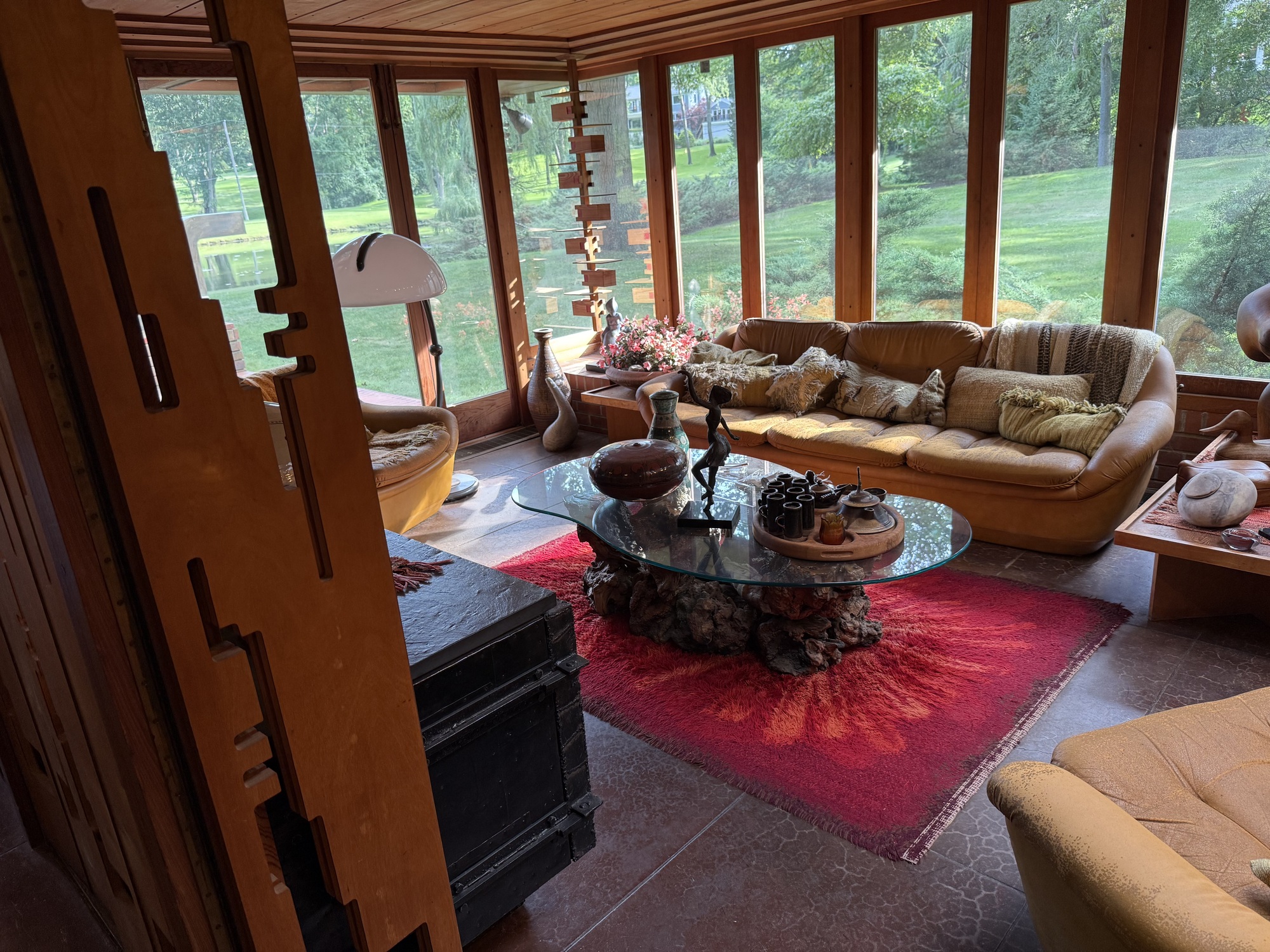
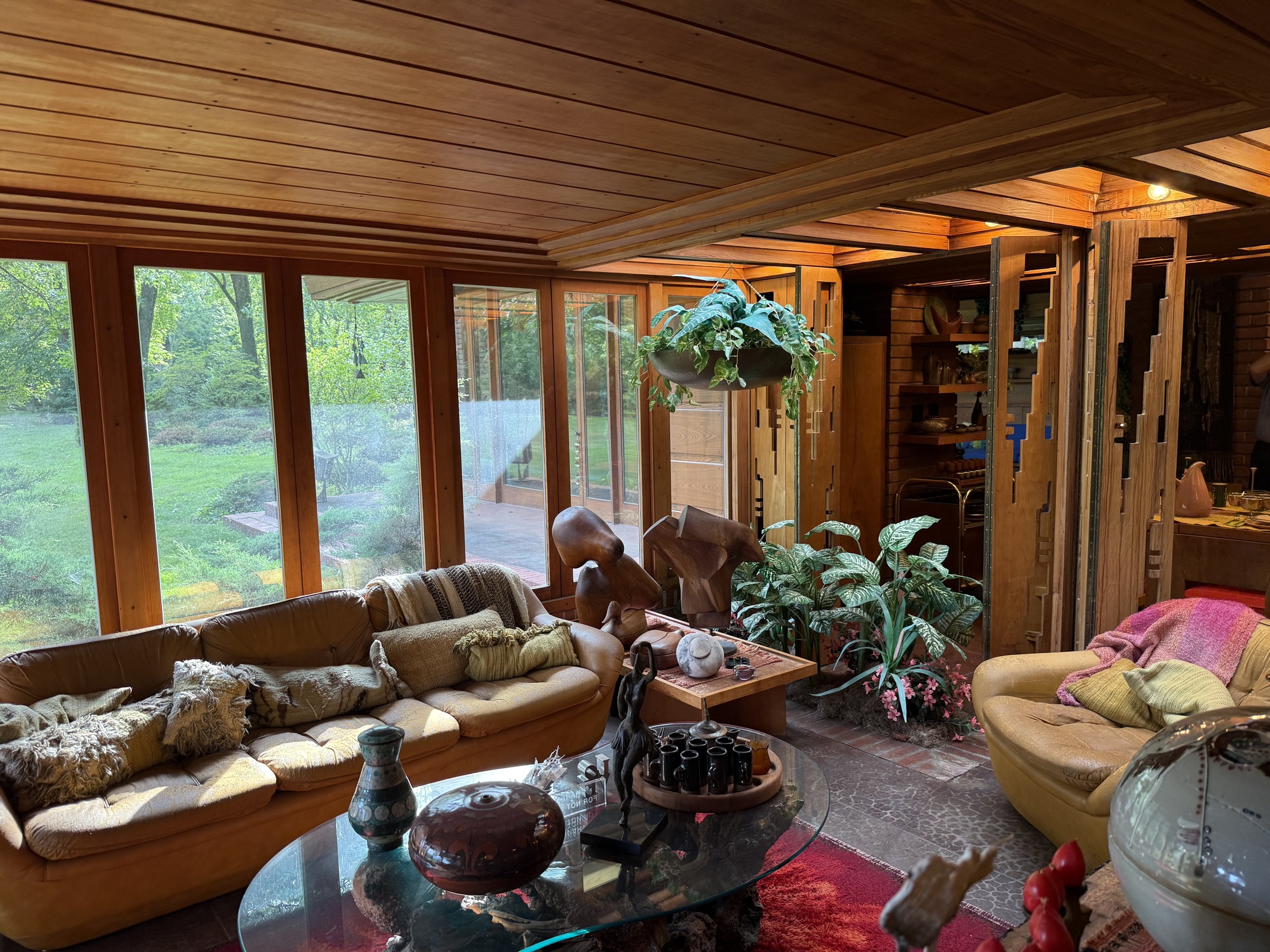
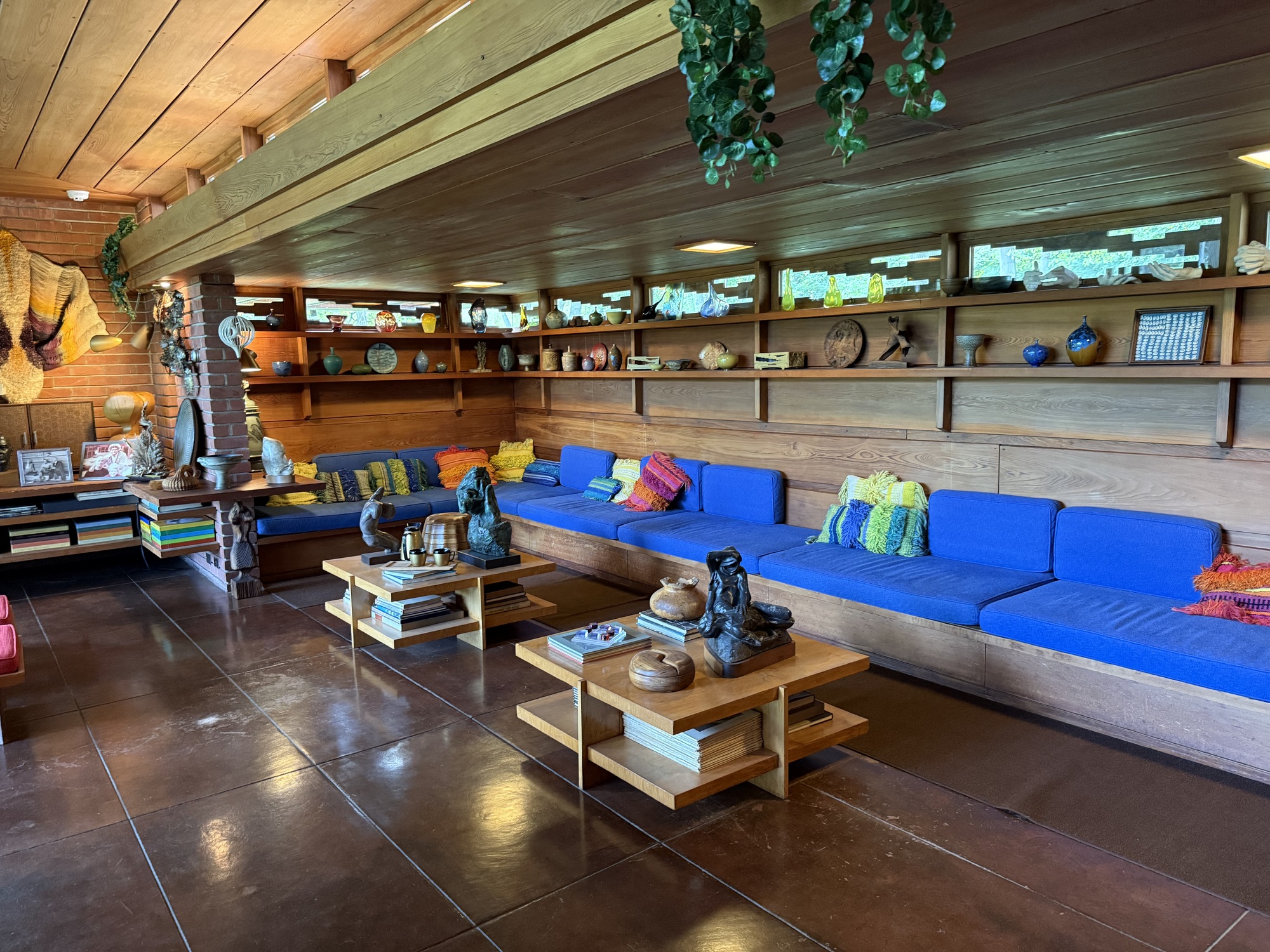
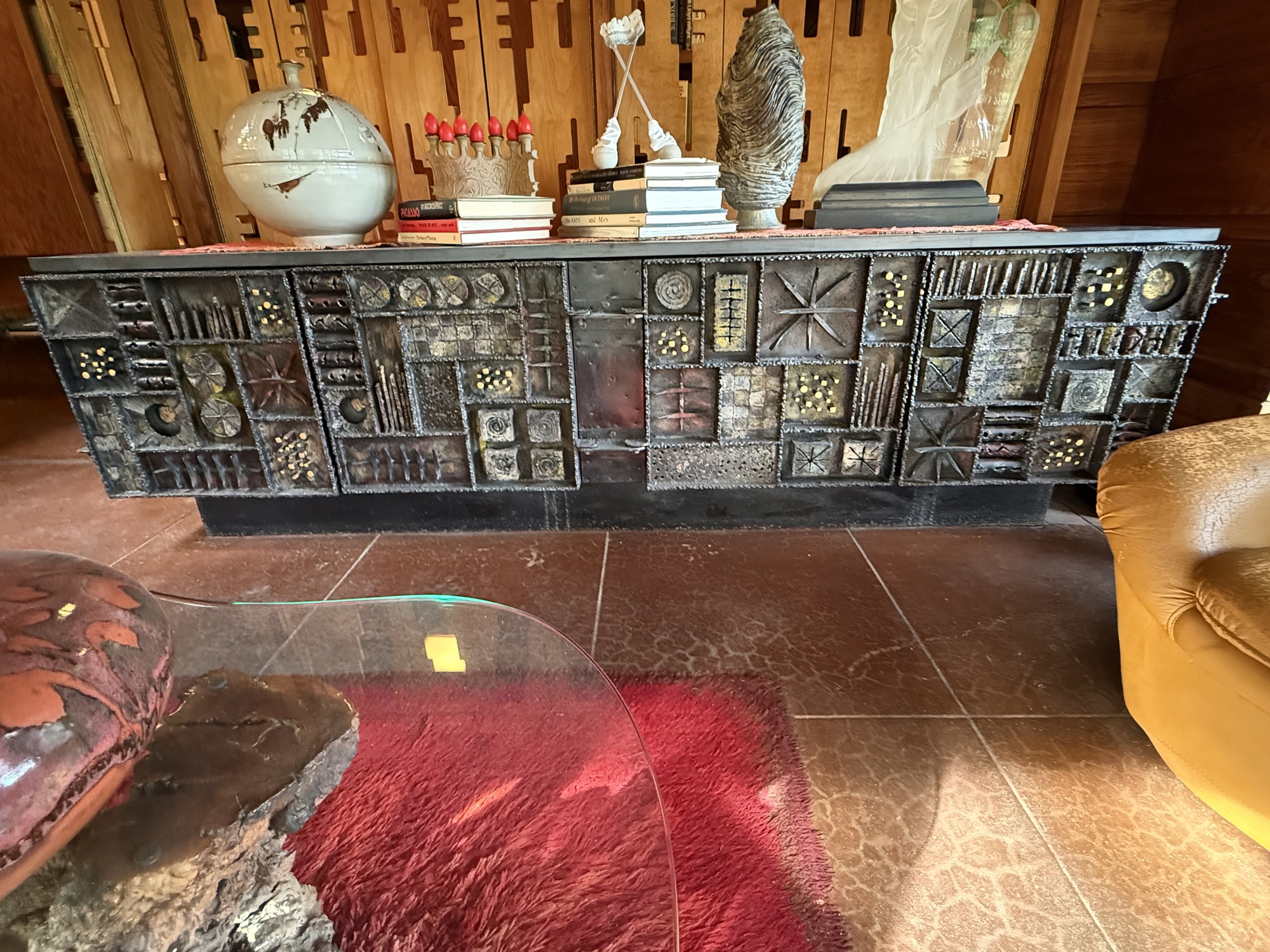
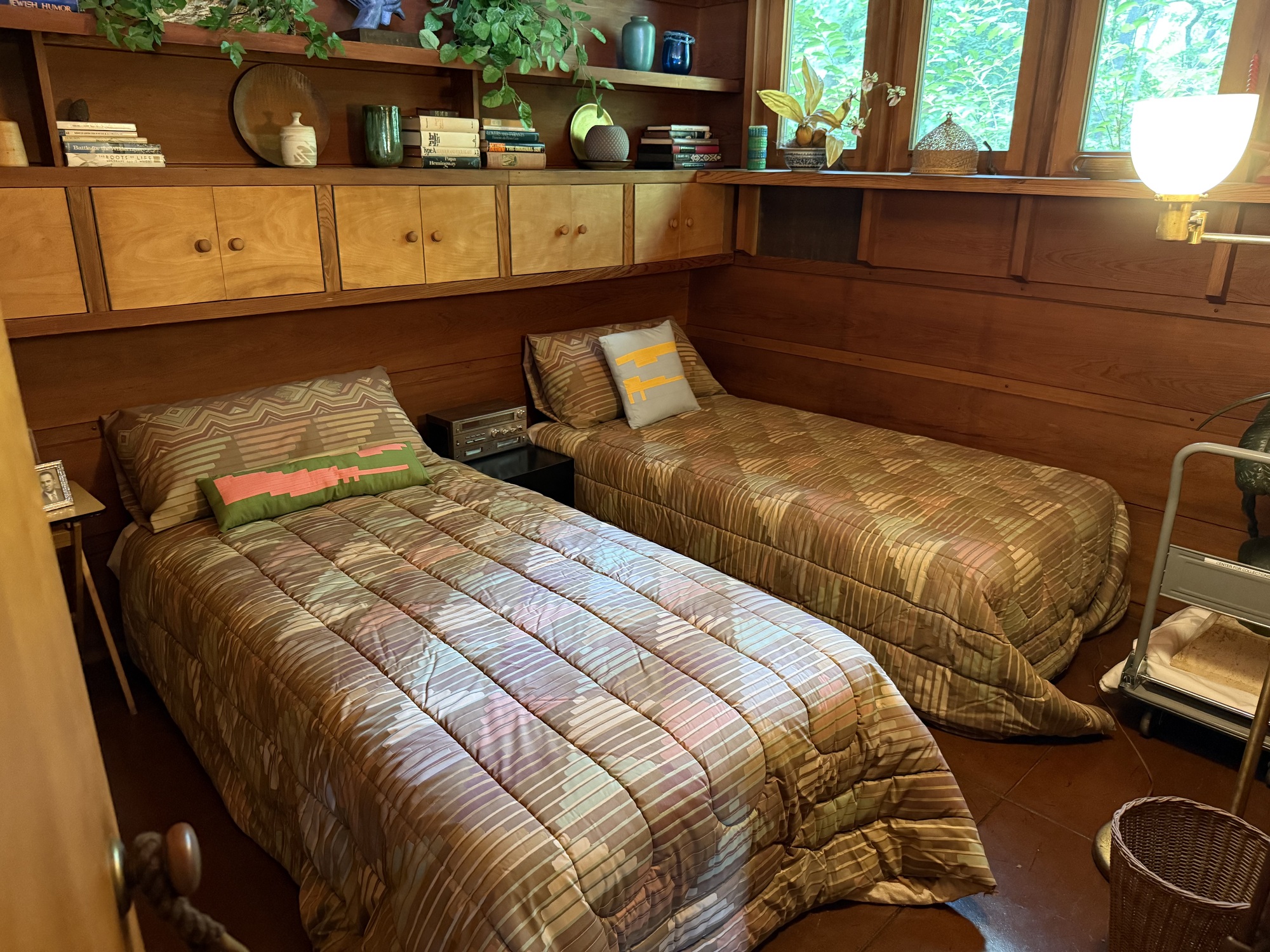
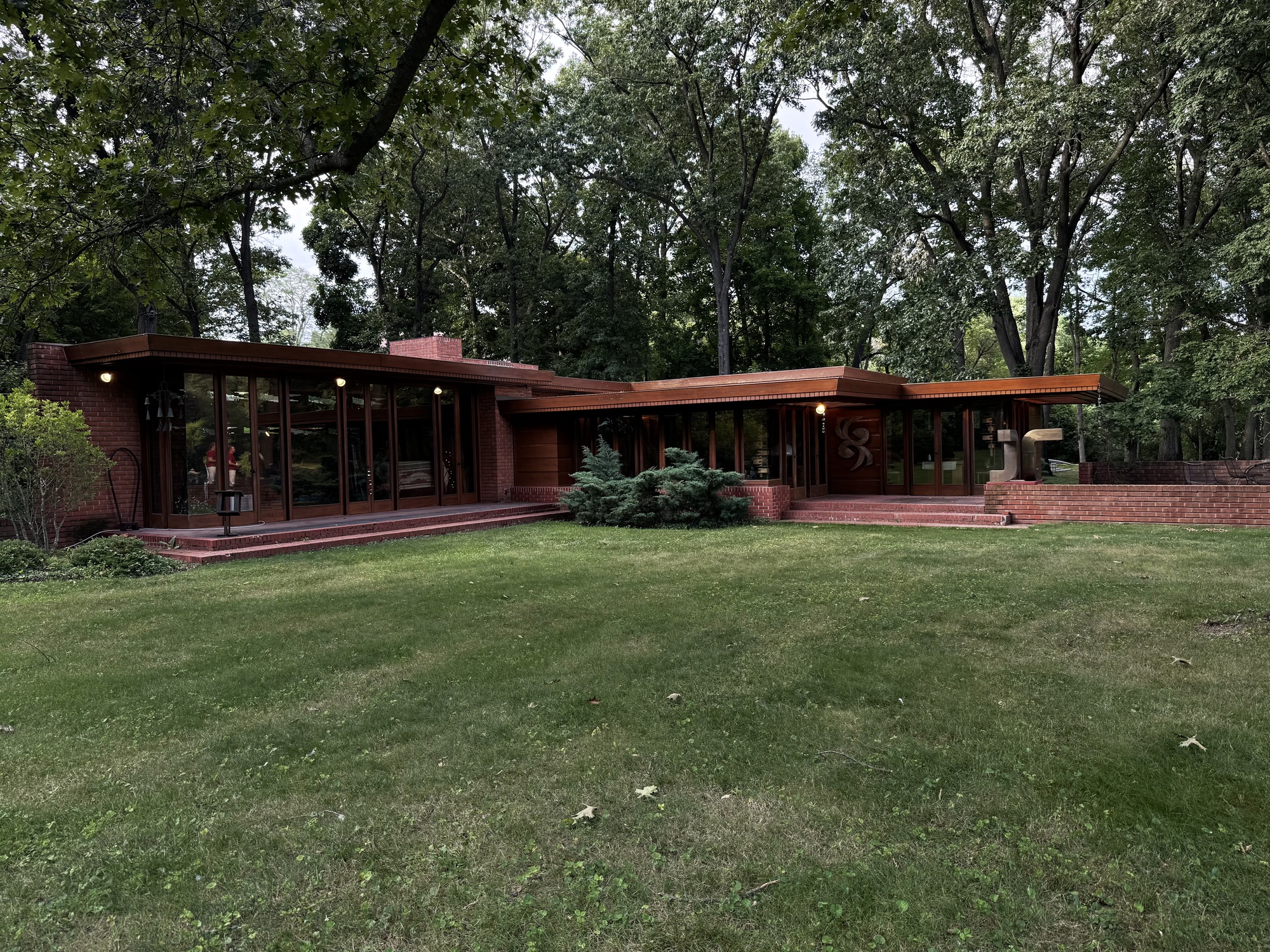
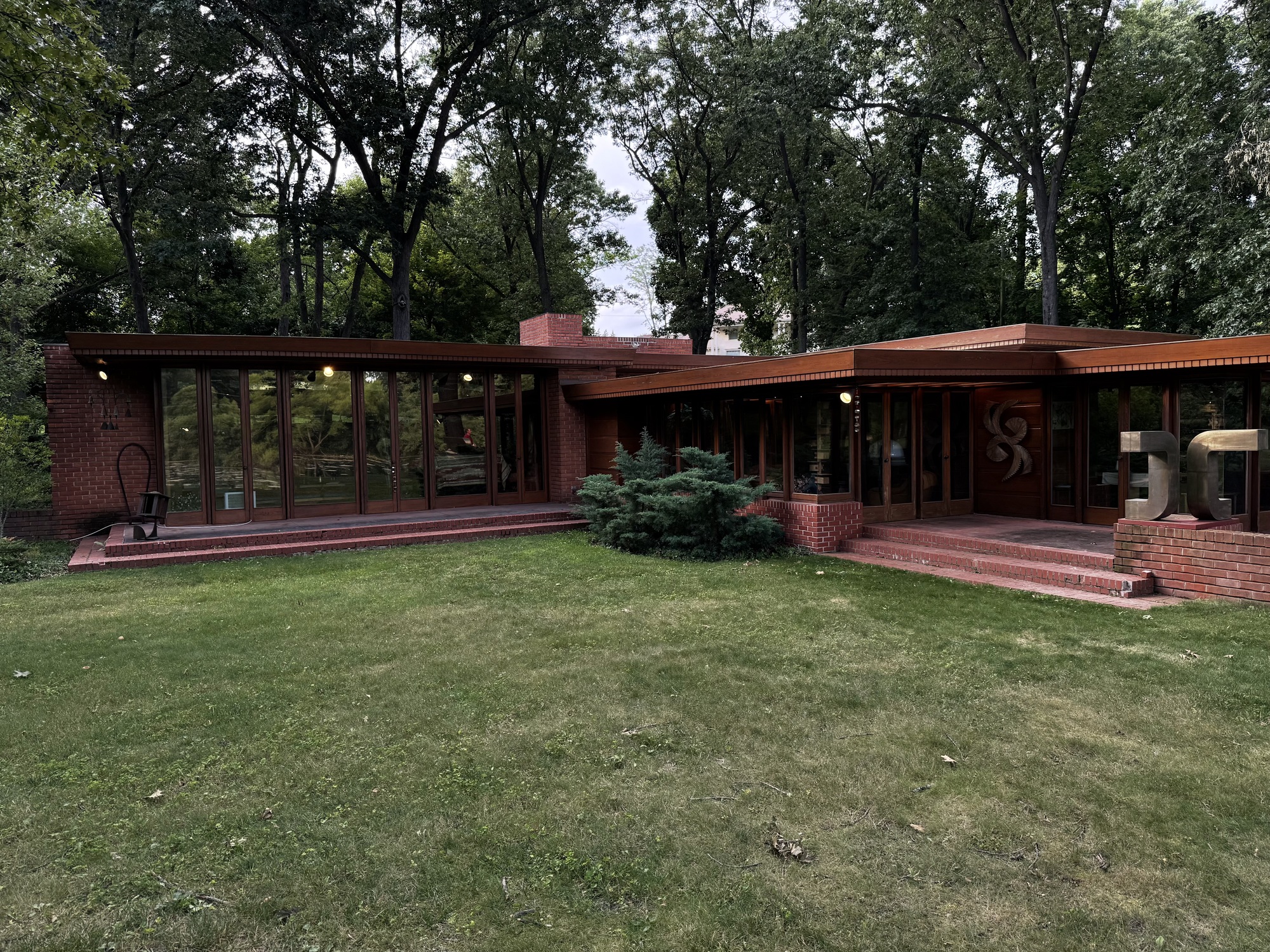
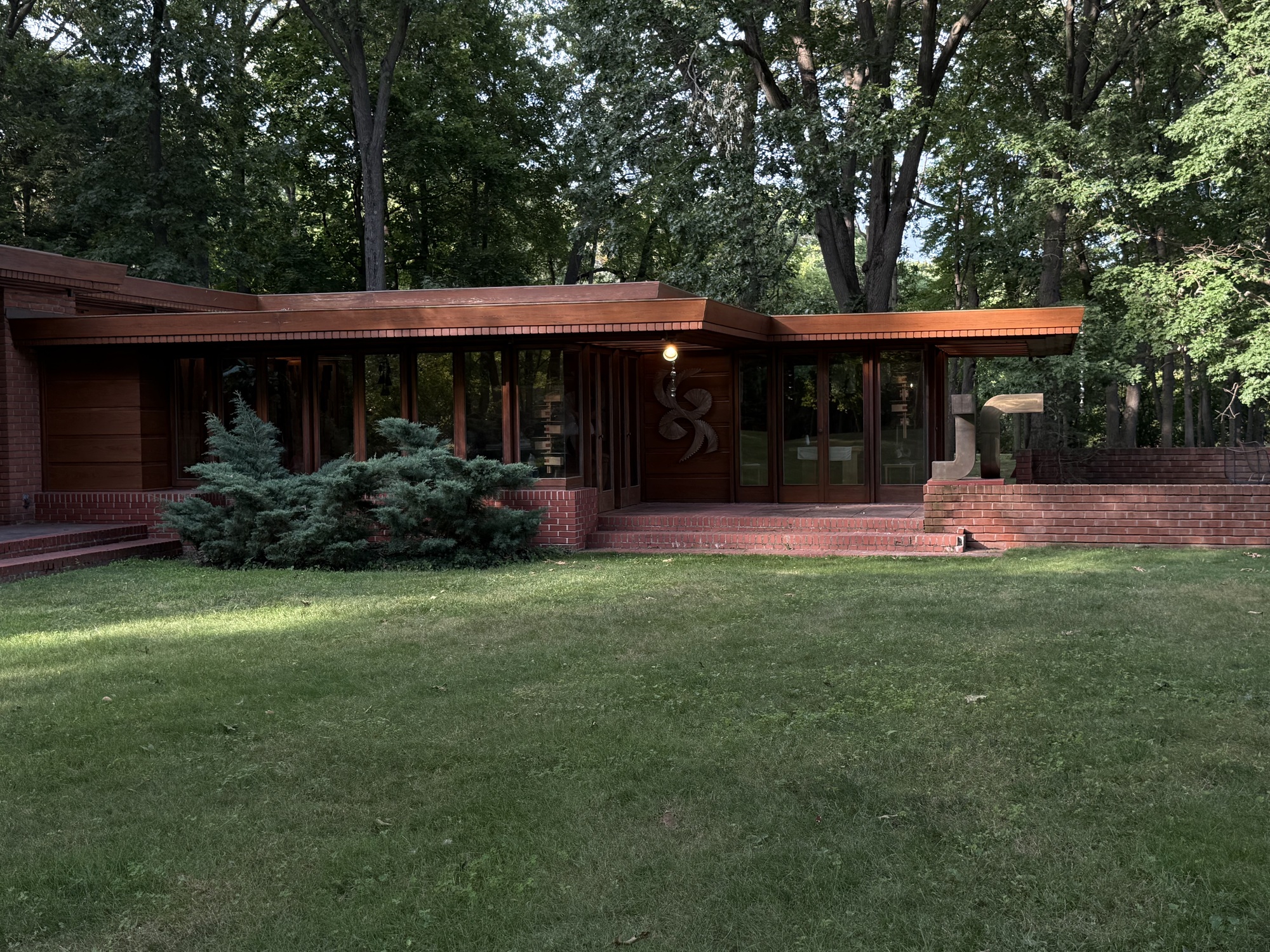
My last item Point of Interest for today was a tour of the Frank Lloyd Wright house in Bloomfield Hills, about half an hour from Detroit. I've had the good fortune to be able to see a number of his works, and this is in the top three. The tour guide, Elena, brought it to life.
As a student, training to become a teacher, Melvyn Smith was in an art class when a slide photograph of Fallingwater flashed across the screen. He jumped up and exclaimed, "Who built that?!?" When he was told Frank Lloyd Wright he announced to everyone in the class that he was someday going to own a house built by that man. As a teacher, his prospect of earning enough money to pay for something like that was laughable, and, of course, everyone laughed at him.
There are so many twists in the tale about how he acquired it, and his love of the place, that I hope you can visit it someday. Don't let my lackluster pictures mitigate any interest you have - it's even better than the Henry Ford Museum.
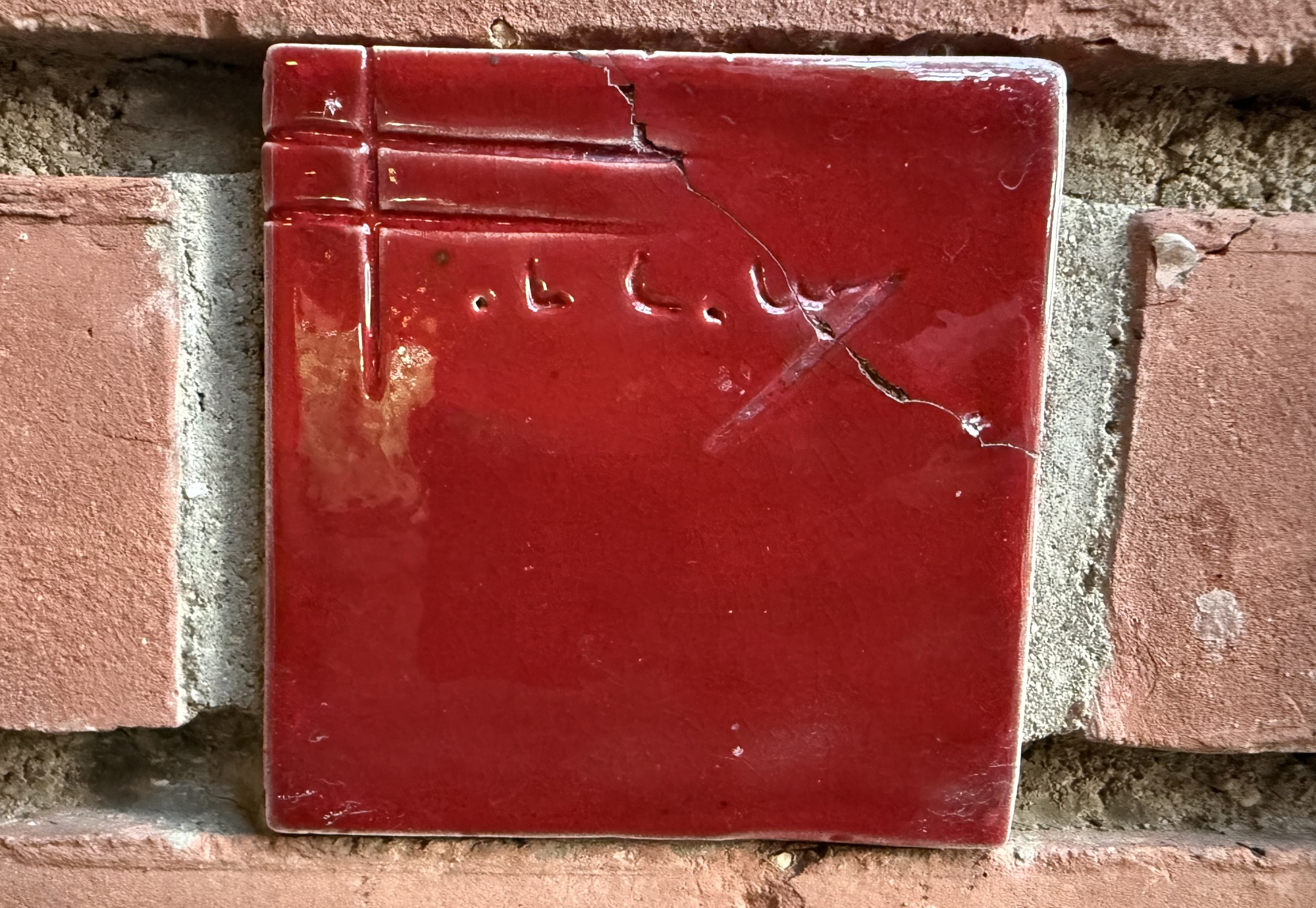
Wright would make a tile for each house he built, then autograph it. Melvyn's hands were so shaky when he was holding it that he dropped it, cracking the corner. He was too shy to ask for another one, and it remained as it is.
My experiences in Detroit weren't as glittery as other towns I've visited on this trip. Even so, I want to be clear that I suspect Detroit has a lot going for it. I have no doubt that there are dozens of wonderful places here, and that through my own ineptitude just wasn't able to discover them (such as The Raven Lounge and Restaurant, something I found later which was described as "a living piece of Detroits's cultural soul)." I hope that my life's journeys will bring me back here at some point, and that I'm sure I'll enjoy my visit.
I'll close with a few interesting facts I discovered about Detroit: * Seventy percent of all the illegal alcohol that entered the US during Prohibition came through Detroit. * MLK made his “I Have a Dream” speech famous at the March on Washington, but it made its debut in Detroit. * The very first state fair was held in Detroit in 1879. * Detroit is the Potato Chip Capital of the world "per consumption," although I wasn't able to determine what "per consumption" means. * Detroit has a gang of renegade landscapers called the Mower Gang who beautify public spaces pro bono. * Detroit has more registered bowlers than any other city. * The crime rate in downtown Detroit dropped by 37% between 2001 and 2012. * In 1872 Elijay J. McCoy invented the best lubrication system for locomotives and other machinery. Consequently, it became the only one that manufacturers would use, and wouldn’t settle for anything less than “the real McCoy,” which is how the phrase originated. * The very first four-way traffic light was hung at the intersection of Woodward and Fort St.
Rate this entry's writing
Heart
10
Comment on this entry
Comment
2
Billie SchultzLove the Henry Ford. Actually bought my brother’s family annual passes for this and Greenfield village as they are down in Ann Arbor frequently. Glad you were pleasantly surprised by it. Reply to this comment 5 months ago