The Yucatan
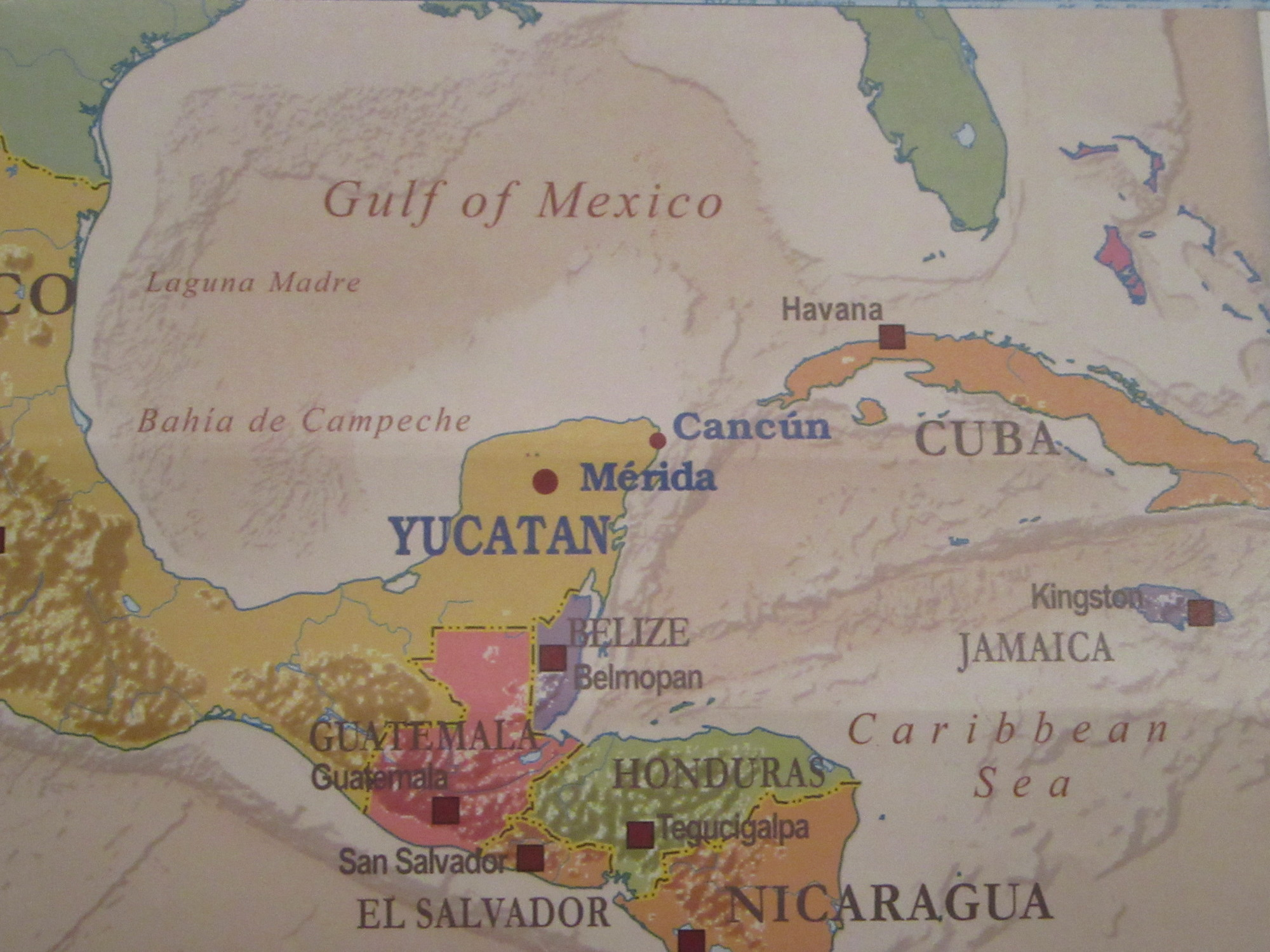
The Yucatan is a peninsula on the east side of Mexico, bounded by the Gulf of Mexico on the north and west and the Caribbean on the east. To the south are Guatemala and Belize. The major city is Cancun, on the Caribbean, while the capital is Merida, in the west near the Gulf of Mexico. Our first introduction to this place came when our daughter Joni was living in Belize. To visit her more cheaply than trying to fly into Belize City, one could take one of the numerous and cheap tourist flights into Cancun. From there it was a matter of hopping what Joni called a "chicken bus", down along the Caribbean coast, past exotic sounding towns like Playa de Carmen, Tulum, and Chetumal, and on to even more exotic Corozal and Orange Walk, in Belize.
Joni took care to instruct her old and naive parents on how to navigate this territory. At that time, getting off a bus in Playa and walking several blocks to a second bus station to find the onward ride seemed for us a monumental adventure. We were just in our 60's then and we must have matured a lot since, because something like that is dead simple for us now!
| Heart | 0 | Comment | 0 | Link |
Although we did (eventually) figure out this route down the coast, we followed it with blinders on, just hoping to reach Belize without screwing up. Only later did we figuratively look up, and see that Yucatan over to the west was a fascinating and varied place.
We soon ventured "inland" on the bikes, and have since swarmed around the place quite a bit.
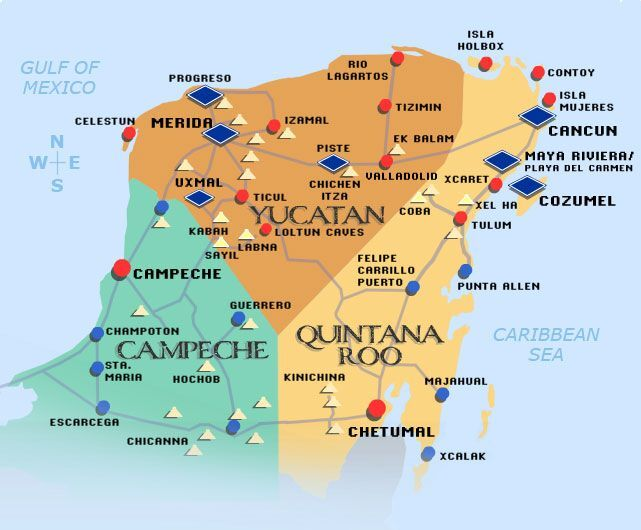
We accurately say this is a trip to the Yucatan peninsula of Mexico. But the peninsula actually contains three states, only one of which is in fact named Yucatan and the others are Quintana Roo and Campeche. These three states are markedly different from each other. Quintana Roo is the site of the tourism mega centre Cancun, and south from there is the Mexican Riviera, a stretch of Caribbean frontage that houses many all inclusive resorts. This resort land stretches 130 km on the one really major highway of the region, to Tulum. At Tulum the luxury tourism thins out in favour of budget travelers, until in the extreme south you have Chetumal, a launching point for Belize and Central America.
The state of Yucatan occupies the west of the peninsula and contains the capital, Merida. Yucatan has most of the small towns and small roads that attract us to the region, plus great bird watching along the Gulf of Mexico
Yucatan state also has a healthy share of the Mayan ruin sites. The Mayan civilisation was the major driving force of this region, from its origins around 2000 B.C. It peaked about 250 to 900 A.D. and seems to have collapsed on its own by the 16th century, with the brakes really slammed on by the Spanish conquest around 1550.
The Maya were renowned for achievements in writing, mathematics, astronomy, architecture, and art, not to mention their famous ball game, which still has some leagues playing today.
The Maya were not a unified empire but a network of independent city-states sprinkled around Central America. Some of the more famous ones are Tikal, Palenque, and Copán. On our route this time we will especially pass by Coba and Chichen Itza. Chichen Itza is the best known site on the peninsula.
The Mayan people are still to be found in Yucatan, and in fact 30-40% still speak Mayan, though only 10% are unilingual. Most do speak Spanish. We found the Mayan people to be proud of their heritage, and quick to tell of their background. Despite the tales of historical ferocity, blood sacrifice and such, we find them gloriously gentle and considerate.
| Heart | 0 | Comment | 0 | Link |
Our big problem in touring the peninsula is that accommodation is to be found (of course) mostly in towns of a certain minimum size. The whole peninsula only has maybe a dozen of these, and even there the places to stay may be few, not available, or may be extravagantly priced "eco villages" for wealthy tourists who must have made a wrong turn on the coast. It's a much different situation from what we sometimes faced in the United States, where we might shift this way and that trying to avoid big roads or big cities.
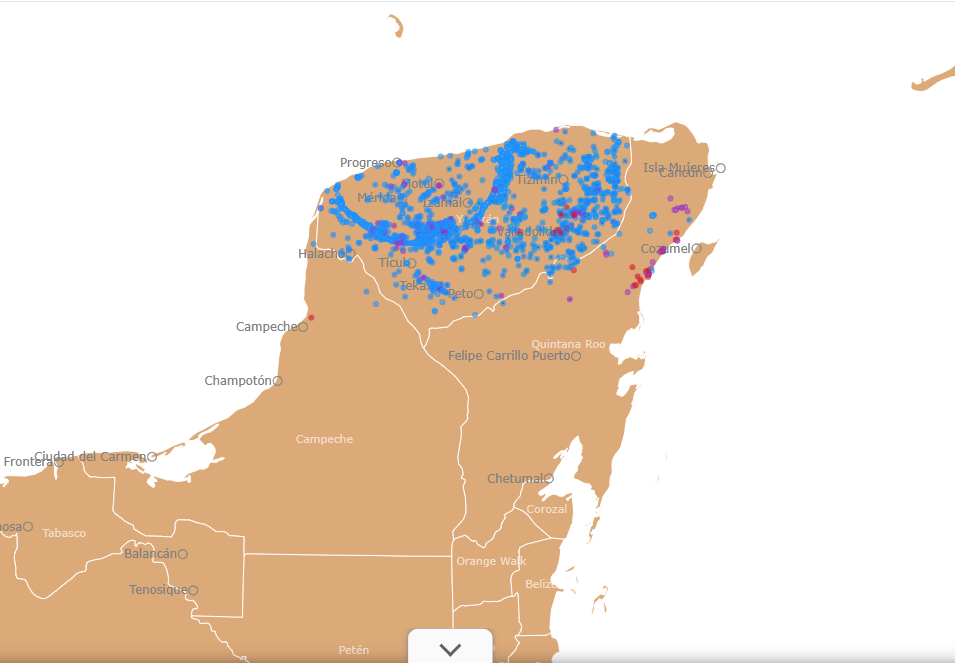
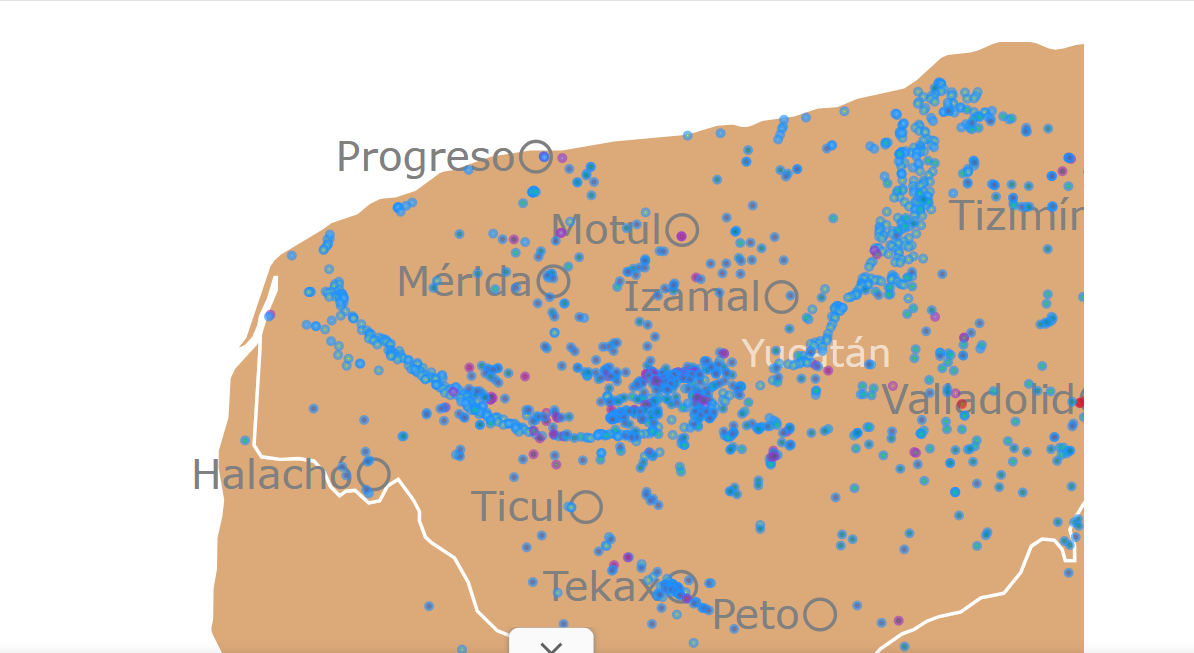
The other huge feature of the Yucatan stems from the fact that it used to be submerged under an ancient sea, causing it to be a huge shield of limestone. When the sea receded, rainwaters eroded the limestone and formed water filled underground caverns and rivers. The roofs of some of these have collapsed, forming open air swimming holes, while others can be accessed from fairly deep (and often slippy) installations of wooden stairs. Collectively they are all "cenotes", and there are about 7,000 of them in Yucatan. The situation was also altered about 66 million years ago, with the arrival of the asteroid that wiped out the dinosaurs. The impact was offshore of the present day town of Chicxulub Puerto, on the Gulf of Mexico. The crater from the impact is 200 km in diameter and 20 km deep. The fracture in the limestone can clearly be seen in the "Ring of Cenotes", centred on Chicxulub Puerto. On this trip, we will be visiting a fair number of cenotes, and we will also pass right through Chicxulub Puerto. Don't look up!
| Heart | 2 | Comment | 0 | Link |
| Rate this entry's writing | Heart | 7 |
| Comment on this entry | Comment | 2 |
1 month ago